Every SaaS founder knows the feeling. You have a limited marketing budget, a product you believe in, and a hundred different places you could spend your next dollar. The question is never whether to market. It is where to put the money so it actually works.
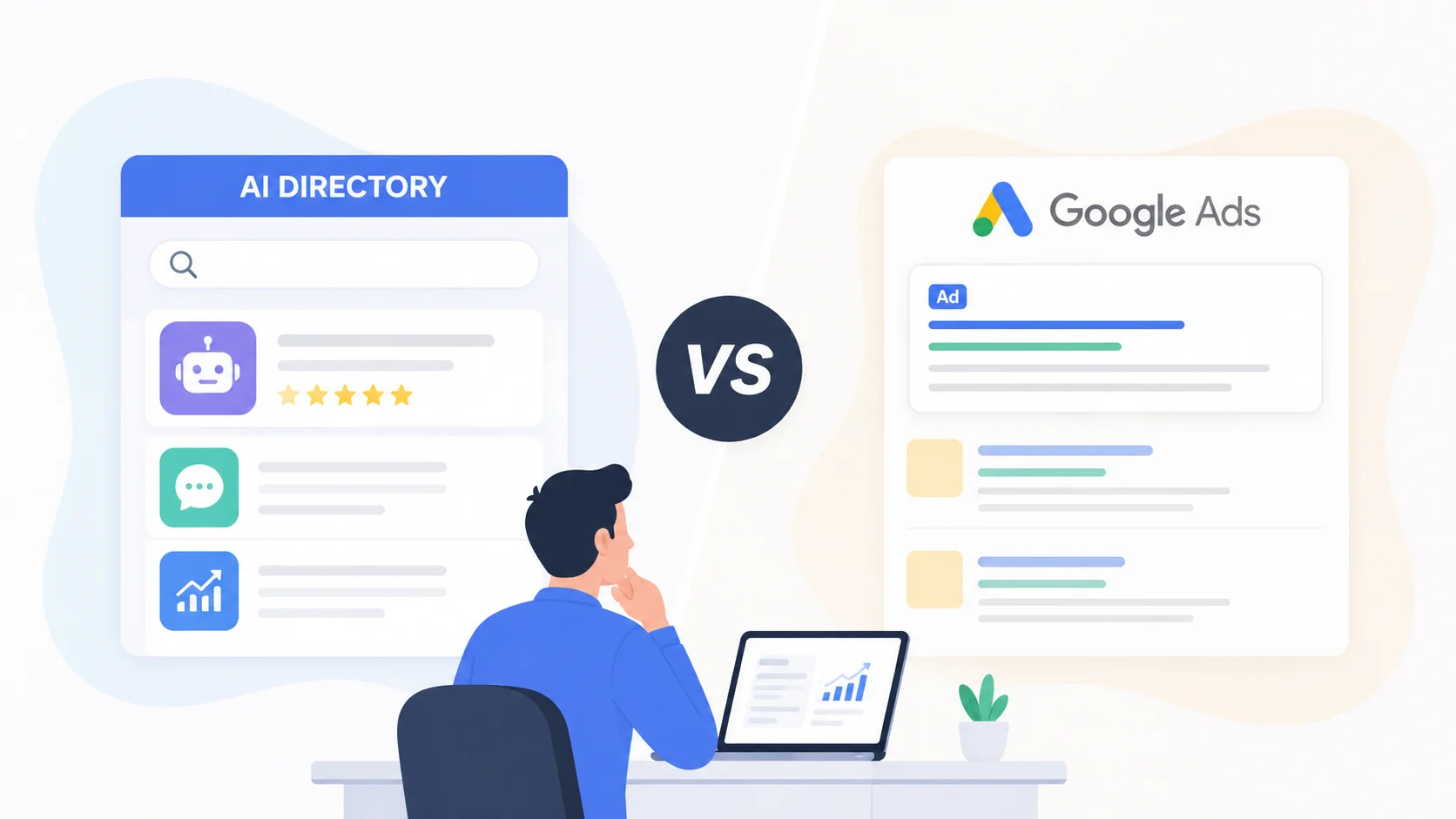
This article breaks down a simple experiment. Take $89 and spend it on a premium AI directory listing. Then take the same $89 and run Google Ads. Compare the clicks, the traffic quality, and the long-term value. The results might surprise you.
The Setup: Same Budget, Two Very Different Channels
For this comparison, we are looking at what a typical SaaS founder gets when they invest $89 in each channel. On one side, a premium listing on an AI tool directory with enhanced visibility, a featured badge, and a permanent backlink. On the other side, a Google Ads campaign targeting relevant keywords in the AI and SaaS space.
Both channels promise the same thing: more eyeballs on your product. But they deliver that promise in fundamentally different ways.
What $89 Gets You on an AI Directory
A premium listing on a reputable AI tool directory typically includes:
- A detailed product listing page with description, screenshots, and category placement
- Priority positioning in category and search results within the directory
- A permanent dofollow backlink to your website
- Exposure to an audience actively browsing for AI tools
- A featured badge or highlight that draws attention
- Listing duration of 30 days to one full year depending on the directory
What $89 Gets You on Google Ads
A Google Ads campaign in the SaaS and AI tools space faces steep competition. Here is what the numbers typically look like:
- Average cost per click for SaaS keywords ranges from $3 to $12
- At $89, that translates to roughly 8 to 30 clicks depending on your keyword selection
- Campaign runs until the budget is exhausted (often within days or even hours)
- No lasting presence after the budget runs out
- Requires ongoing management to optimize bids and targeting
The math alone tells a story, but the full picture goes much deeper than click counts.
Click Volume: How the Numbers Stack Up
Let us put real numbers on the table. Based on industry benchmarks and data from SaaS founders who have tested both channels, here is a typical comparison.
| Metric | AI Directory Listing ($89) | Google Ads ($89) |
|---|---|---|
| Estimated clicks (30 days) | 500 to 1000+ | 8 to 30 |
| Cost per click | $0.74 to $2.22 | $3.00 to $12.00 |
| Duration of exposure | 30 days to 12 months | 1 to 5 days (until budget runs out) |
| Ongoing management needed | None after setup | Daily monitoring recommended |
| SEO backlink value | Yes, permanent dofollow link | None |
| Visibility after budget ends | Listing remains active | Ads disappear immediately |
The directory listing delivers significantly more clicks per dollar because the cost is fixed for a set period. Google Ads, on the other hand, charges per click and stops the moment your budget hits zero.
As marketing consultant Rand Fishkin once observed, “The best kind of marketing is the kind that keeps working while you sleep.” That description fits a directory listing far better than a pay-per-click campaign.
Traffic Quality: Not All Clicks Are Created Equal
Raw click numbers only tell part of the story. What matters more is whether those clicks turn into sign-ups, trials, or paying customers.
AI Directory Traffic Quality
Visitors coming from an AI directory are in a specific mindset. They are actively browsing tools, comparing options, and looking for solutions. This is high-intent traffic.
When someone clicks your listing on a directory, they have already decided they want an AI tool in your category. They are not casually scrolling. They are shopping. This translates to higher conversion rates compared to cold traffic from generic ad campaigns.
Directories also build trust through context. Your product appears alongside other legitimate tools, verified by the directory’s curation process. That association signals credibility before the visitor even reaches your site.
Google Ads Traffic Quality
Google Ads traffic quality depends heavily on your keyword strategy and ad copy. Well-targeted campaigns can deliver excellent results, but there are common pitfalls that drain budgets without generating real leads.
- Broad match keywords attract irrelevant clicks from people not looking for your product
- Competitor brand bidding can bring visitors who are already loyal to another tool
- Ad fatigue reduces click-through rates over time, requiring constant creative refreshes
- Bot clicks and click fraud can consume a meaningful portion of small budgets
For a SaaS founder spending just $89, the margin for error is razor thin. One or two bad clicks at $8 each and a quarter of your budget is gone with nothing to show for it.
The Hidden Value of Directory Listings
Beyond direct clicks, a premium directory listing generates value that Google Ads simply cannot match.
SEO Benefits That Compound Over Time
A quality backlink from a high-authority AI directory strengthens your domain authority. This is not a marginal benefit. For early-stage SaaS products, directory backlinks can meaningfully improve your ranking for competitive keywords.
Every month that backlink exists, it continues passing authority to your site. Compare that to Google Ads, which contributes zero SEO value. The ad spend is a pure cost with no compounding return.
Discovery by the Right Audience
AI tool directories attract a very specific audience: founders, developers, marketers, and product managers who are actively evaluating tools. This is exactly the audience most SaaS products want to reach.
Getting featured on a directory puts your product in front of people at the moment of decision. It is the digital equivalent of being on the shelf at eye level in a store where every shopper is already looking for what you sell.
Social Proof and Credibility
Being listed on a curated directory sends a signal that your product has been vetted. Visitors trust directory recommendations in a way they do not trust ads. A Google Ad explicitly says “sponsored.” A directory listing says “this tool belongs here.”
This distinction matters enormously for early-stage SaaS products that have not yet built widespread brand recognition. The directory’s credibility rubs off on your product. You can further amplify this by optimizing your listing with compelling descriptions, screenshots, and clear value propositions.
When Google Ads Still Makes Sense
This comparison is not about declaring one channel universally better than the other. Google Ads have clear strengths that directory listings cannot replicate.
| Scenario | Better Channel | Why |
|---|---|---|
| Testing messaging and positioning | Google Ads | Fast feedback on what copy resonates |
| Targeting non-English markets | Google Ads | Most AI directories are English-focused |
| Scaling with a large budget | Google Ads | Directories have fixed inventory; ads scale linearly |
| Building long-term organic presence | AI Directory | Backlinks and permanent listings compound |
| Reaching high-intent AI tool shoppers | AI Directory | Audience is pre-qualified by category browsing |
| Getting started with under $100 | AI Directory | Fixed cost delivers more value at small budgets |
Google Ads become more effective as your budget grows and your optimization skills improve. But at the $89 level, the economics heavily favor the directory approach for most SaaS founders.
A Smarter Strategy: Using Both Channels Together
The founders who get the most out of their marketing budgets do not pick one channel and ignore the rest. They layer their efforts so each channel reinforces the others.
Here is how a practical combined approach might look:
- Start with a premium directory listing to establish your presence and earn a backlink
- Use the listing to generate initial traffic and collect data on who visits your site
- Run a small Google Ads retargeting campaign to reach people who visited but did not convert
- Use directory traffic data to refine your Google Ads keyword targeting
- Reinvest early revenue into content marketing that supports both channels
This approach uses the directory listing as the foundation and Google Ads as a precision tool for retargeting. The result is a more efficient use of every dollar in your marketing budget.
What Real SaaS Founders Say
The debate between directories and paid ads is not theoretical. SaaS founders discuss this tradeoff constantly in indie maker communities and startup forums.
A common theme in those conversations is that directories deliver “quiet, steady traffic” while Google Ads deliver “bursts that disappear.” For bootstrapped founders who need sustainable growth rather than spikes, the steady approach wins.
Another recurring observation is the time factor. Google Ads demand ongoing attention. You need to monitor bids, adjust targeting, test ad copy, and manage budgets. A directory listing takes 30 minutes to set up and then works on its own. For solo founders already stretched thin, that time savings has real value.
As entrepreneur and marketing writer Seth Godin puts it, “Don’t find customers for your products. Find products for your customers.” Directories connect you with people already looking for a solution. Ads try to interrupt people who might not be.
How to Maximize Your AI Directory Listing
If you decide to invest in a directory listing, a few simple steps can dramatically increase the return on your $89.
- Write a description that leads with the problem you solve, not the features you offer
- Include high-quality screenshots that show the actual product interface
- Choose the most specific category that fits your tool rather than the broadest one
- Add a clear call to action like “Start Free Trial” rather than a generic “Visit Website”
- Keep your listing updated when you add new features or change pricing
The SEO impact of directory listings also improves when your product page is well-optimized. Make sure the landing page visitors arrive at matches the promises made in your directory description.
You should also consider listing on multiple AI directories to maximize your reach. Each listing adds another source of high-intent traffic and another backlink supporting your organic search presence.
The Bottom Line: Cost Per Click Comparison
When you strip everything down to the core metric that SaaS founders care about, the comparison is clear.
| Channel | Budget | Estimated Clicks | Effective CPC | Residual Value |
|---|---|---|---|---|
| AI Directory | $89 | 500 to 1000+ | $0.09 to $0.18 | Backlink, ongoing visibility |
| Google Ads | $89 | 8 to 30 | $3.00 to $12.00 | None |
At the $89 price point, the AI directory listing delivers 3x to 10x more clicks, costs significantly less per click, and continues generating value long after the initial investment. Google Ads offers more control and faster feedback but burns through small budgets quickly with no lasting benefit.
For SaaS founders looking to promote their AI tool on a lean budget, pairing a directory listing with smart SEO fundamentals creates a foundation that paid ads alone cannot match.
Conclusion
For SaaS founders working with tight budgets, the $89 comparison tells a convincing story. An AI directory listing consistently delivers more clicks, higher-intent traffic, lasting SEO value, and zero ongoing management compared to a Google Ads campaign at the same price point. That does not mean you should ignore paid ads forever, but it does mean that when every dollar counts, putting your first $89 into a quality directory listing is the smarter bet. The clicks compound, the backlink strengthens your site over time, and your product stays visible long after the initial spend.