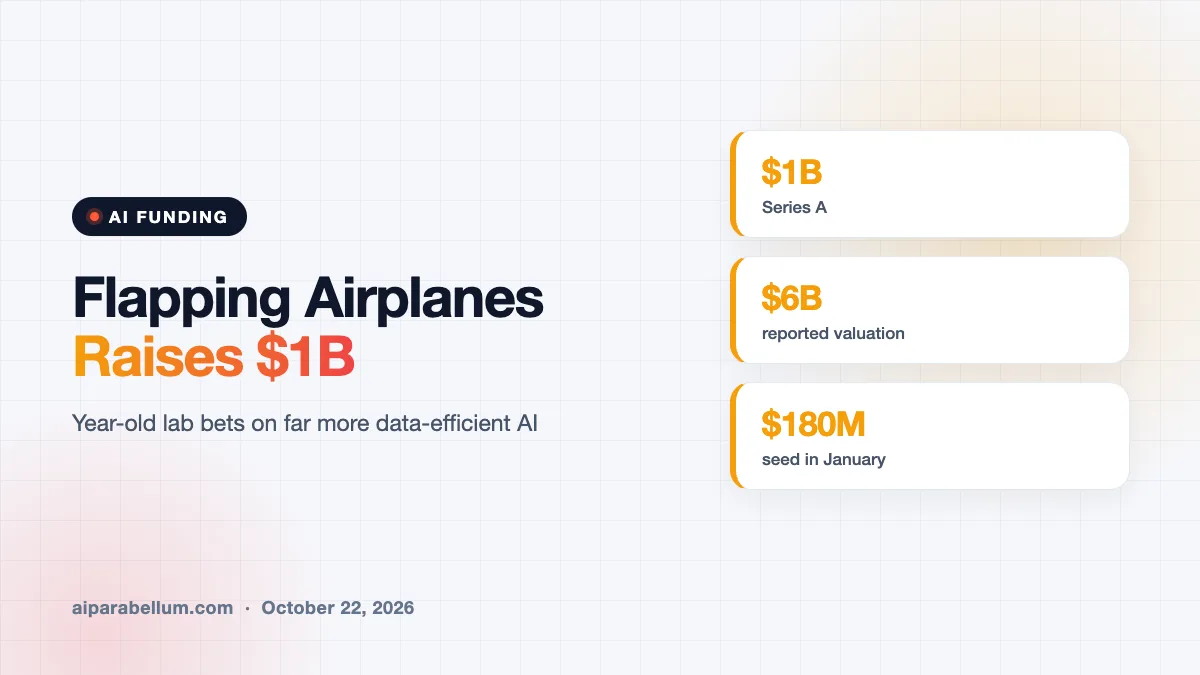
Flapping Airplanes funding just hit a new level. The year-old AI research lab announced a $1 billion Series A round on Wednesday, reportedly at a $6 billion valuation, even though it has not released a commercial product yet.
The lab’s pitch is bold: train powerful AI models with a tiny fraction of the data today’s systems use. Investors are betting that efficiency, not just bigger data centers, will shape the next phase of AI.
Inside the Flapping Airplanes Funding Round
Index Ventures and Lux Capital co-led the round, and Index partner Mark Xu is joining the company’s board. Earlier backers Sequoia and GV returned, and Kleiner Perkins, Valor, Atreides and Nvidia are also among the company’s investors.
The jump in value is striking. The lab launched about nine months ago with a $180 million seed round that valued it at $1.5 billion, so its reported valuation has roughly quadrupled since then.
| Detail | Seed round | Series A |
|---|---|---|
| Amount raised | $180 million | $1 billion |
| Valuation | $1.5 billion | $6 billion (reported) |
| Lead investors | Index, Sequoia, GV | Index and Lux |
| Total raised so far | About $1.18 billion | |
The size of the bet puts it among the larger early rounds this month, alongside deals like the Legora legal AI raise.
The Megakernel Idea Behind the Lab
Most of the lab’s first year went into low-level work on how software runs on GPUs. A kernel is a program that runs on a GPU, and the team built what it calls a very complete megakernel framework, which bundles many tasks into one program.
According to the founders, a single megakernel can handle a full training run, serve inference and even play a video game at the same time. Lead investor Index says this removes wasted time between steps so each chip does more useful work.
Why Overlapping Work Matters
Some AI tasks spend most of their time waiting for data, while others spend it crunching math. The company says its framework can run both kinds side by side, so the GPU is rarely sitting idle.
That matters because chips are scarce and expensive. If the approach works, the same hardware could deliver more, which would help everyone from chipmakers like Nvidia’s AI factories to the startups renting compute.
Who Is Building Flapping Airplanes
The lab was founded by brothers Ben and Asher Spector along with Aidan Smith. Ben, the CEO, is a Stanford computer science PhD student who started the student-run accelerator Prod at MIT, and Asher earned a statistics doctorate at Stanford.
Smith is a Thiel Fellow who worked at Neuralink during college. Index says the team is only a couple dozen people, all working in person in San Francisco, and covers everything from GPU kernels to pre-training, post-training and inference.
- Hiring focus: skill and growth potential over age or resume.
- Index says one engineer joined while still in high school and built the team’s agent tools.
- Another hire had never trained a model before leading the pre-training run, per Index.
What This Means for You
You can’t use a Flapping Airplanes product today, so this is a story to watch rather than act on. Still, it signals where a lot of AI money is heading.
- Cheaper AI could follow: models that need less data and compute could lower prices for tools you use.
- New markets may open: investors named robotics, trading and life sciences as areas where data is scarce.
- Expect more efficiency claims: as more labs chase this angle, compare real results, not just promises.
If you follow the startup side of AI, our Tenstorrent funding coverage shows another big bet on getting more from hardware.
Takeaway: The next AI race may be about doing more with less, not just building bigger.
Sources
Primary source: Index Ventures on leading the Flapping Airplanes Series A. Additional reporting from TechCrunch and SiliconANGLE.
Conclusion
Flapping Airplanes has turned a bold research idea into a $1 billion Series A in about a year, without shipping a product. Its focus on megakernels and data-efficient training is a direct challenge to the idea that AI progress needs ever more data and compute. Investors clearly believe the team can deliver, but the real test will be whether its models match today’s leaders while using far less. For now, it is one of the clearest signs that efficiency is becoming a major theme in AI. Keep up with stories like this on our AI news page.