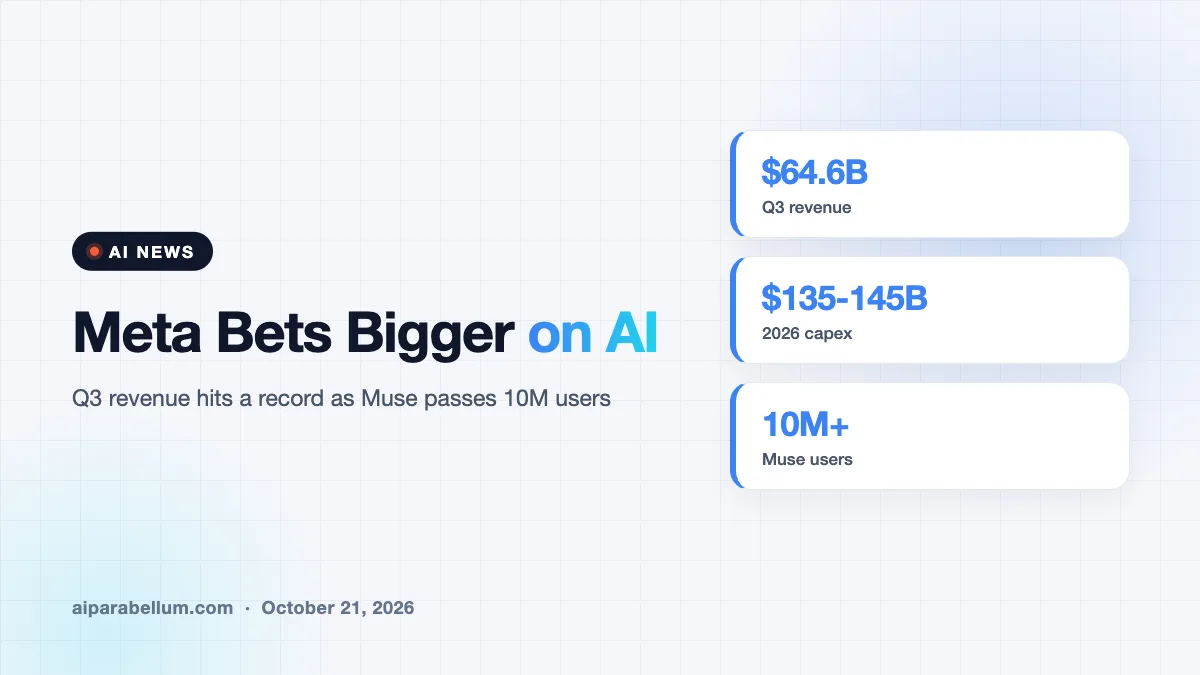
Meta’s Q3 earnings show a company going all in on AI, even as that bet starts to squeeze its cash. The Facebook and Instagram owner posted record revenue of $64.6 billion, raised the low end of its AI spending plans for 2026, and said its Muse AI agent now has more than 10 million users. Here is what changed, what it costs, and why it matters if you use Meta’s apps.
Meta Q3 Earnings at a Glance
The headline numbers were strong on the ad side. Revenue for the quarter that ended September 30 rose 26% from a year earlier, and profit came in at $9.8 billion, up from $2.7 billion a year ago, when a one-time tax charge weighed on results.
Costs grew much faster than sales, though. Total costs and expenses jumped 68% to $51.6 billion, driven largely by the price of building out AI.
| Metric | Q3 2026 | Comparison |
|---|---|---|
| Revenue | $64.6 billion | Up 26% year over year |
| Costs and expenses | $51.6 billion | Up 68% year over year |
| Net income | $9.8 billion | $2.7 billion a year earlier |
| Capital expenditures | $34.91 billion | $31.08 billion in Q2 |
| Free cash flow | Negative $2.12 billion | $784 million in Q2 |
| 2026 capex outlook | $135 to $145 billion | Was $130 to $145 billion |
Meta’s AI Spending Keeps Rising
Meta spent nearly $35 billion on capital projects in the third quarter, mostly data centers and the computing power behind its AI models. That was up from about $31 billion in the second quarter.
For the full year, the company now expects capital spending of $135 billion to $145 billion. It raised the bottom of that range from $130 billion, which means the floor for its 2026 AI build-out just went up.
Meta is not slowing down. It is spending more on AI infrastructure than ever and telling investors to expect more next year.
Chief financial officer Susan Li said the company expects “to continue investing aggressively” in both its core business and new AI projects as it plans its 2027 budget.
Cash Flow Turns Negative
All that spending pushed Meta’s free cash flow below zero for the quarter, to negative $2.12 billion. A year earlier, the figure was $8.55 billion.
To give itself more ways to raise money, Meta said it will create a new class of stock in January. It also announced a two-for-one stock split, which lowers the price per share without changing the company’s total value.
Muse Tops 10 Million Users
The bright spot for Meta’s AI push is Muse, the AI agent app it launched recently. On the earnings call, CEO Mark Zuckerberg said Muse has more than 10 million users, confirming earlier outside estimates. If you followed our coverage of Muse’s early downloads, this is the first time Meta has put its own number on it.
Zuckerberg shared a few more details about how people use it:
- About 25% of people who set up Muse now use it every day.
- Shopping is a top activity, with average purchases among engaged shoppers above $200.
- Muse links to bank accounts through Plaid’s connector to complete purchases.
- Many users connect it to email and calendars for everyday productivity tasks.
The shopping angle fits a wider trend. Retailers are opening up to AI shopping agents, and payment firms are building rules for agent purchases.
How Meta Plans to Make Money From Muse
Meta wants to keep Muse free for most people and take a small cut of the purchases made through it. Power users who want the most advanced models or more usage will pay.
The company even predicts Muse will one day earn more per user than its Facebook, Instagram, WhatsApp and Messenger users do today. Zuckerberg admitted Muse is costly to run right now, but said Meta expects to make it more than 10 times cheaper to serve within a year.
Privacy Features and the Muse Network
Zuckerberg pointed to a feature called Muse Secure VM, meant to protect user data, and said an upcoming Muse Confidential VM will stop even Meta from seeing users’ content. He also teased a Muse network, where your agent could work with the agents of friends, family and businesses.
What This Means for You
If you use Meta’s apps, expect AI to show up in more places, from your feed to shopping and messaging. Here are a few practical points:
- Muse is free for now, but heavy use of top models will likely cost money later.
- If you let an AI agent shop for you, review its spending limits and linked accounts.
- Check what email or calendar access you grant, since agents can act on that data.
- Watch for Meta’s confidential computing feature if privacy is a concern for you.
For businesses, Meta’s agent push could change how customers find and buy products. It is worth comparing options in our guide to AI business tools and keeping up with the latest AI news.
What Meta Q3 Earnings Mean for Reality Labs
Muse is also central to Meta’s smart glasses plans. Reality Labs, the unit behind glasses, VR headsets and the metaverse, still loses billions, but its losses are expected to shrink from $19.1 billion in 2025 to about $15 billion this year.
Investors seemed to like the overall story. Meta’s stock rose about 4% in after-hours trading shortly after the results came out, a change from earlier quarters when big spending plans sent shares lower.
Sources
Primary source: Meta Reports Third Quarter 2026 Results. Additional reporting from The New York Times, TechCrunch and Business Insider.
Conclusion
Meta’s third quarter showed both sides of the AI race. Ad revenue is booming, and Muse is giving the company its first clear AI consumer hit, with more than 10 million users and real shopping activity. But the cost of building AI is now large enough to push cash flow negative and force new ways of raising money. For now, Meta is betting that agents like Muse will pay for the data centers, and the next few quarters will show whether that bet holds up.