A new Google model called Gemini 4 Neon has shown up in the official Gemini API documentation, complete with a model page and a price list, even though Google has not announced it. The listing went live on the evening of November 18 (US time), and as of this writing there is no blog post, launch event or press release about it. Here is exactly what the official pages show, and what they don’t.
Where Gemini 4 Neon Showed Up
The name first appeared on Google’s “All models” page for the Gemini API. It now sits in the Gemini 4 section between two models Google already launched this month. The listing reads Carbon, Argon, Neon and Hydrogen, in that order.
Neon also has its own model page and an entry on the API pricing page. Those pages point to a “What’s new in Gemini 4 Neon” guide and a model card, which suggests the documentation was prepared for a full release. Still, Google has not said a word about Neon in public, so treat everything below as unconfirmed until it does.
We checked Google’s main AI blog, the DeepMind blog and the Google developers blog. None of them mentions Neon at the time of writing.
What the Docs Say About Neon
Google’s own description calls Neon a model with “frontier-level intelligence” and fast end-to-end task completion. The docs say it targets complex software engineering, knowledge work and science workflows. That wording places it near the top of the lineup, but the page does not publish any benchmark scores.
Specs listed on the model page
- Model code: gemini-4-neon, marked as a stable version with a “November 2026” latest update
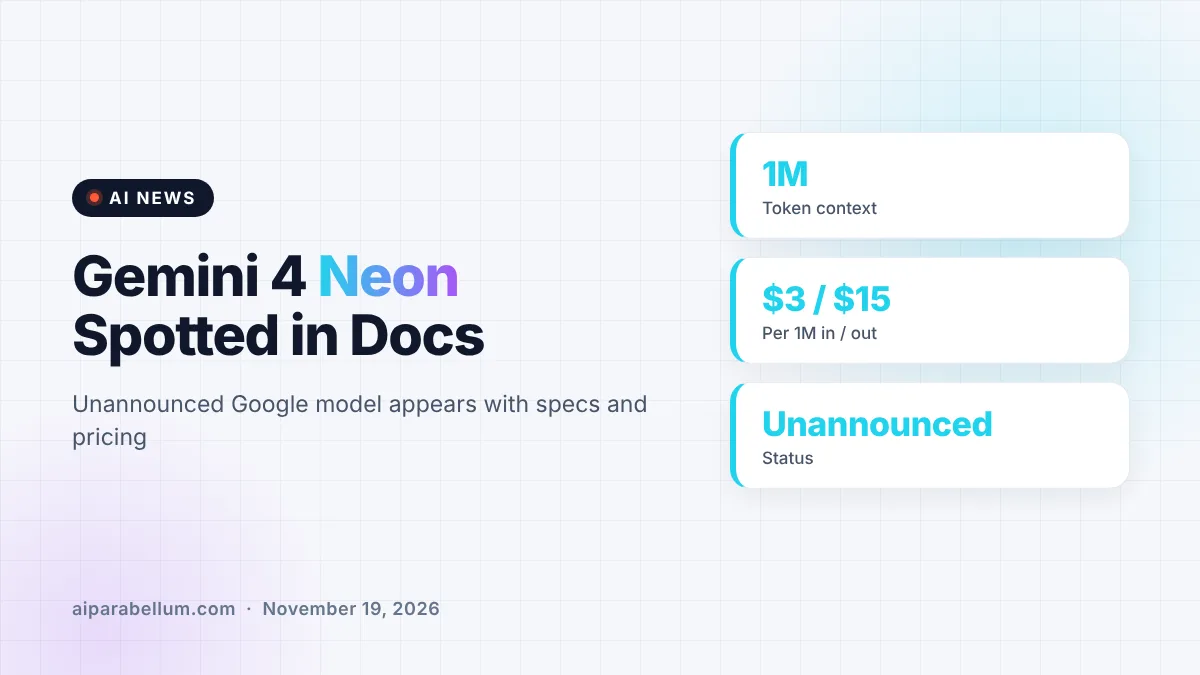
- Context window: 1,048,576 tokens, shared between input and output
- Max output: 65,536 tokens by default, or up to about 1 million tokens with long decode
- Inputs: text, images, video, audio and PDF files; output is text only
- Supported tools: function calling, code execution, computer use, file search, URL context, structured outputs and thinking
- Grounding with Google Search and Google Maps is supported
- Not supported: image generation, audio generation and the Live API
The page also lists Batch, Flex and Priority inference options. Context caching works only in implicit mode, since explicit caching is marked as unsupported.
Gemini 4 Neon Pricing on the API Page
The pricing page already shows paid rates for Neon. It is not offered on the free tier, and Google notes that every token is billed, including thinking tokens.
| Model (per 1M tokens, paid tier) | Input | Output | Free tier |
|---|---|---|---|
| Gemini 4 Carbon | $2.00 now, $4.00 from Dec. 1 | $10.00 now, $20.00 from Dec. 1 | No |
| Gemini 4 Argon | $2.00 through Nov. 30 | $10.00 through Nov. 30 | No |
| Gemini 4 Neon (unannounced) | $3.00 | $15.00 | No |
| Gemini 4 Hydrogen | $1.50 | $7.50 | Yes |
The listed context caching price for Neon is $0.15 per million tokens. Search and Maps grounding follow the same rules as other recent Gemini models, with 5,000 free requests a month and then $14 per 1,000. Google also states that data from paid Neon use is not used to improve its products.
How it fits the Gemini 4 family
Google opened the Gemini 4 generation with Gemini 4 Argon, then made Gemini 4 Carbon broadly available as its strongest reasoning model. Last week it added Gemini 4 Hydrogen for everyday coding and agent work. Based on the order of the docs and the prices, Neon looks like a middle option between Hydrogen and the top models, though Google has not described it that way.
What We Don’t Know Yet
A documentation page is strong evidence, but it is not a launch. Pages like this can change or vanish before release, and prices on a draft listing are not final until Google confirms them.
- No release date has been given
- No benchmark results or model card details are public yet
- It is unclear whether Neon will reach the Gemini app or Google Search
- It is unclear how its speed compares with Argon or Hydrogen in practice
What This Means for You
If you build on the Gemini API, Neon could soon give you another choice between cost and capability. The listed $3 input and $15 output rates sit above Hydrogen, so it will only make sense if it clearly beats Hydrogen on hard tasks.
- Don’t change production code yet. Wait for Google’s official launch and real benchmark numbers.
- Prepare a short test set from your own coding or research tasks so you can compare Neon with Hydrogen quickly once it opens.
- Watch your budget. Thinking tokens are billed as output, so long reasoning runs can cost more than the headline price suggests.
- If you are still picking a provider, our Claude vs Gemini comparison is a good place to start.
For everyday users of the Gemini app, nothing changes today. Google usually brings new models to developers and the app on its own schedule, and it has not shared one for Neon. You can follow future updates in our AI news section.
Sources
Primary source: Gemini API models page. Additional details from the Gemini 4 Neon model page and the Gemini API pricing page.
Conclusion
Gemini 4 Neon is now visible in Google’s official API documentation with full specs and pricing, but Google has not announced it. The pages describe a frontier-level model with a 1 million token context window, computer use support and a price of $3 input and $15 output per million tokens. Until Google confirms the launch, treat the details as a preview that could still change. We will update our coverage once the company speaks.