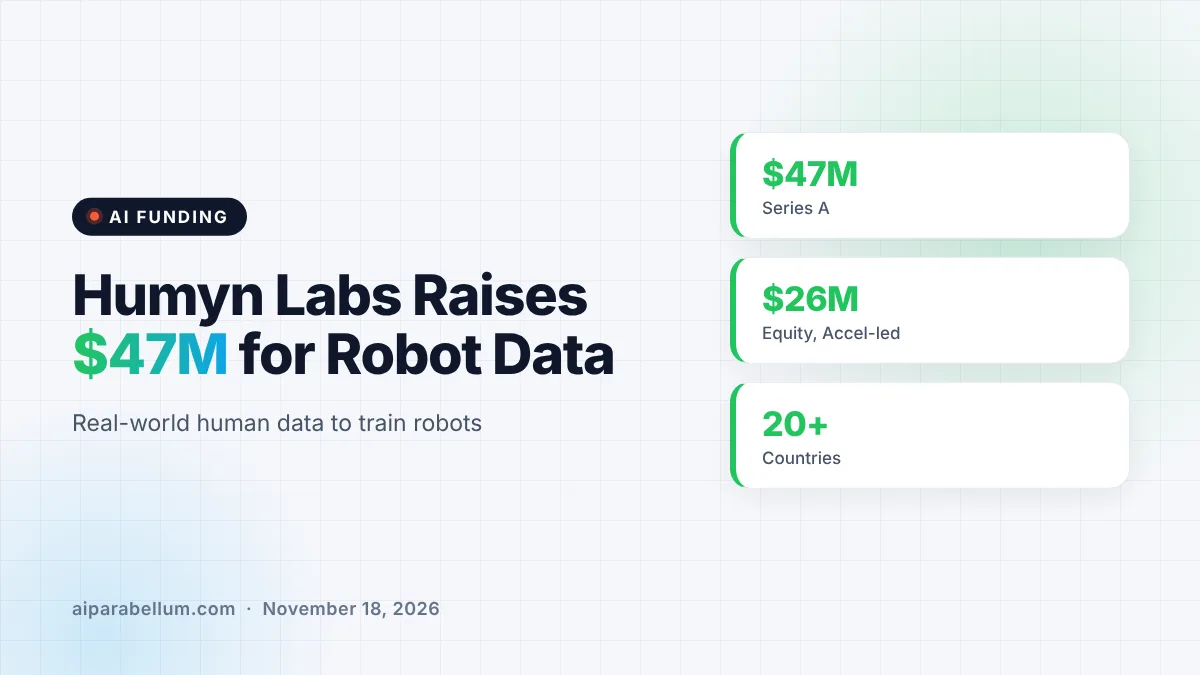
Humyn Labs, a Bengaluru-based startup that records how people do everyday work so robots can learn from it, has raised $47 million in Series A funding. The robot training data company says the round mixes $26 million in equity led by Accel with $21 million in venture debt. Most of its customers are AI labs and robotics companies in the United States.
Inside the $47M Humyn Labs Round
The equity part of the deal was led by Accel. Prosus Ventures, BeeGlobal, Finserv Intelligence through Bajaj Finance, the Bajaj Alts AI Opportunities Fund, Dallas Venture Capital, Lighthouse Canton and Jump Trading also joined, along with an unnamed angel investor.
The debt portion was led by Lighthouse Canton, with Trifecta Capital taking part. Co-founder Manish Agarwal explained the debt piece in interviews: the company pays its data workers daily or weekly, but AI lab customers often take 30 to 60 days to pay. Borrowing covers that gap without selling more of the company.
| Detail | What was announced |
|---|---|
| Total raised | $47 million (Series A) |
| Equity | $26 million, led by Accel |
| Venture debt | $21 million, led by Lighthouse Canton |
| Founded | Early 2026, in Bengaluru, India |
| Data collection | 20+ countries, with hubs in Brazil, India and South Korea |
| Team | 51 full-time employees |
Why Robots Need Real-World Training Data
Chatbots learn from huge piles of text scraped from the internet. Robots can’t. To fold laundry or pick parts off a shelf, a model needs to see how human hands grip objects, how much force they use, and how people recover when something slips.
That kind of footage is hard to get at scale. Humyn Labs builds its own two-camera, head-mounted capture rigs and records people doing their normal jobs and household chores, rather than staged demos. Its software then labels the footage, tracking hand positions, object contact, depth and other signals that a robot model can learn from.
The company argues that location matters too. A home robot trained only on American kitchens may struggle in an Indian home, where the tools, appliances and room layouts look different. That’s why it collects data across Latin America, East Asia, and South and Southeast Asia.
More than video
Humyn Labs also sells speech data for languages that get little attention from big AI companies, such as Bengali, Tamil, Telugu, Korean, Tagalog and Vietnamese. It also publishes BRIDGE, a benchmark series for physical AI covering voice, vision and touch.
Revenue Claims and Customers
Humyn Labs says it crossed $50 million in annualized revenue within six months of starting operations. In interviews, Agarwal said the startup earned $10 million in revenue between April and October and has another $20 million in signed contracts. These figures come from the company and have not been independently verified.
The startup says it has 12 paying customers, including frontier AI labs, humanoid robot makers and companies building world models. About 90% of revenue comes from the U.S., though it declined to name customers. Agarwal also said the company aims to build a $1 billion annual revenue business, which is a goal, not a forecast.
Humyn Labs isn’t alone in this race. Other startups are also paying people to record everyday tasks for robot training, and the trend has drawn questions about privacy and consent, especially when cameras record inside private homes. We covered a related shift in how AI labs buy training data earlier this year.
What the Robot Training Data Funding Pays For
The company says it will spend the new money on a few clear priorities:
- Building “deployment readiness” sites in Brazil, South Korea and India, where robots are tested against how humans actually do the same job.
- Scaling its capture hardware and its data enrichment engine.
- Expanding new data types, especially touch and motion, alongside audio and video.
- Growing teams in San Francisco, London and Seoul.
The deployment testing piece is the interesting bet. Instead of only selling footage, Humyn Labs wants to measure where robots fail on real job sites and feed those gaps back into the next round of model training.
What This Means for You
You probably won’t buy anything from Humyn Labs directly. But its growth is a strong sign of where AI money is heading next: out of the chat window and into machines that move.
- Home and warehouse robots are getting closer, and the data behind them is now a business of its own. Recent rounds like Dream Labs’ raise and Tutor Intelligence’s funding point the same way.
- Big AI labs are moving into robots too. See our report on OpenAI’s humanoid plans.
- If you’re asked to record your own work or chores for an AI data project, read the consent terms closely and ask how the footage is stored and used.
- Businesses testing robots should ask vendors what data trained them and whether it matches their own sites.
For more funding and launch updates, browse our latest AI news.
Sources
Primary source: Humyn Labs’ Series A announcement. Additional reporting from TechCrunch, SiliconANGLE and Moneycontrol.
Conclusion
Humyn Labs’ $47 million round shows that investors see real-world human data as a key bottleneck for physical AI. The startup is betting that footage of people doing actual work, gathered across many countries, will help robots perform outside the lab. Its revenue claims are bold and come only from the company, so watch whether its named customers and deployments follow. Either way, the race to teach robots how humans move is now a funded industry of its own.