Microsoft has launched MAI Code 2 and a lighter MAI Code 2 Flash, two in-house coding models that are now live in GitHub Copilot. The company unveiled them on November 17 at its Ignite conference in San Francisco, alongside a new security model and a small “decision” model for AI agents. The pitch is simple: almost the same coding results as the top models from OpenAI and Anthropic, for far less money.
What MAI Code 2 Actually Is
MAI Code 2 is Microsoft’s new general-purpose coding model. Microsoft says it is built for the everyday work developers do, like deep debugging, changes that span many files, refactoring and reasoning across a whole repository. It also claims the model is especially good at building dashboards, charts and other visual front-end work.
MAI Code 2 Flash is the smaller sibling. It targets high-volume jobs such as explaining code, making quick targeted edits and fixing routine bugs. Both models are designed for agentic coding, where the AI plans and carries out several steps on its own.
Microsoft is also clear about the limits. The company says these models are not yet tuned for the hardest problems, such as fundamental science research or very long-running agent tasks.
How MAI Code 2 Compares on Price and Performance
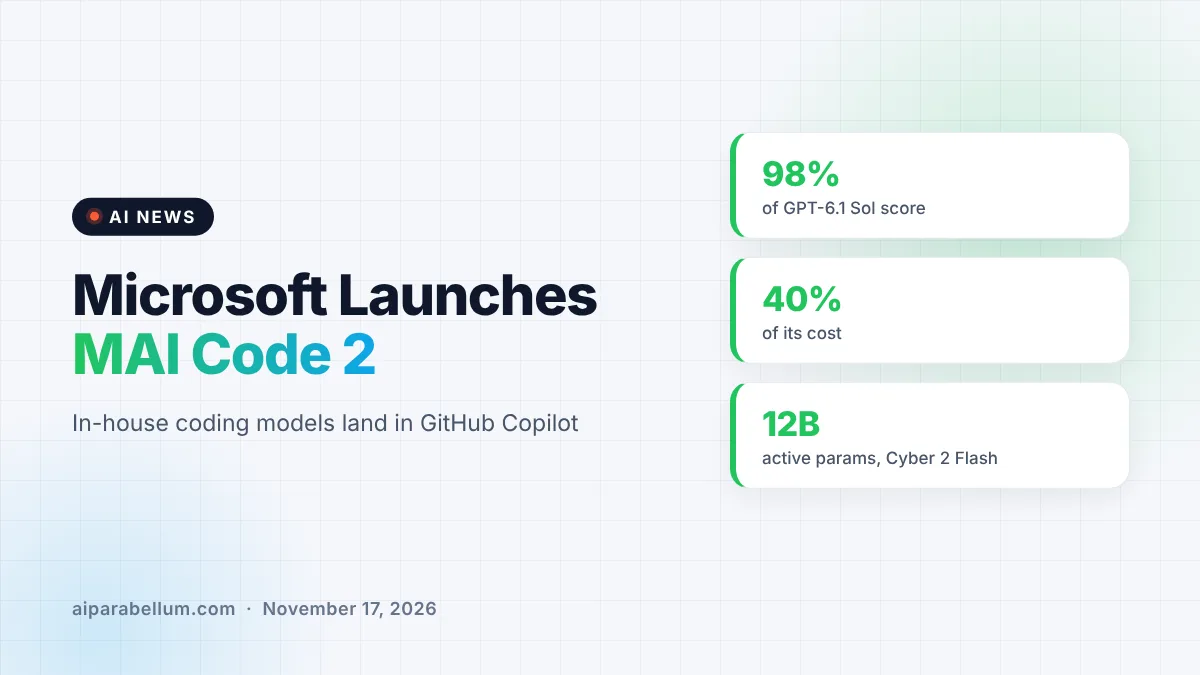
The headline numbers come from Microsoft’s own testing, so treat them as company claims until independent benchmarks catch up. Averaged across four coding benchmarks, Microsoft says MAI Code 2 delivers 98% of the performance of OpenAI’s GPT-6.1 Sol at 40% of the cost. It also says the model reaches 96% of Claude Opus 5.5’s performance at just 5% of the cost.
| Model | Microsoft’s claim | Best for |
|---|---|---|
| MAI Code 2 | 98% of GPT-6.1 Sol at 40% of the cost; 96% of Claude Opus 5.5 at 5% of the cost | Debugging, multi-file changes, repo-wide work |
| MAI Code 2 Flash | Comparable to GPT-6 Luna and Claude Haiku 5.5 at 65% and 20% of their cost | Quick edits, explanations, routine fixes |
| MAI Cyber 2 Flash | Within a few points of larger security models at a fraction of the price | Security work for selected customers |
There is one important footnote. Microsoft says the cost figures use the models’ 50% promotional price, so the gap may narrow once that promotion ends. In blind tests of front-end apps, Microsoft says reviewers preferred MAI Code 2’s results over GPT-6 Sol 67% of the time.
Security and Agent Models Join the Lineup
The coding pair was only part of the Ignite news. Microsoft also introduced MAI Cyber 2 Flash, which it calls its most capable security model, with 12 billion active parameters. The company plans to offer this cyber model to a limited group of customers as AI tools turn up more and more software vulnerabilities.
There is also Microsoft-Decision-1.1, a fast and cheap model for the many small choices agents make. Think routing a request to the right tool, flagging an urgent ticket or checking whether a step worked. Microsoft also released new image-generation and transcription models, and it will let enterprise customers license model weights to customize with their own data, as long as they deploy on Azure.
A domain-by-domain strategy
Microsoft AI chief Mustafa Suleyman describes the approach as building models for specific jobs to keep costs down, telling Reuters, “This isn’t just one model. It’s not a flash in the pan.” Microsoft has also tuned Code 2 Flash into a model called MAI Work Flash to serve Microsoft 365 apps like Word, Excel, PowerPoint and Teams, plus Fabric IQ.
Where You Can Use the New Models
Both coding models show up in the model picker in GitHub Copilot and are billed on usage. Here is who gets access:
- MAI Code 2: Copilot Pro, Pro+, Max, Business and Enterprise plans
- MAI Code 2 Flash: all of the above, plus Copilot Free and Student
- Microsoft Foundry: MAI Code 2 Flash in a limited-access preview
- Coming soon: OpenRouter, Vercel, Hermes, OpenCode and Kilo, according to Microsoft
For Business and Enterprise plans, new models are switched on by default unless an admin has turned off that setting or blocks the model. If you manage a team, it is worth checking your AI coding policies before developers start picking it.
What This Means for You
If you write code with Copilot, you now have a cheaper option for the bulk of your daily tasks. The smart move is to test it on your real work instead of trusting the benchmark chart.
- Try MAI Code 2 Flash for small edits and explanations, especially on the free plan.
- Compare MAI Code 2 against your current model on one real bug or feature.
- Keep a premium model handy for very long or unusual tasks, since Microsoft says Code 2 is not tuned for those.
- Watch your usage bill after the promotional pricing ends.
This also signals a bigger shift. Microsoft has long leaned on OpenAI for its best models, and it now wants its own in-house models to compete on price. Teams already weighing AI for security will want to watch how the cyber model performs once it reaches more customers.
The takeaway: Microsoft is betting that “almost as good, much cheaper” wins most everyday coding work.
For more of today’s AI headlines, visit our AI news page.
Sources
Primary source: Microsoft AI’s MAI Code 2 announcement. Additional details from the GitHub Changelog, the Microsoft Ignite live news blog, Reuters via Yahoo Tech and Axios.
Conclusion
MAI Code 2 is Microsoft’s clearest attempt yet to compete with OpenAI and Anthropic on its own terms, by matching most of their coding quality at a much lower price. The models are available in GitHub Copilot now, with a security model and an agent decision model rounding out the launch. The benchmark claims are Microsoft’s own, and the cost figures rely on promotional pricing. Still, for developers who mostly fix bugs and ship features, this is a real new choice worth testing. Expect rivals to answer on price soon.