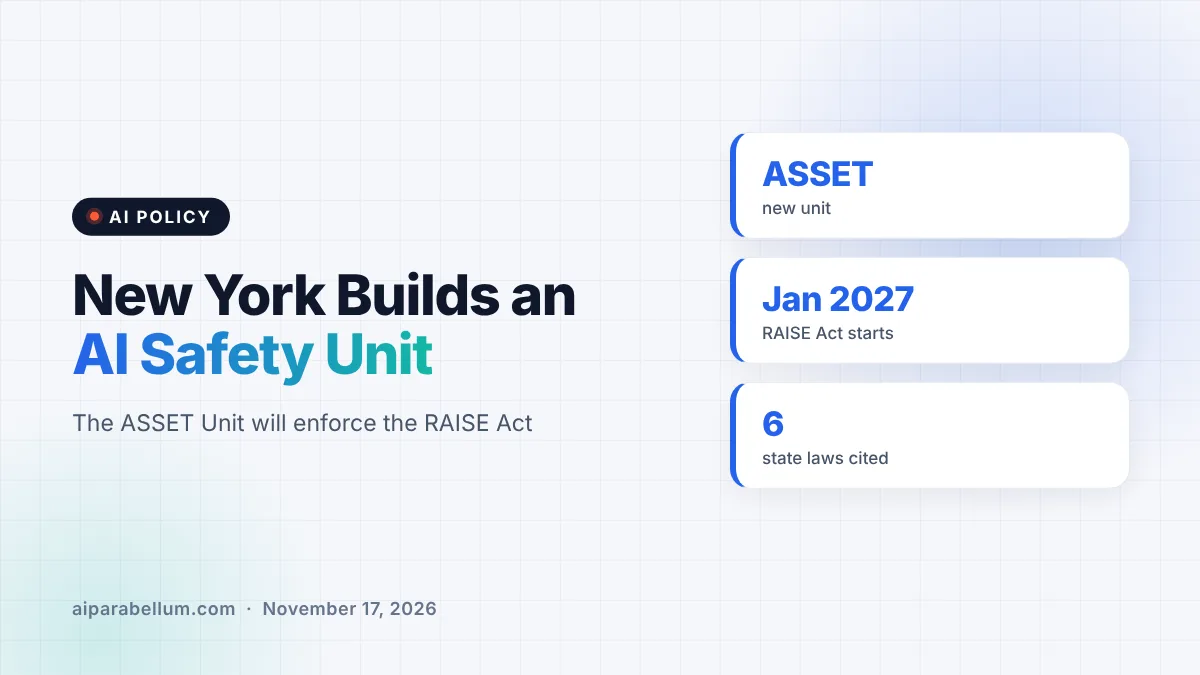
New York Attorney General Letitia James announced a new AI safety unit on Tuesday, November 17, 2026. Called the ASSET Unit, it will police how AI companies follow state law, starting with the RAISE Act, which takes effect on January 1, 2027. If you live in New York or build AI products used there, this office is now the one watching.
What the New AI Safety Unit Will Do
ASSET stands for AI Safety, Standards, Enforcement, and Transparency. The attorney general’s office says the unit will lead enforcement of the RAISE Act and other AI safety laws. It will also write new policy proposals and lend technical know-how to investigations across the office.
The unit’s focus goes beyond big AI models. It will look at how new technology affects data privacy, digital scams, cybersecurity and online safety. That is a wide net, and it covers many of the everyday risks people already face with chatbots and AI-made fakes.
Takeaway: New York is not waiting for Washington. It is building its own team to enforce the AI rules it has already passed.
Who Leads It
The office is still hiring for the team. It will be led by Cristy Phillips, who previously served as special counsel for the Economic Justice Division. The ASSET Unit sits inside that division and will work closely with the Bureau of Internet and Technology.
The RAISE Act Is the Unit’s Biggest Job
The RAISE Act, short for Responsible AI Safety Education Act, targets developers of large frontier AI models. Starting in January 2027, those companies must publicly share their safety measures. They must also report security and safety incidents quickly.
Until now, it was not clear who inside state government would handle that work day to day. This announcement answers that question. For the biggest model makers, it means a dedicated team will be reading their safety disclosures and incident reports.
You can read our earlier coverage of a draft AI safety bill for background on how these rules have taken shape.
The New York AI Laws the Unit Can Enforce
The attorney general’s office listed several state laws that give it power over AI-related harm. Here is a quick look at each one.
| Law | What It Covers | When It Applies |
|---|---|---|
| RAISE Act | Safety disclosures and incident reports from large frontier AI developers | January 1, 2027 |
| S.9051B/A.10379C | Bans unsafe chatbot features for children | June 2027 |
| General Business Law, Article 47 | Chatbots must try to detect suicidal ideation and tell users they are not human | Already in force |
| SHIELD Act | Reasonable data security to prevent breaches | Already in force |
| Penal Law 245.15 | Sharing intimate images with intent to harm, including AI-made images | Already in force |
| Synthetic Performer Disclosure Act | Ads must disclose AI used in place of humans | Already in force |
The office also has broad civil powers. It can act against unfair or deceptive business practices, privacy violations, hackers and fraudsters, including under the federal Computer Fraud and Abuse Act.
Why New York Is Moving Now
The new unit builds on a string of earlier actions by the same office. James says the move continues her work to keep New Yorkers safe online. Her office pointed to several recent steps:
- Encouraging AI company employees to file whistleblower complaints with her office about unsafe development.
- Issuing a consumer alert about scammers using AI-generated celebrity fakes to lure investors.
- Backing the recently signed chatbot safety law that targets harmful bot features for kids.
- Pressing xAI in January 2026 to stop its Grok chatbot from creating inappropriate images.
- Leading a bipartisan push in 2025 against federal legislation that would have blocked state AI rules.
“Promising new technologies like artificial intelligence should never come at the expense of New Yorkers’ safety and privacy,” James said in the announcement. Other states are also taking a tougher line, as seen when several states sued OpenAI over child safety.
What This Means for You
For most people, this does not change how your AI apps work today. But it does change who you can turn to when something goes wrong. Here are a few practical points:
- If an AI scam or deepfake targets you in New York, the attorney general’s office now has a team built for these cases.
- If you work at an AI company and see unsafe practices, the office has openly invited whistleblower complaints.
- If you build AI tools, expect closer attention to chatbot safety features, data security and clear AI disclosures.
- Parents should watch for the June 2027 child chatbot rules, which will limit risky features in apps kids use.
Businesses using AI for threat detection or customer chat may want to review their privacy and security practices now. State enforcement often starts with the easiest cases to prove, like weak data protection or missing disclosures.
Sources
Primary source: New York Attorney General’s ASSET Unit announcement. Additional reporting from KATV.
Conclusion
New York has passed some of the country’s most detailed AI laws, and now it has a team to enforce them. The ASSET Unit will take charge of the RAISE Act when it starts in January 2027, along with chatbot, privacy and deepfake rules. For AI companies, the message is clear: disclosures and safety reports will be read closely. For everyday users, it means one more place to turn when AI causes real harm. Keep up with more policy moves on our AI news page.