OpenAI says it is now supplying AI models for NATO cyber defense, giving the alliance’s core institutions access to its advanced cybersecurity models. The company shared the details on November 17, 2026, along with a list of European cyber agencies that are already using the same tools. It is one of the clearest looks yet at how a frontier AI lab is working with military and government defenders.
What OpenAI Announced About NATO Cyber Defense
According to OpenAI, the work runs through NATO’s Communications and Information Agency, known as NCIA. That agency gives NATO’s core institutions access to OpenAI’s cybersecurity models, with the goal of protecting Allied networks.
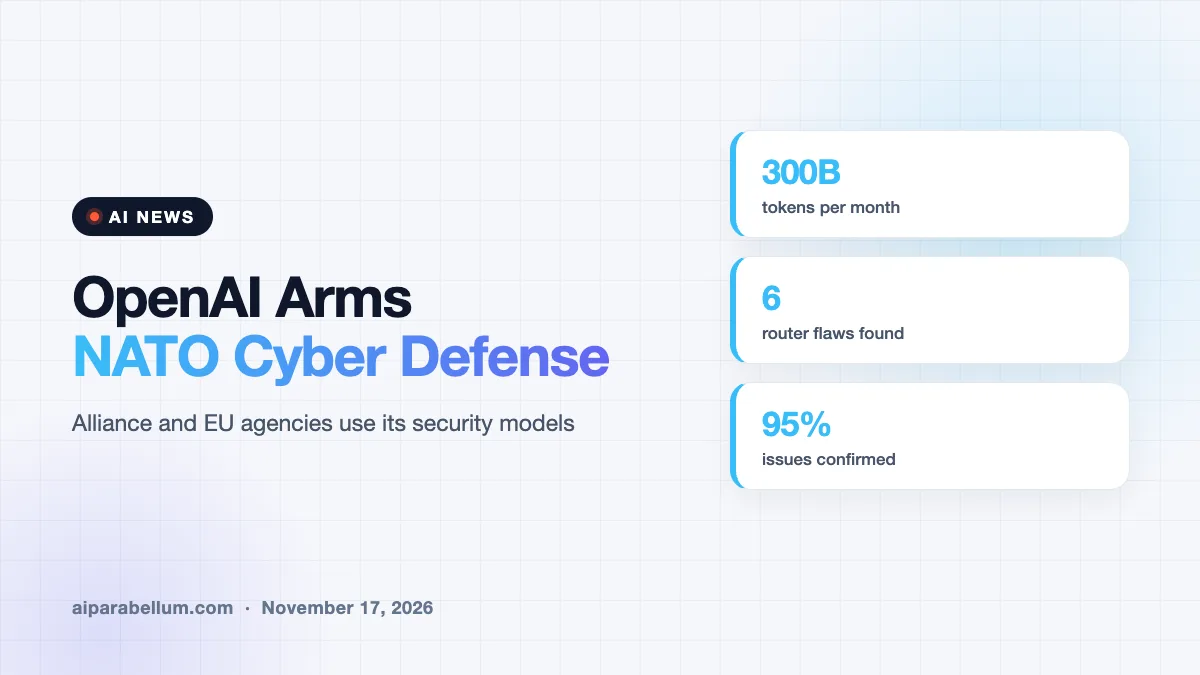
The scale is the part that stands out. OpenAI says NATO has used up to 300 billion raw input and output tokens per month as part of this work. Tokens are the small chunks of text a model reads and writes, so that figure points to heavy, daily use and not a small pilot.
The access comes through Daybreak, the OpenAI offering aimed at trusted defenders doing authorized security work. The company describes that work as reviewing software, investigating suspicious activity, validating vulnerabilities, and developing and testing fixes.
Takeaway: this is not a research demo. A military alliance is running a frontier AI lab’s security models at very large volume to protect its own networks.
AI Agents Join a NATO Cyber Exercise
OpenAI also says it supported the 2026 Crossed Swords exercise. The event is organized by the NATO Cooperative Cyber Defence Centre of Excellence, often shortened to CCDCOE.
This year’s exercise included a new training stream. Participants built, deployed and evaluated AI agents for cyber operations, with Daybreak available inside the technical environment.
Humans Stay in Charge
OpenAI stresses that the training placed people alongside the agents as operators, with a focus on keeping human oversight. The company adds that it remains committed to NATO’s principles for responsible AI adoption. That matters, because autonomous agents acting inside live networks is exactly the scenario that worries many security teams.
Which Agencies Are Using the Models
NATO is not the only customer here. OpenAI says it has already given access to its cyber models to defenders across Europe, and it shared a few early results.
| Organization | How it used OpenAI’s models | Result OpenAI reports |
|---|---|---|
| NATO (through NCIA) | Access to cybersecurity models for core institutions | Up to 300 billion tokens used per month |
| ENISA (EU cyber agency) | Checked software used across EU institutions | Four vulnerabilities found, fixes published for all four |
| CERT Polska | Analyzed MikroTik RouterOS | Six vulnerabilities identified and fixed by the vendor |
| Ukraine’s Ministry of Digital Transformation | Uses Daybreak to defend civilian infrastructure | Aims to find and fix software flaws faster |
| France (ANSSI), Germany and Poland | National cyber agencies given model access | No specific results shared |
What the EU Review Found
OpenAI points to a November joint report from ENISA and CERT-EU. It describes a review of 27 software projects using frontier models, including OpenAI models reached through Daybreak, plus tools such as the Codex security plug-in.
Across the models tested, 95% of the 88 potential issues that software maintainers assessed were confirmed as genuine. That is a useful number, since a common complaint about AI security research is that it floods maintainers with false alarms. Note that the figure covers all the models in the review, not only OpenAI’s.
The Router Flaws in Poland
In Poland, CERT Polska used OpenAI models to help identify six vulnerabilities in MikroTik RouterOS, software that runs on widely used networking gear. Researchers directed the work, tested findings on real systems and verified the impact themselves. MikroTik released fixes, and CERT Polska confirmed those fixes blocked the attacks it had observed.
Why AI Cyber Defense Matters Right Now
AI models have become good at reading code and spotting weak points. That cuts both ways, because attackers can use the same skills. Labs have responded by offering their strongest security features to vetted defenders first, and this announcement fits that pattern.
It also shows the AI security market heating up. Deals such as Cohere buying Aisle show that model makers see defense work as a serious business line. Government and alliance contracts add credibility that is hard to earn any other way.
There are open questions too. OpenAI’s post does not name the specific models NATO uses, the value of the arrangement, or when the work began. All of the results come from OpenAI’s own account, although several link back to public advisories from the agencies involved.
What This Means for You
You probably do not run a military network, but the lessons carry over to any business or home setup. Here are the practical takeaways:
- Patch your network gear. If you use MikroTik routers, check that RouterOS is up to date, since fixes for the newly reported flaws are out.
- Expect faster bug discovery. When defenders and attackers both use AI, the gap between a flaw being found and being exploited gets shorter, so automatic updates are worth turning on.
- Keep a person in the loop. Even NATO’s training kept human operators beside the agents, which is a sound rule for any team trying AI threat detection.
- Treat AI findings as leads, not verdicts. In the Polish case, researchers tested every finding on real systems before reporting it.
- Start small if you are curious. A personal security assistant can help you review your own habits before you look at bigger tools.
For more stories like this one, you can follow our daily AI news coverage.
Sources
Primary source: OpenAI’s announcement on NATO and allied cyber defenses.
Conclusion
OpenAI’s work with NATO shows that AI-driven security has moved from lab tests into daily use by some of the world’s most demanding defenders. The numbers the company shared, from 300 billion tokens a month to confirmed router and software flaws, suggest the tools are finding real problems. Still, the account comes from OpenAI itself, and key details like cost and model names remain private. For everyday users, the message is simple: bugs will be found faster from now on, so keeping your software and devices updated matters more than ever.