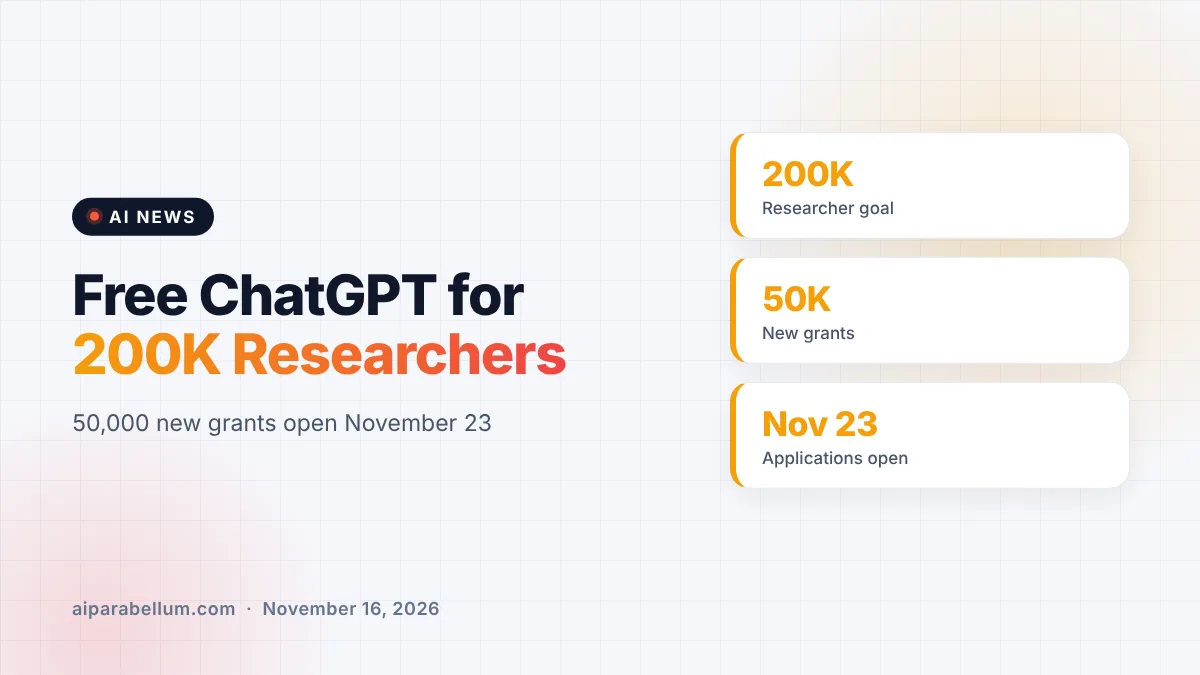
OpenAI is expanding its ChatGPT for Academic Researchers program with a goal of giving up to 200,000 researchers worldwide free ChatGPT access. The next round opens on Monday, November 23, with 50,000 new grants handed out first come, first served. Each grant covers the recipient plus up to two collaborators, so this round alone could reach 150,000 researchers.
How the Free ChatGPT for Researchers Program Works
The program started as a pilot in July. OpenAI says 20,000 researchers in 33 countries have joined since then. The new round brings a few big changes based on what the company learned over the summer.
| Feature | Summer Pilot | Next Round |
|---|---|---|
| Plan offered | ChatGPT Pro | ChatGPT Plus |
| Selection | Lottery | First come, first served |
| New grants | Pilot group | 50,000 |
| People per grant | Not stated | Recipient plus up to 2 collaborators |
| Applications open | July | November 23, 2026 |
Researchers already on the waitlist who qualify will get an email with activation steps before applications open. OpenAI says that by default it does not use data shared through the program to train its models.
Why OpenAI Switched From Pro to Plus
The pilot gave researchers ChatGPT Pro, the company’s most expensive plan. When OpenAI reviewed usage, it found most participants would have stayed within ChatGPT Plus limits. Offering Plus instead lets the company stretch the program to many more research teams.
The lottery is gone too. Researchers asked for a clearer process, so the first 50,000 eligible applications will get access.
What Researchers Did With ChatGPT in the Pilot
OpenAI shared a few examples from pilot participants. One researcher at Brigham and Women’s Hospital and Harvard Medical School is exploring whether ChatGPT can help link lab and patient data to speed up tuberculosis drug work. A team at the Florida Museum of Natural History uses AI tools to turn photos of museum specimens into searchable databases.
Alongside the expansion, OpenAI’s economic research team published a study of more than 1,800 researchers from the summer pilot. Surveyed participants estimated that the same work at the same quality would have taken nearly twice as long without AI. Keep in mind that this is a self-reported estimate from program users, not an independent measurement.
Other Ways OpenAI Is Courting Scientists
The free grants are one piece of a bigger push into science. OpenAI listed several other efforts:
- A $5 million contribution to a new Simons Foundation initiative to help mathematicians check and build on AI-generated results
- ChatGPT Edu, which lets universities give campus communities access for research, teaching and learning
- GPT-Rosalind, a biology-focused model available through a trusted-access approval process
- The Rosalind Academic Plan, offering eligible U.S. university labs up to 30 free seats for up to 12 months
This follows a busy stretch for AI in science. Anthropic recently published its own Claude research study, and a large group of researchers has pushed for stricter AI containment rules.
What This Means for You
If you work in academic research, this is one of the easiest ways to get paid-tier ChatGPT for free. Here is how to make the most of it:
- Mark November 23 on your calendar, since grants go to the first 50,000 eligible applicants.
- Pick your two collaborators ahead of time so your whole team gets access at once.
- Check whether your university already has ChatGPT Edu before you apply.
- Biology labs at U.S. universities should look into the Rosalind Academic Plan as well.
Even with free access, check AI output carefully before it goes into a paper. Our guide to AI research tools compares other options, and our citation comparison looks at which one cites sources better. For general tips, see our ChatGPT overview.
Sources
Primary source: OpenAI’s announcement on expanding ChatGPT for Academic Researchers. Additional reporting from Semafor.
Conclusion
OpenAI is doubling its goal for free researcher access to 200,000 people and making the process faster and fairer by dropping the lottery. Switching from Pro to Plus is a practical trade that lets far more teams in. Applications open November 23, and spots are first come, first served. For researchers who have been priced out of paid AI tools, this is a real opening worth grabbing early.