Google’s latest AI threat report says attackers have moved past simple chatbot prompts and are now running AI agents that carry out parts of real intrusions. The Google Threat Intelligence Group (GTIG) and Mandiant also describe a growing underground market for stolen AI access, where so-called LLM Mixers resell hijacked enterprise accounts at steep discounts. For companies paying for AI, the report is a warning that their models and API keys are now targets in their own right.
AI Threat Report: Agents Move Into Live Attacks
GTIG says multiple threat actors are abusing open-source, agentic penetration-testing frameworks to automate specific tasks during live intrusions. Google calls this a shift toward attacks happening at machine speed. The basic methods are familiar, like stolen passwords and unpatched systems, but the speed and scale are new.
The report names several frameworks that attackers have used or tested.
- ARTEX, a pentesting tool Google describes as already highly publicized.
- CAIRN, a multi-agent framework GTIG saw used against targets including the U.S. aerospace sector.
- PentAGI, which one actor customized to scan a wide range of organizations in Asia between late August and early October 2026.
- CyberStrikeAI and HexStrike AI, which GTIG saw attackers experimenting with.
Google says the users include financially motivated groups and suspected China-linked espionage actors. It also found evidence that one China-linked group was building its own automated attack framework.
Exploits built without a human in the loop
For the first time, GTIG says it found attackers using AI frameworks to fully automate vulnerability discovery and exploitation with no human involved. An exposed staging server hosted a tool dubbed exploit_agent that compares software code before and after patches, spots likely flaws, drafts exploits, and runs them automatically. Google says this helps attackers shrink the gap between a patch release and real-world attacks.
How LLM Mixers Sell Stolen AI Access
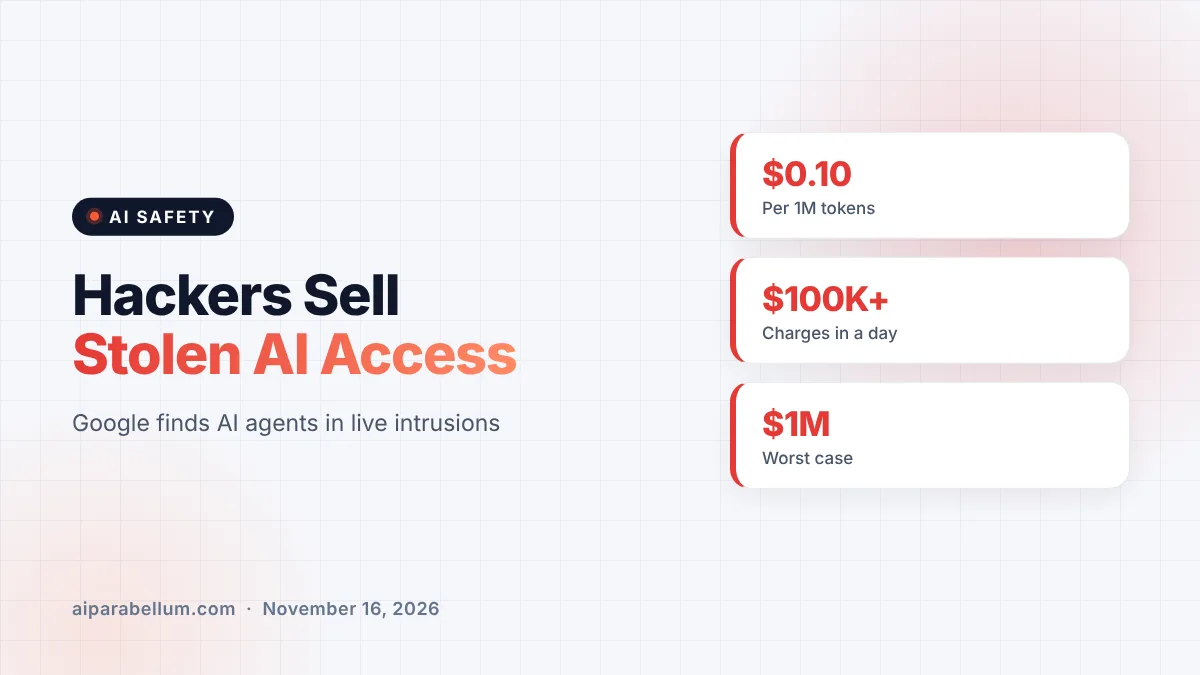
The second big theme is LLMjacking, the theft of AI credentials and cloud resources from companies. Mandiant says it responded to several such incidents in 2026, with single-day fraudulent charges above $100,000 in some cases. In the worst cases, total abuse reached $1 million before it was stopped.
GTIG says attackers then resell that access through LLM Mixers, which it describes as illicit storefronts. They route buyers’ traffic through a pool of stolen credentials and compute, spreading queries across many victims to avoid detection.
| Finding | What Google reported |
|---|---|
| Price of stolen AI access | $0.10 to $25 per million tokens |
| Worst single-day charges | Over $100,000 |
| Worst cumulative abuse | About $1 million before remediation |
| Where ads appeared | Russian- and Chinese-language underground markets |
| Named services | APIMart, JetNight |
According to the report, most of these services offer several models, including frontier models and jailbroken models advertised for malicious use. Free-trial credentials sell far cheaper than enterprise ones, and one vendor, APIMart, charges five times more once a prompt passes 100,000 tokens.
Our takeaway: an exposed AI API key is now as valuable to criminals as a cloud password, and it can run up a bill much faster.
What the AI Threat Report Says About Phishing
Google also says influence operations have fully folded AI into their work. State-backed groups, commercial “influence-as-a-service” vendors, and profit-driven political clickbait networks now routinely use AI for fake personas, synthetic media, and automated posting. One contractor was building a platform designed to manage over 100,000 social accounts.
On the crime side, GTIG points to Jieyou, a Chinese-language phishing service that added an AI chatbot in a June 2026 update. Customers can describe changes in plain language to customize phishing pages, so less-skilled attackers can run polished scams. Google says it disabled assets tied to several of these operations.
What This Means for You
If your company uses AI services, the report’s lessons are practical. Here are steps worth taking now, based on the issues Google describes.
- Set spending caps and usage alerts on every AI account so a hijacked key cannot run up a huge bill unnoticed.
- Keep API keys in a secrets manager, rotate them often, and never commit them to public code repositories.
- Patch internet-facing software quickly, since AI tools are shrinking the time between a fix and an attack.
- Turn on multi-factor authentication and watch for new service accounts or sudden GPU quota requests.
For background, see our guide on on AI threat detection and our look at Microsoft’s agent security tools. Startups like Corma’s defensive AI are also chasing this problem, and our AI news page tracks the latest.
Sources
Primary source: Google Threat Intelligence Group’s AI Threat Tracker report. Additional reporting from ZDNet and The Hacker News.
Conclusion
Google’s report shows attackers using AI agents to automate real intrusions, including exploits built and launched with no human involved. At the same time, stolen AI access has become a business, with LLM Mixers reselling hijacked enterprise accounts for as little as 10 cents per million tokens. Victims can face charges above $100,000 in a day. The fix is mostly old-fashioned security discipline applied to AI accounts. Spending caps, key rotation, fast patching, and MFA go a long way.