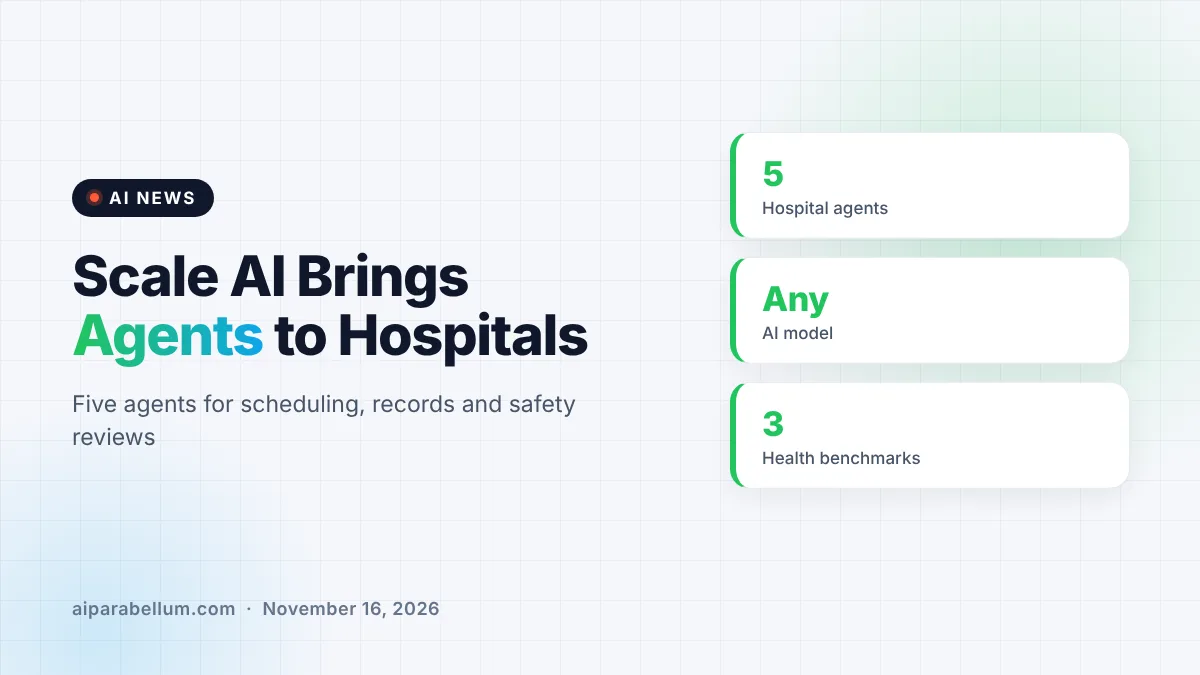
Scale AI has launched Scale for Hospital Operations, a set of five AI agents built to handle the behind-the-scenes work that keeps hospitals running. The hospital AI agents cover scheduling, test orders, medical record summaries, safety investigations and clinical paperwork, and Scale says health systems can start using them today.
The launch puts one of the best-known AI data and evaluation companies directly into hospital workflows. It also arrives with a clear pitch: every agent runs inside the hospital’s own environment, works with any AI model, and keeps clinicians in charge of the final call.
What Scale for Hospital Operations Includes
Scale describes the five applications as the first part of a larger healthcare portfolio. More applications and agents are planned for the coming months. Here is what each one is designed to do, based on the company’s announcement.
| Agent | Main job | Human check |
|---|---|---|
| Scheduling Intelligence | Triages referrals by urgency and matches visits to rooms, equipment and doctor preferences | Staff approve the final schedule |
| Order Guidance | Flags missing tests and suggests labs, imaging and prescriptions with cited evidence | Clinician review of every suggestion |
| Medical Record Review and Summarization | Builds a short patient history from scattered records | Each finding links back to its source |
| Safety and Incident Investigation | Ranks patient safety events and spots recurring patterns | Safety teams decide what to investigate |
| Clinical Documentation and Quality Review | Drafts clinical reports and checks them against hospital guidelines | Clinician sign-off and auditor confirmation |
Built for the work outside the exam room
Scale argues that the biggest backlogs in hospitals sit outside direct patient visits. Referrals pile up, records go unread and safety reports wait in a queue in the order they arrived. The agents are meant to take on that volume so care teams do not fall behind.
The scheduling agent, for example, can rework an existing calendar to fit an urgent patient and combine visits across specialties into one plan. The order guidance agent aims to catch a missing routine test before an appointment rather than after it.
How Scale AI Wants Hospitals to Trust Its Agents
Trust is the hardest sell in hospital AI, and Scale leans on its background in AI testing to make the case. The company says it spent the past year working inside hospitals, including a top-ranked U.S. health system it did not name, helping clinicians spot safety events sooner.
Scale also tied the launch to three healthcare benchmarks from its research team. Each one targets a different kind of failure that a simple accuracy score can miss.
- CliniCARE-Bench checks whether an agent reviewing a real health record reaches the right answer for the right reasons, and knows when to defer to a clinician.
- PSEBench tests whether an agent triages patient safety reports correctly against a written reporting policy.
- DistressBench tests whether a patient-facing chat tool recognizes a person in crisis and points them to help.
According to coverage of the benchmark results, the 16 agentic systems tested on CliniCARE-Bench scored between 65.3% and 76.1% on raw accuracy. Their scores dropped noticeably once flawed reasoning shortcuts were penalized, and every system committed to answers more often than it should have instead of deferring. Those are benchmark findings, not test results for the five new hospital agents.
Why the “any model” approach matters
Scale is not tying hospitals to one AI provider. The agents can run on any model, and each deployment comes with Scale engineers and clinical subject-matter experts. That setup lets a health system compare models on its own workflows rather than relying on general leaderboards.
Keeping data inside the hospital’s environment is also a big deal for privacy and compliance teams. Patient records are some of the most sensitive data there is, and many hospitals are wary of sending them to outside services.
The Bigger Push Into Healthcare AI
Scale is joining a crowded field. Big cloud providers and startups are all racing to sell AI help for hospital paperwork, as seen with Gemini for Healthcare and funding rounds like Suki’s $90M raise. Medical groups are also writing rules for how these tools should behave, such as the AMA agent framework.
To support the case for AI documentation tools, Scale points to a 2025 study of clinicians across six U.S. health systems. After 30 days with an AI documentation tool, reported burnout fell from 51.9% to 38.8%. That study looked at a different product in outpatient care, so it does not show how Scale’s own agents will perform.
Scale is showing the agents to buyers at the HLTH USA conference this week. The real test will be whether hospitals see measurable time savings without new safety risks once the tools are live.
What This Means for You
Most people will never log into these tools, but they could shape how quickly you get an appointment or how complete your chart is. Here is what to keep in mind, and you can follow more updates in our AI news section:
- If you work in a hospital, expect more AI drafts and summaries that you review and sign rather than write from scratch.
- If you lead IT or compliance, ask vendors how their AI agents handle uncertain cases and whether data stays on your systems.
- If you are a patient, AI scheduling and record review could mean faster triage, but a clinician should still make every care decision.
The safest hospital AI rollouts will measure not just whether an agent gets the answer right, but whether it knows when to step back and ask a human.
Sources
Primary source: Scale’s Scale for Hospital Operations announcement. Additional reporting from Unite.AI.
Conclusion
Scale AI’s five hospital operations agents target the paperwork, scheduling and safety reviews that slow care down behind the scenes. The company is betting that its testing background, model flexibility and on-site deployment will win over cautious health systems. Its own benchmarks show why caution is warranted, since even strong AI systems often answer when they should defer. Hospitals that adopt these tools will need to keep clinicians firmly in the loop. If Scale can prove real time savings in live hospitals, its broader healthcare portfolio could grow quickly.