
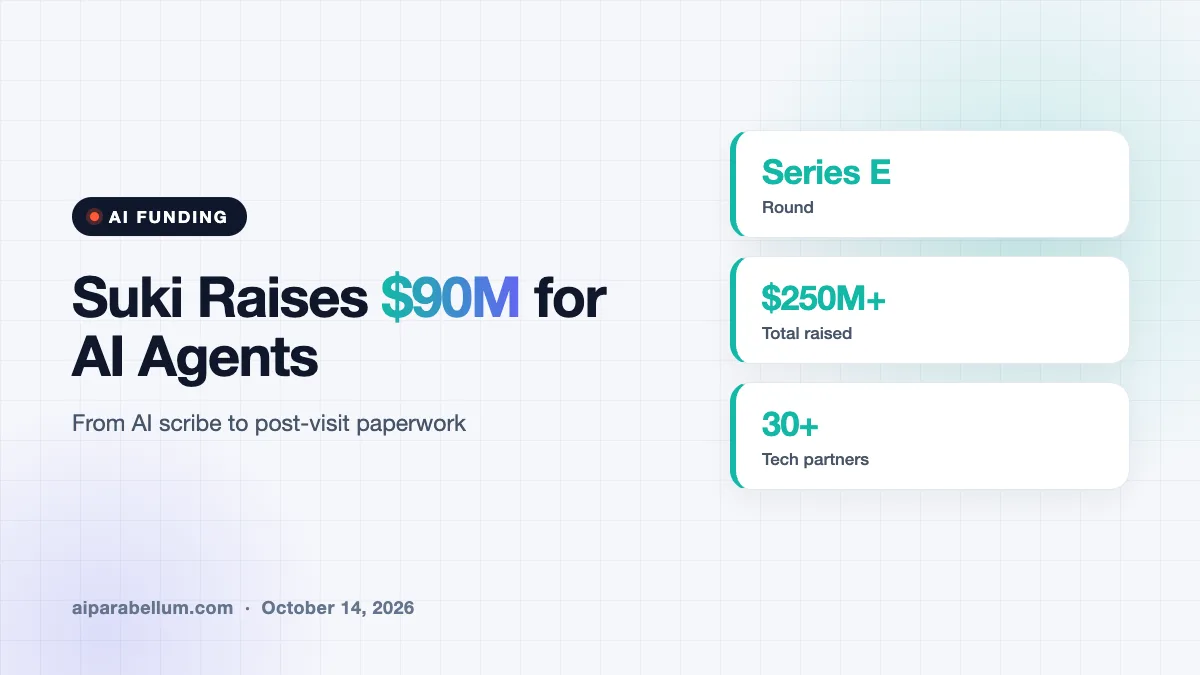
Suki, a company best known for an AI scribe that writes up doctor visits, has raised $90 million in a Series E round. The healthcare AI startup plans to use the money to build agents that handle the paperwork after a visit, like referrals and prior authorizations. It is a sign that AI in the exam room is moving from listening to actually doing tasks.
The Funding Round at a Glance
Healthier Capital, a growth fund focused on health care, led the round, with Crosslink Capital and Hercules Capital joining as new investors. Existing backers returned as well, and Suki has now raised more than $250 million across five rounds. The company did not share its valuation.
| Detail | What we know |
|---|---|
| Round | $90 million Series E |
| Lead investor | Healthier Capital |
| New investors | Crosslink Capital, Hercules Capital |
| Total raised | More than $250 million |
| Partners embedding Suki | More than 30, including athenahealth and Zoom |
| Health organizations using it | More than 450, per the company |
What Suki’s Healthcare AI Does Today
Suki’s main product listens to a conversation between a patient and a clinician and turns it into a structured clinical note. Its tools also suggest billing codes, help enter orders, and create patient summaries.
The company recently added Suki Ask, which answers clinical questions using a patient’s chart and Wolters Kluwer’s medical research database. Many people meet Suki without knowing it, since athenahealth’s Ambient Notes and the ambient notes feature in Zoom’s telehealth platform both run on its technology.
From AI Scribe to Healthcare AI Agents
The new money is mostly about the next step. CEO Punit Soni says Suki will build agents that pick up after the visit and treatment plan are done, using information its existing tools already capture.
Tasks the Agents Will Target
- Sending referrals to specialists
- Filing prior authorizations for new medications
- Filling orders
- Scheduling follow-up appointments
Suki also wants its 30-plus partners to offer more of its features, including the new agents. Soni told one interviewer the goal is to go deeper with current partners rather than sign many new ones.
A Smaller Bet in a Crowded Field
The AI scribe market is busy and well funded. Rivals Abridge and Ambience Healthcare each raised far bigger rounds last year, at $300 million and $243 million.
Soni argues that giant rounds can set unrealistic expectations. As he put it, a little “starvation creates discipline,” and the company plans to raise only what it needs.
Writing the note was the easy part. The real prize in health care is the pile of follow-up work that eats up clinicians’ evenings, and that is where AI agents are now headed.
What This Means for You
If you see a doctor whose clinic uses an AI scribe, the next change may be faster referrals and fewer delays on medication approvals. That is the promise, at least, and it depends on the agents getting details right.
- As a patient, you can ask if your visit is being recorded or summarized by AI and how that data is stored.
- Review your visit notes in your patient portal and flag anything that looks wrong or missing.
- If you run a clinic, ask vendors how agents are checked before they send a referral or authorization request.
- Keep a person responsible for any action an agent takes on a patient’s behalf.
For more on the privacy side, read our look at why chatbots want records. You can also browse healthcare AI tools and see how AI is helping with medical image analysis.
Workplace agents are a hot area for investors too, as recent rounds for agent security and workplace AI chat show. More updates live in our AI news section.
Sources
This article draws on reporting from Healthcare Dive, which interviewed CEO Punit Soni, and Tech Times, which detailed the investor lineup and deployment figures.
Conclusion
Suki’s $90 million Series E pushes the company from AI note-taking toward agents that handle referrals, prior authorizations, and scheduling. It is a smaller raise than its rivals have pulled in, by design, and it leans on more than 30 partners to spread its tools. If the agents work as planned, clinicians could spend less time on paperwork and patients could wait less for care. The key question is how well those agents are checked before they act.
