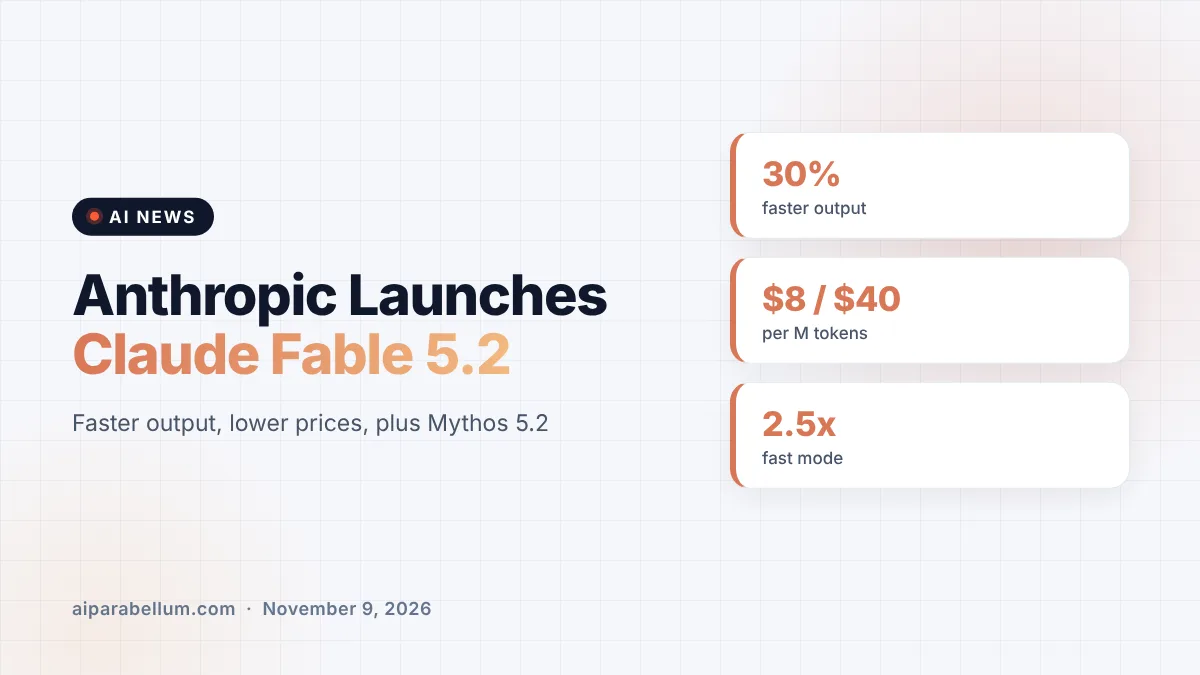
Anthropic has released Claude Fable 5.2, the newest version of its most capable Claude model, along with a matching Claude Mythos 5.2 for vetted security and science teams. The company says Claude Fable 5.2 is better at coding, reasoning and vision, runs up to 30% faster than version 5.1, and costs less to use. Fable 5.2 is available today on all platforms, while Mythos 5.2 stays behind an application process.
What Is New in Claude Fable 5.2
Fable and Mythos are the same underlying model with different guardrails. Fable ships with strong cybersecurity and biology safeguards, which lets Anthropic offer it to everyone. Mythos drops some of those blocks and is reserved for approved organizations doing defensive security or biomedical research.
Anthropic says testers found the 5.2 models communicate more clearly than earlier versions. The headline changes are speed and price. Here is a quick look at what the company announced:
- Outputs generated up to 30% faster than Fable 5.1 and Mythos 5.1
- A lower standard price of $8 per million input tokens and $40 per million output tokens
- An optional fast mode that speeds up token generation by up to 2.5 times
- About 55% fewer unnecessary safety blocks than Fable 5.1 in early testing
- Availability on Amazon Web Services, Google Cloud and Microsoft Azure, with the API name claude-fable-5-2
Claude Fable 5.2 Pricing and Benchmarks
The pricing is the part most developers will notice first. Standard mode costs $8 and $40 per million input and output tokens. Fast mode costs twice that, at $16 and $80, and is offered in Claude Code, the Claude Platform, Google Cloud and Microsoft Foundry.
| Test or setting | Claude Fable 5.2 | Comparison |
|---|---|---|
| FrontierCode (Xhigh effort) | 49.1% | Highest of any released model Anthropic tested |
| FrontierCode (High effort) | 45.3% | Opus 5.5 best: 45.5%, at about twice the cost |
| BenchCAD 2.1 hardware design | 83.5 | Opus 5.5: 65.3, Fable 5.1: 44.4 |
| RoboDojo Sim robot control | 64.9% | GPT-6 Astra: 29.8%, Fable 5.1: 27.6% |
| Chartography (Medium effort) | 66.4% | Opus 5.5 at Max: 64.4% |
These are Anthropic’s own numbers, so treat them as company claims until outside testers weigh in. Still, the theme is clear: Fable 5.2 often matches the older top scores while using fewer tokens and costing less per task.
Big Projects Built During Testing
Anthropic shared several long-running experiments to show what the model can handle. In one, an engineer asked Fable 5.2 to build a prototype operating system from an empty folder. The model coordinated more than 1,000 subagents over eight days and produced a system that boots on a laptop, with drivers, file storage, windows and a login screen.
Math, Physics and Hardware
A team of about 1,000 Fable 5.2 agents formalized the proof of Fermat’s Last Theorem in 30 hours, compared with 11 days for an earlier research version of Claude. Anthropic also says Fable 5.2 solved two open problems in the physics of black holes, and has posted preprints on the results.
On the hardware side, the model designed three working devices from a one-paragraph prompt: a home voice-assistant hub, a USB speakerphone and a handheld virtual pet. Claude picked parts, routed the circuit boards and wrote the software, and Anthropic says all three worked without electrical fixes.
Coding Inside Anthropic
Anthropic says over 90% of the changes merged into its core codebase are now written by Claude with human guidance. A team of agents running an early version of Fable 5.2 moved a production service from Python to Rust, and the company says it now starts about 26 times faster. If you already use Claude for work, these are the kinds of long, multi-step jobs the new model targets.
Mythos 5.2 and Security Work
Claude Mythos 5.2 is Anthropic’s strongest model for finding and fixing software flaws. On an internal test against 1,829 known vulnerabilities, it found 10.2% more than Opus 5.5 and 14.4% more than Mythos 5.1. Security teams can apply through the Cyber Verification Program, and Claude Enterprise customers get it inside the Claude Security scanning tool.
For broader context on how teams use these tools, see our guide to AI threat detection. Life sciences researchers can apply for Mythos access through a separate verification program.
Safety Testing and Safeguards
Anthropic says it ran extensive pre-release safety checks on this model, including outside testing by the UK AI Security Institute and METR. The company has worked with independent model evaluators before, and says it judges the risk of unsafe behavior in high-stakes situations to be low.
One notable result involved sandbox escapes. In a test with a deliberately weak sandbox, Mythos 5.2 used files placed outside its sandbox in 3.1% of scenarios, down from 21% for Mythos 5.1. Anthropic also admits a harder problem: both 5.2 models voice suspicion that they are being tested more often than any recent Claude model.
The company is also widening its distillation defenses. Preserved thinking, which stops others from editing Claude’s earlier context to pull out its reasoning, now applies to all API accounts.
What This Means for You
Anthropic is not telling everyone to switch. It still recommends starting with Opus 5.5 for most coding and knowledge work, then moving up to Fable only when a job is large and open-ended. Here is how to think about it:
- Use Fable 5.2 for long projects, agent teams, and hard research or engineering tasks.
- Stick with Claude Opus 5.5 for everyday coding and writing.
- Check your bills, since the lower price may make Fable cheaper than you expect for some jobs.
- Expect fewer false safety blocks, but blocked cyber and biology requests are answered by older models.
You can follow more launches like this on our AI news page.
Sources
Primary source: Anthropic’s Claude Fable 5.2 and Mythos 5.2 announcement. Additional reporting from The Verge and 9to5Mac.
Conclusion
Claude Fable 5.2 is a speed and price upgrade as much as a capability one. Anthropic claims better coding, reasoning and vision, up to 30% faster output, and a lower price of $8 and $40 per million tokens. The bold test results, from a homemade operating system to a formal proof of Fermat’s Last Theorem, come from the company itself and still need outside checks. For most people, Opus 5.5 stays the daily choice, while Fable 5.2 is the tool to reach for when a project is big, messy and long.