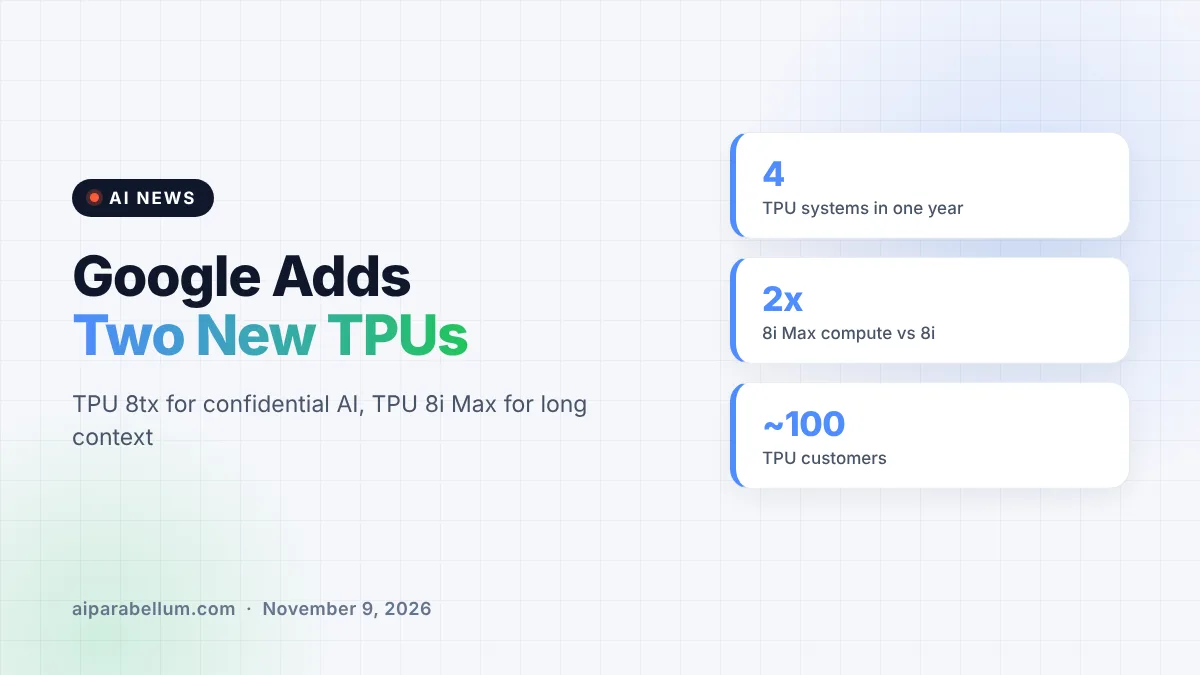
Google just expanded its newest Google TPU systems with two additions: TPU 8tx, built for confidential AI work, and TPU 8i Max, built for huge context windows. The company says this is the first time it has introduced four TPU systems in a single year. It is also a clear sign that Google wants outside businesses, not just its own Gemini teams, running AI on its chips.
The New Google TPU Systems Announced on November 9
Back at Google Cloud Next in April, Google introduced two eighth-generation chips: TPU 8t for large-scale training and TPU 8i for fast reasoning. Google says those deliver up to 2.7 times better training performance and 80% better inference price performance than the previous generation. Now it is adding two more systems built on that same silicon.
The key detail is that these are new systems, not new chips. Google explains that designing a chip takes years, while a system is about how compute, memory, networking and security are packaged around the chip. That modular approach, the company says, lets it ship new hardware in months rather than years.
The four eighth-gen TPUs at a glance
| System | Main job | Key detail |
|---|---|---|
| TPU 8t | Large-scale training | Up to 2.7x better training performance |
| TPU 8i | Low-latency reasoning | 80% better inference price performance |
| TPU 8tx | Confidential inference | Data stays protected while in use |
| TPU 8i Max | Massive context windows | Two TPU 8i chips on one package |
TPU 8tx Brings Confidential Computing to Google TPU Systems
Most data is encrypted when it is stored or sent across a network, but it usually has to be unlocked in memory while a processor works on it. TPU 8tx is designed to close that gap. Google says it keeps sensitive data and model weights protected and isolated even while they are being processed.
TPU 8tx is built on the same silicon as TPU 8t and paired with custom AMD CPU hosts. It also uses Google’s low-latency Boardfly network, and the company claims up to 2x lower latency than TPU 8t with a near-zero performance penalty. Google is aiming it at regulated businesses and governments that want to run powerful models next to their most private data.
Because it pairs training-grade compute with a fast inference network, teams can do more than just run models on it. Google says customers can fine-tune models on private data, distill big models into smaller ones, and train agents with reinforcement learning, all without moving data between clusters. Nvidia already offers a similar confidential computing feature on its GPUs, so this helps Google match a key enterprise checkbox.
TPU 8i Max Targets the Memory Wall
The second system tackles a different problem. When many AI agents work across a whole codebase or hours of video at once, memory bandwidth becomes the bottleneck. Google’s answer is to put two TPU 8i chips onto a single package.
According to Google, TPU 8i Max delivers double the compute, double the on-chip SRAM and double the HBM bandwidth of TPU 8i. Since it fits twice the silicon into the same rack footprint, data centers can pack more computing power per square foot and per watt. That matters as long-context, agent-heavy workloads become more common.
The Software Push Behind the New Hardware
Google paired the hardware news with software meant to make TPUs feel as easy to use as general-purpose chips. Last month it open-sourced TorchTPU, which we covered when Google and Meta announced PyTorch support for TPUs. Other pieces include:
- An open-source TPU agent suite, now in preview, that plugs into coding tools like Claude Code, Cursor and Google Antigravity
- A new open-source XLA Serving Engine for serving models in a low-latency C++ runtime
- TPU Sync, an open-source layer that moves KV caches and model weights across memory tiers
- GKE dynamic slicing, now generally available, for building custom TPU topologies on demand
Google also highlighted its Agent Compute Engine software, which suspends idle agent sessions to cut wasted compute. The company says TPUs now have nearly 100 customers, including frontier labs, trading firms, retailers and universities.
Why the Chip Race Is Shifting to Inference
As AI apps spread, the money is moving from one-time training runs to inference, the daily work of running models for users. Custom chips can be very efficient at that job, which is why Amazon, Microsoft and OpenAI are building their own accelerators too. Microsoft’s own effort, the Maia 300 chip, is one recent example.
For Google, a faster release pace and better software are the main tools for competing with Nvidia. Nvidia still dominates, with platforms like Vera Rubin setting the pace. But four TPU systems in one year shows Google is moving quickly.
What This Means for You
Most people will never buy a TPU directly, but these chips power the AI tools many of us use daily. Here is what to keep in mind:
- If you work in a regulated field, confidential computing on TPUs could make cloud AI easier to approve for sensitive data.
- Developers using PyTorch can now try TPUs with fewer code changes than before.
- More competition in AI chips could help push down the cost of running AI models over time.
- Long-context tools, like coding agents that read whole projects, may get faster as hardware like TPU 8i Max rolls out.
Google did not share pricing or exact availability dates for the new systems in its announcement. If you rely on Google Cloud, watch for those details before planning any move. You can follow more updates like this on our AI news page.
Sources
Primary source: Google Cloud’s TPU 8tx and TPU 8i Max announcement. Additional reporting from The Decoder.
Conclusion
With TPU 8tx and TPU 8i Max, Google now offers four eighth-generation TPU systems, each aimed at a different stage of AI work. The confidential computing angle targets banks, health companies and governments, while the dual-chip design targets long-context agents. Paired with open-source software like TorchTPU and TPU Sync, the launch shows Google treating its chips as a real platform for outside customers. Pricing and availability will decide how much of a dent this makes in Nvidia’s lead. For now, it is one of Google’s most aggressive hardware moves yet.