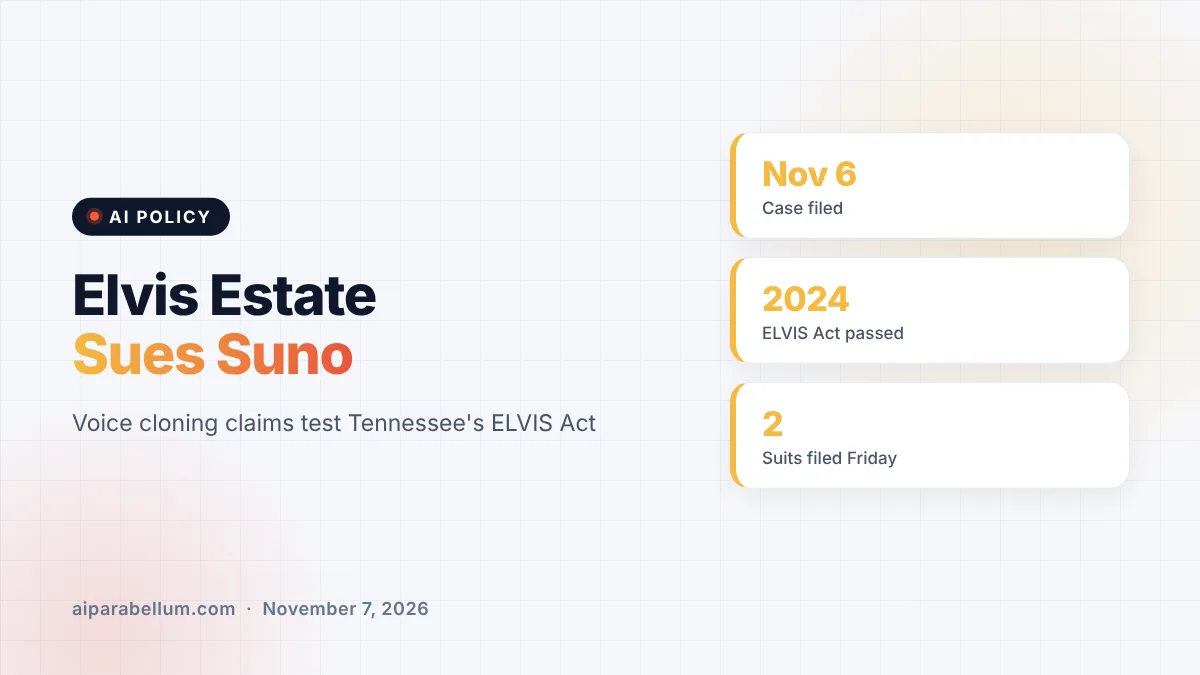
The company that controls Elvis Presley’s music and likeness has filed a new Suno lawsuit, accusing the AI music app of letting users clone the King’s famous voice. Elvis Presley Enterprises filed the case on Friday, November 6, and it goes beyond the usual training-data fight. It is one of the first big tests of Tennessee’s ELVIS Act, a 2024 law built for the age of AI deepfakes.
What the Suno Lawsuit Claims
Elvis Presley Enterprises is a unit of Authentic Brands Group, which owns much of Presley’s song catalog and the rights to his name, image and likeness. The complaint makes two kinds of claims. The first is about copyright, and the second is about identity.
On copyright, the estate says Suno trained its models on classic Presley recordings without a license. The suit names tracks such as “Can’t Help Falling in Love,” “Don’t Be Cruel,” “All Shook Up” and “Return to Sender.” These claims closely mirror the case the same owners filed against Anthropic a few weeks ago.
The identity claims are the new part. The estate argues that Suno lets people generate songs that sound like Presley singing, which it says violates his likeness rights. According to the complaint, typing Elvis’s name into Suno’s Create tool as recently as last month produced a vocal that copied his recognizable sound.
Suno’s Earlier Defense
In other cases, Suno has said its current models block artist names in prompts and do not imitate specific real voices. The Presley complaint calls those statements “unequivocally false” and includes links to videos of Suno outputs that sound strikingly like the singer. Suno did not immediately respond to a request for comment, according to Billboard, which first reported the filing.
Why the ELVIS Act Matters Here
Tennessee passed the Ensuring Likeness Voice and Image Security Act in 2024. Older right-of-publicity laws mostly covered commercial uses, like putting a celebrity’s face in an ad without permission. The ELVIS Act removed that limit and added something bigger for tech companies.
The law can hold liable the companies that provide tools used to copy a person’s voice or likeness without permission. That means the case is not only about what users made. It asks whether an AI platform itself is responsible for enabling the clone.
If this argument works in court, AI music apps may need much stronger guardrails against copying real singers, not just a block on typing their names.
Suno’s Growing Pile of Legal Fights
This is far from Suno’s only court battle. On the same Friday, the same legal team filed a separate copyright suit on behalf of Eight Mile Style, a publisher that owns much of Eminem’s catalog. That case names songs like “Lose Yourself” and “The Real Slim Shady.”
| Case | Who Is Suing | Main Claim |
|---|---|---|
| Major label suit (2024) | UMG and Sony Music (Warner settled) | Training on copyrighted songs |
| Publisher suits (2026) | Round Hill Music and Reservoir | Training on copyrighted songs |
| Artist likeness case | Jason Isbell and other artists | Copying artist identities |
| Eminem catalog case | Eight Mile Style | Training on Eminem’s hits |
| Elvis case (Nov. 6) | Elvis Presley Enterprises | Training plus voice and likeness cloning |
Suno settled with Warner Music Group last year and has said it wants to partner with the music industry. Universal and Sony, however, are still fighting it in court. You can read our earlier coverage of the Reservoir music lawsuit and the Elvis estate’s Anthropic copyright case for more background.
What This Means for You
If you make music with AI tools, this case is worth watching. It could change what these apps allow and who gets blamed when something goes wrong.
- Avoid prompting AI music tools to sound like a specific real singer, living or dead. Laws like the ELVIS Act are aimed squarely at that use.
- Expect tighter filters. A court loss could push apps to block sound-alike voices, not just artist names.
- Read the terms of any AI music service before you release songs commercially, since rights to outputs vary.
- If you want to clone a voice, use your own or one you have clear permission to use. Our guide on legal voice cloning covers the basics.
Listeners may notice changes too. Streaming services are already testing ways to label AI tracks, as we saw with Deezer’s AI filter, and lawsuits like this add pressure to do more.
The Bigger Question
Together with the Anthropic case, these suits are among the most significant actions filed for a single musician over AI. A ruling on whether an AI company is liable for voice clones made by its users could shape the whole industry. For more updates like this, visit our AI news hub.
Sources
Primary source: the complaint has not been posted publicly, so this article relies on reporting from Billboard, which reviewed the filing and spoke with Authentic Brands Group.
Conclusion
Elvis Presley’s rights owners are taking Suno to court over both training data and voice cloning. The case leans on Tennessee’s ELVIS Act, which can hold AI tool makers liable for unauthorized likeness copies. It joins a crowded list of suits against Suno, including a new one over Eminem’s catalog. How courts handle the voice claims could decide how far AI music apps can go in mimicking real artists. For now, anyone making AI music should steer clear of sound-alike vocals.