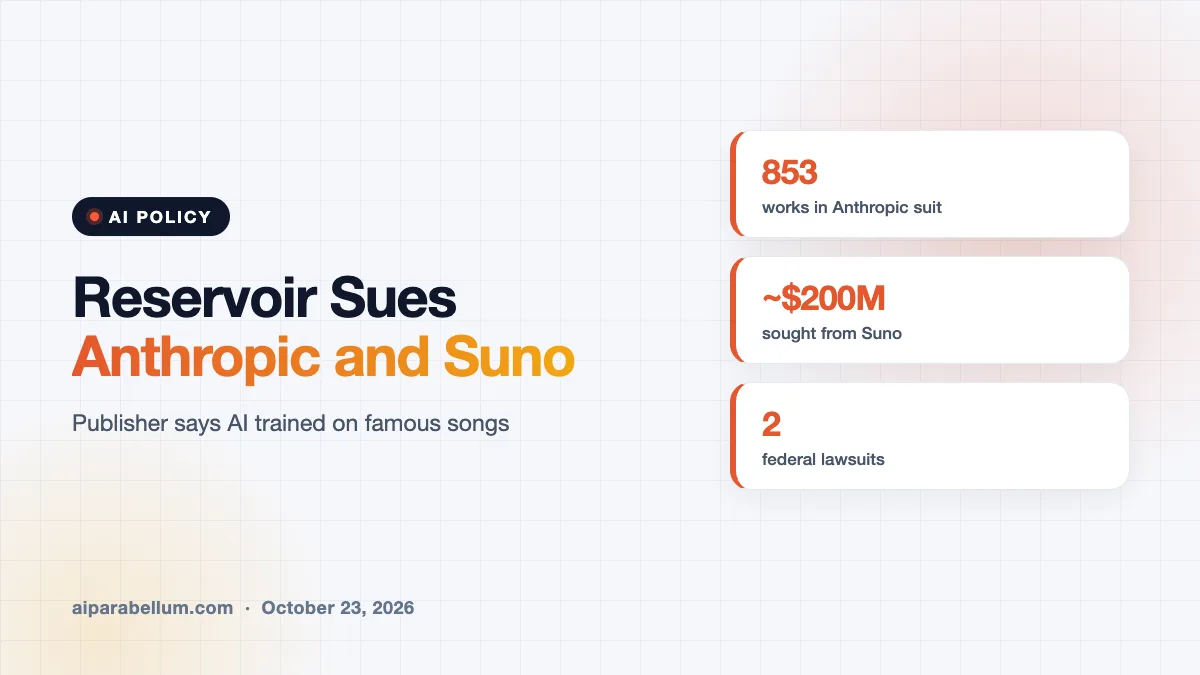
A new Anthropic music lawsuit just landed, and Suno got hit with a matching one on the same day. Reservoir Media, an independent music publisher, says both AI companies copied famous songs by Joni Mitchell, Johnny Cash and Madonna to train their models without permission. Together, the two complaints seek close to $340 million in damages.
The cases were filed on Wednesday, October 21, in the U.S. District Court for the Northern District of California. Each company is named as a defendant in its own suit, and no executives are named personally.
What the Anthropic Music Lawsuit Claims
The complaint against Anthropic, the company behind Claude AI, covers 853 works from Reservoir’s catalog. Reservoir says Anthropic used those songs and lyrics as training data without a license. It argues this was willful infringement, not an accident.
The suit goes beyond basic copyright claims. It also accuses Anthropic of breaking the Digital Millennium Copyright Act (DMCA) in two ways:
- Getting around access controls that protect copyrighted material
- Removing copyright management information, such as author and owner details, from the works
- Copying the songs as part of a willful, large-scale training effort
To support its case, Reservoir leans on public information about AI training datasets. That includes a dataset search tool run by a news magazine that lets people check whether specific works appear in known training collections.
Anthropic’s response
Anthropic pushed back quickly. “We disagree with the allegations and intend to defend this case vigorously,” a company spokesperson said in a statement. This isn’t Anthropic’s first fight with the music business, since it already faces ongoing cases from other music companies.
The Matching Case Against Suno
Reservoir’s suit against Suno follows the same playbook but asks for more money. It seeks nearly $200 million, including $2.63 million for alleged circumvention of access controls and $26.25 million for alleged removal of copyright management information. Suno declined to comment.
The complaint takes aim at Suno’s recent shift toward working with the music industry. Suno settled with Warner Music Group and later signed deals with BMG and Believe. Reservoir argues those licensing deals show a real market for training data already exists, so Suno could have paid for access but chose not to.
Reservoir’s lawyer, Richard Busch, framed Suno’s approach as “infringe now” and settle cheaply later. Universal Music Group and Sony Music are still suing Suno too, along with smaller publishers like Round Hill Music and several groups of independent artists.
Anthropic and Suno Cases Side by Side
| Detail | Reservoir v. Anthropic | Reservoir v. Suno |
|---|---|---|
| Court | N.D. California | N.D. California |
| Filed | October 21, 2026 | October 21, 2026 |
| Works or demand cited | 853 works | Nearly $200 million |
| Main claims | Willful infringement, DMCA violations | Willful infringement, DMCA violations |
| Company response | Will defend vigorously | Declined to comment |
The songs named in the filings include “Big Yellow Taxi,” “Ring of Fire” and “Papa Don’t Preach.” Reservoir also points to tracks by Glenn Miller, Kings of Leon and Evanescence.
Why Music Lawsuits Against AI Keep Growing
AI companies train models on huge piles of existing work, and that habit has sparked lawsuits from authors, artists, movie studios and record labels. The labs say training turns those works into something new, which they argue counts as fair use. Rights holders say it’s copying, plain and simple, and courts haven’t settled the question yet.
Reservoir’s founder and CEO, Golnar Khosrowshahi, said the company supports new technology but will hold AI platforms accountable when creators’ work is used without permission. The music world has been pushing hard on this front lately, from labels chasing AI song uploads to streaming apps adding AI music labels for listeners.
Every new licensing deal an AI company signs makes it harder to argue that paying for training data was never an option.
What This Means for You
If you use Claude or Suno, nothing changes today. Lawsuits like these usually take years, and both services keep running while they play out. Still, it’s worth knowing where things could head.
- Expect more licensing deals. Pressure from cases like this pushes AI companies to pay rights holders, which could shape pricing down the road.
- Watch the fair use rulings. A court decision on AI training could affect every tool you use, not just music apps.
- Be careful with commercial use. If you make songs with an AI music generator, check the tool’s terms on who owns the output before you release anything.
You can follow more updates like this in our AI news coverage.
Sources
The complaints were not posted publicly by either party. Reporting from Billboard, which first reported the lawsuits, and Digital Music News.
Conclusion
Reservoir’s twin lawsuits add Anthropic and Suno to a long list of AI companies accused of training on copyrighted work without paying for it. The Anthropic case covers 853 works, while the Suno case seeks nearly $200 million, and both lean heavily on DMCA claims. Anthropic says it will fight, and Suno isn’t talking yet. For now, the bigger story is the same one playing out across books, film and art: courts still have to decide whether AI training is fair use, and every new case raises the stakes.