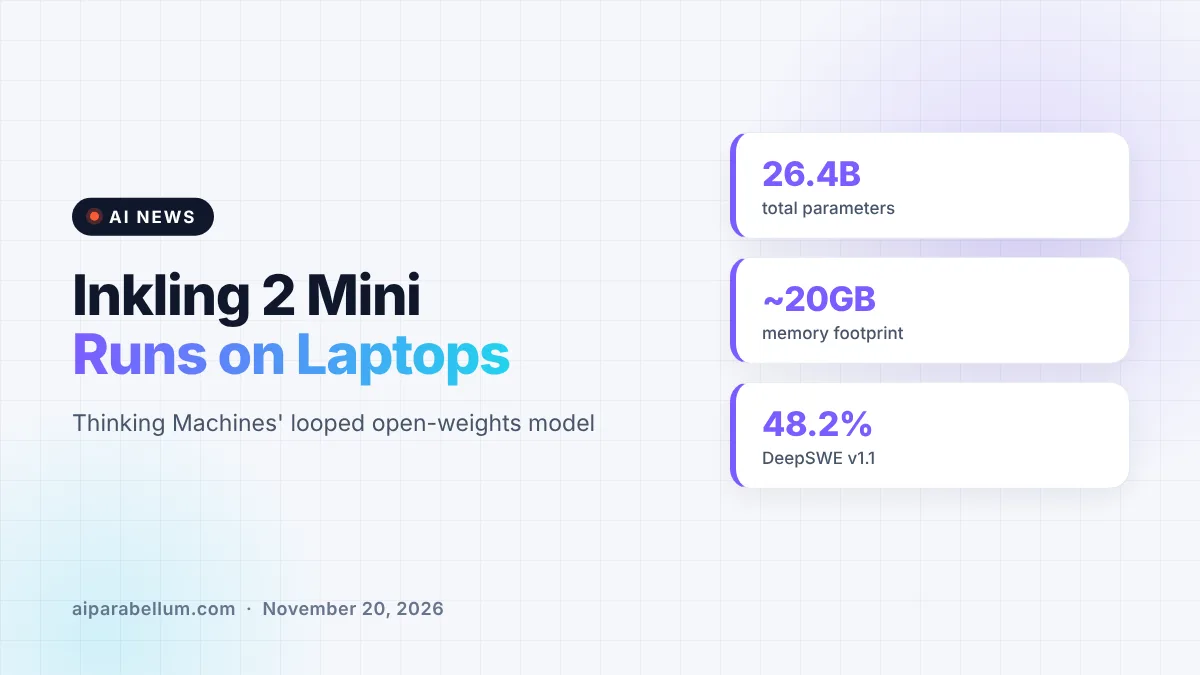
Thinking Machines Lab has released Inkling 2 Mini, a small open-weights AI model designed to run on your own laptop or desktop. The company says Inkling 2 Mini leads every open model under 100 billion total parameters on key agentic coding tests, while fitting in about 20GB of memory. It also uses an unusual “looped” design that runs part of the model three times for every token it writes.
What Inkling 2 Mini Is
Inkling 2 Mini is the smaller sibling of Inkling 2 Small, which the lab released earlier this month. It is a Mixture-of-Experts model with 26.4 billion total parameters, but only 3.4 billion are active for each token. Because some layers run more than once, the company counts about 5.4 billion weight activations per token.
The model accepts text and images and writes text back. The Hugging Face team, which helped with the launch, says it supports a context window of up to 1 million tokens. Full weights are free to download, and the model is also available for inference and fine-tuning on Thinking Machines’ Tinker platform.
Key specs at a glance
| Detail | Inkling 2 Mini |
|---|---|
| Total parameters | 26.4 billion |
| Active parameters per token | 3.4 billion |
| Memory footprint | About 20GB |
| Layers | 24 physical, middle 12 run three times |
| Precision | NVFP4, with the last 4 layers in MXFP8 |
| DeepSWE v1.1 score | 48.2% |
| Minimum Mac memory | 32GB RAM (via Ollama) |
How the Looped Design Works
Most language models push each token through their stack of layers just once. Inkling 2 Mini has 24 layers split into four blocks, and the two middle blocks run three times in a row. The first and last blocks run only once, so the model behaves like a much deeper network without storing extra weights.
The lab’s reasoning is that the middle layers handle more abstract thinking, while the outer layers translate between words and internal ideas. In its tests, looping the middle layers beat looping the last layers on 27 of 28 evaluations. The company also says a looped version needed far less inference compute to match a non-looped model on long agentic tasks.
To shrink the model, the team started with 384 experts per layer and later cut two-thirds of them, keeping the 128 used most often. It then trained on 1 trillion tokens distilled from a larger internal model to recover lost skill. The weights ship in the same 4-bit and 8-bit formats used in training, so there is no extra quantization loss.
Inkling 2 Mini Benchmarks and Weak Spots
Thinking Machines says Inkling 2 Mini scored 48.2% on DeepSWE v1.1 and 46.5% on Vals Index v2.2, ahead of every open model under 100 billion parameters. It also reports strong results on search and tool-use tests such as BrowseComp and MCP Atlas. If you care about local coding models, those agentic scores are the headline.
The company is upfront about limits, too. Looping helps reasoning but does not add stored knowledge, so factual recall is in line with other models of its size. It also trails Qwen3.8-27B on multi-turn chat (50.0% on MultiChallenge) and on following many constraints at once (33.4% on ComplexConstraints v1.1).
- Strengths: agentic coding, search and tool use, long-context tasks, and speed per watt.
- Weaknesses: pure factual recall, multi-turn chat, and instructions with many constraints.
- Efficiency: Stanford researchers measured 0.703 on an intelligence-per-joule test on NVIDIA DGX Spark, versus 0.430 for Qwen3.6-35B-A3B.
A Research Tool for AI Safety
Looped models raise a real safety question. If a model does more thinking inside its layers, less of that reasoning may show up in the written chain of thought that people use to monitor it. Thinking Machines released a second research model, TML-d24-varloop-research, that can run between one and five loops so researchers can study this.
Early results are mixed but reassuring. The research model’s ability to answer without written reasoning grew from 16 seconds of human-task length at one pass to 37 seconds at three. Its chain of thought got shorter with more loops, yet stayed just as readable, and the company saw no clear rise in hidden sabotage tests.
What This Means for You
If you have a recent Mac with 32GB of RAM or more, you can run Inkling 2 Mini offline today through Ollama. It is also supported in llama.cpp, MLX, vLLM, SGLang and Unsloth, so most local AI setups should handle it. This fits a wider push toward local AI agents that keep your data on your own machine.
- Try it for coding help and agent tasks, where it is strongest.
- Pair it with web search or tools when you need accurate facts.
- Compare it against its bigger sibling, Inkling 2 Small, if you have server hardware.
- Watch for other small on-device models before you commit to one.
As with any company benchmark, test it on your own work before switching. You can follow more model launches on our AI news page.
Sources
Primary source: Thinking Machines’ Inkling 2 Mini announcement. Additional details from Hugging Face and the Inkling 2 Mini model card.
Conclusion
Inkling 2 Mini shows that a small open model can punch above its weight by reusing its own layers. It brings strong coding and agent skills to a laptop-sized package, though it still leans on search for facts and lags in chat. The bundled research model also gives the safety community a rare way to study how looping affects AI oversight. For anyone building with local AI, it is one of the most interesting releases of the month.