Recursive, the startup led by former Salesforce chief scientist Richard Socher, has released Flint, an open-weight coding model built to run locally on a laptop. The company says its own automated research system, called the Eureka Machine, shaped nearly every step of building the model. That makes Flint one of the first public tests of recursive self-improvement, the idea of using AI to build better AI.
What the Flint Coding Model Is
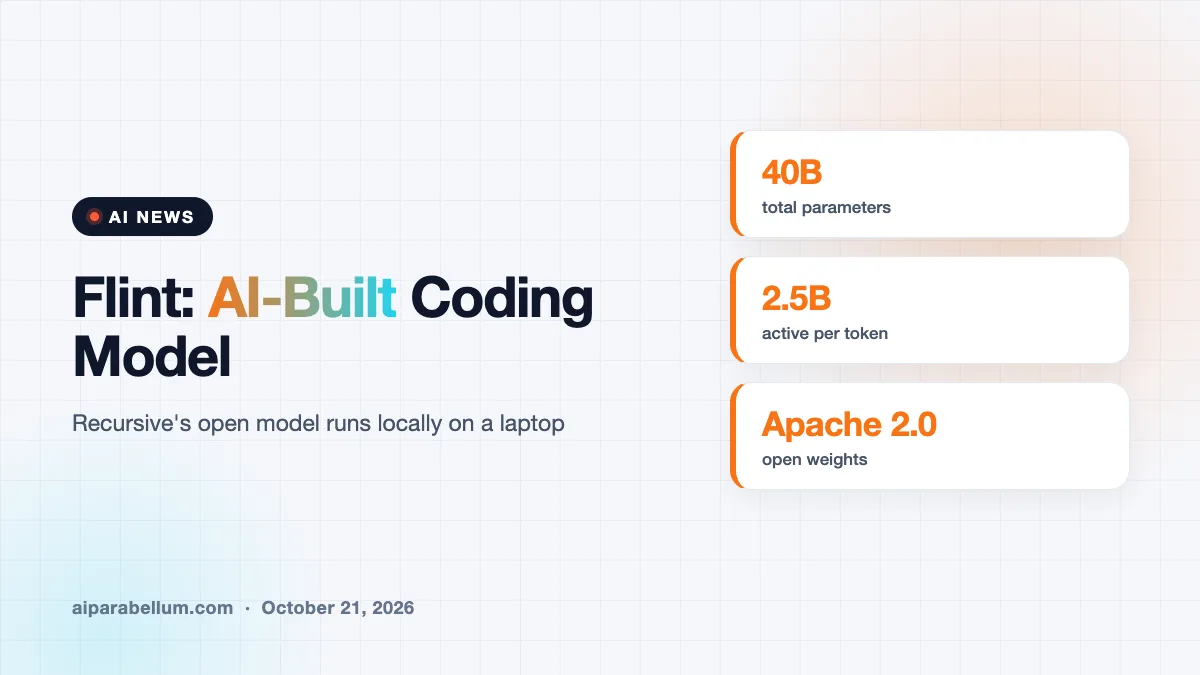
Flint is a mixture-of-experts model with about 40 billion total parameters. Only about 2.5 billion of those are active for each token it produces, which is why it can run fast on consumer hardware. Recursive says a small team of people and AI agents built it from scratch in under four months.
The weights are free to download under the Apache 2.0 license. That means developers can run Flint offline, keep their code on their own machine, and adapt the model for their own products without paying API fees.
Key specs at a glance
| Detail | What Recursive reports |
|---|---|
| Model type | Mixture-of-experts, built for agentic coding |
| Total parameters | About 40 billion |
| Active per token | About 2.5 billion |
| Context window | Up to 512K tokens (256K recommended) |
| Speed | 125+ tokens per second on an M4 Pro MacBook Pro |
| License | Apache 2.0, open weights |
| Build time | Under four months |
How Flint Performs on Coding Tasks
Recursive says Flint leads all mixture-of-experts models under 50 billion total parameters on agentic coding benchmarks. Its model card lists a score of 74.2% on SWE-bench Verified and 54.9% on Terminal-Bench 2.1. These are company-reported numbers, and setups vary between labs, so independent testing will matter.
The company also claims Flint matches dense models of 25 to 40 billion parameters on coding while running more than five times faster. On an NVIDIA RTX Spark with 64GB of memory, it says Flint tops 150 tokens per second at short contexts.
Early hands-on impressions are positive. A reporter who tested Flint on a Mac with 48GB of RAM said it handled every coding request quickly, including a command-line to-do app and a small website. Recursive itself is more cautious, noting the model may need clearer instructions than larger closed models for complex jobs.
Recursive Self-Improvement Behind the Model
The bigger story is how Flint was made. Recursive says the Eureka Machine proposes ideas, writes the code to test them, checks the results, and decides what to try next, running many experiments in parallel.
According to the company, the system helped in several areas:
- Architecture: it tested expert layouts and settled on the 40B total, 2.5B active design.
- Quantization: it found a way to shrink the model to 4-bit precision while staying within 0.7 points of the full model on benchmarks.
- Kernels: it wrote custom code tuned for Apple Silicon and NVIDIA RTX Spark chips.
- Training: it worked on data, optimizers, and training recipes.
Socher says the system that built Flint cannot escape human control, and that any future fully self-improving version would still be overseen by people who can stop it. Recursive has raised $650 million at a $4.65 billion valuation, with backers that include Google Ventures, Nvidia, and AMD Ventures, according to the WIRED report.
Why the idea is controversial
Recursive self-improvement worries some AI safety experts, who fear a system that keeps upgrading itself could slip out of human control. Several bills in Congress have proposed limits on the practice. Recursive argues those fears are overblown and that the approach can make strong AI cheaper and more widely available.
What This Means for You
If you write code, Flint is one more sign that capable coding assistants no longer need the cloud. Here is what to keep in mind:
- Local and private: you can run it on a well-equipped laptop, so your code never leaves your machine.
- No API bills: the open license lets you use and adapt it for free.
- Familiar tools: Recursive says it works with llama.cpp, Ollama, LM Studio, vLLM, and SGLang.
- Check its work: like any model, it can write buggy or unsafe code, so review changes before you ship them.
If you are new to running models at home, our look at RTX Spark hardware explains the kind of machine that helps. Flint joins other small, efficient releases such as Liquid AI’s on-device agent model and the Mercury 3 model.
For bigger projects, cloud tools are still strong options, and our guide on coding with Claude shows how to get started. You can follow more releases like this on our AI news page.
Sources
Primary source: Recursive’s Flint announcement. Additional details from the Flint model card on Hugging Face and reporting from WIRED.
Conclusion
Flint gives developers a fast, free coding model that runs on their own hardware, and it doubles as a public test of AI helping to build AI. Recursive’s benchmark claims still need outside confirmation, but early hands-on results look promising. The release also adds fuel to the debate over recursive self-improvement, which lawmakers are already watching. For now, the practical upside is simple: strong local coding help just got easier to try.