Google has officially launched Gemini 4 Neon, a new member of its Gemini 4 family that aims to deliver near top-tier intelligence at much higher speed and lower cost. The company says Gemini 4 Neon is built for complex coding, analysis and long-running agent work, and it is available today in the Gemini app, for businesses and in Google Antigravity.
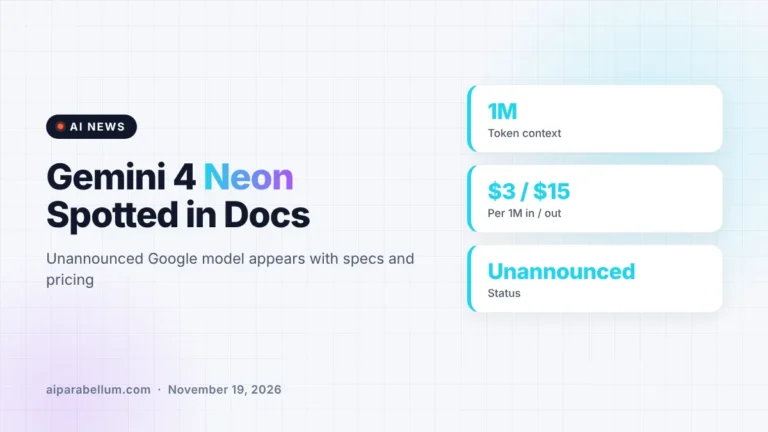
The launch comes just hours after the model name showed up in Google’s developer documentation. Now Google has filled in the details: pricing, benchmarks, safety results and where you can actually use it.
What Gemini 4 Neon Is
Gemini 4 Neon sits between Google’s other Gemini 4 models. According to Google, Carbon handles the hardest long-horizon projects, Hydrogen covers fast everyday tasks, and Neon is meant to balance depth with efficiency.
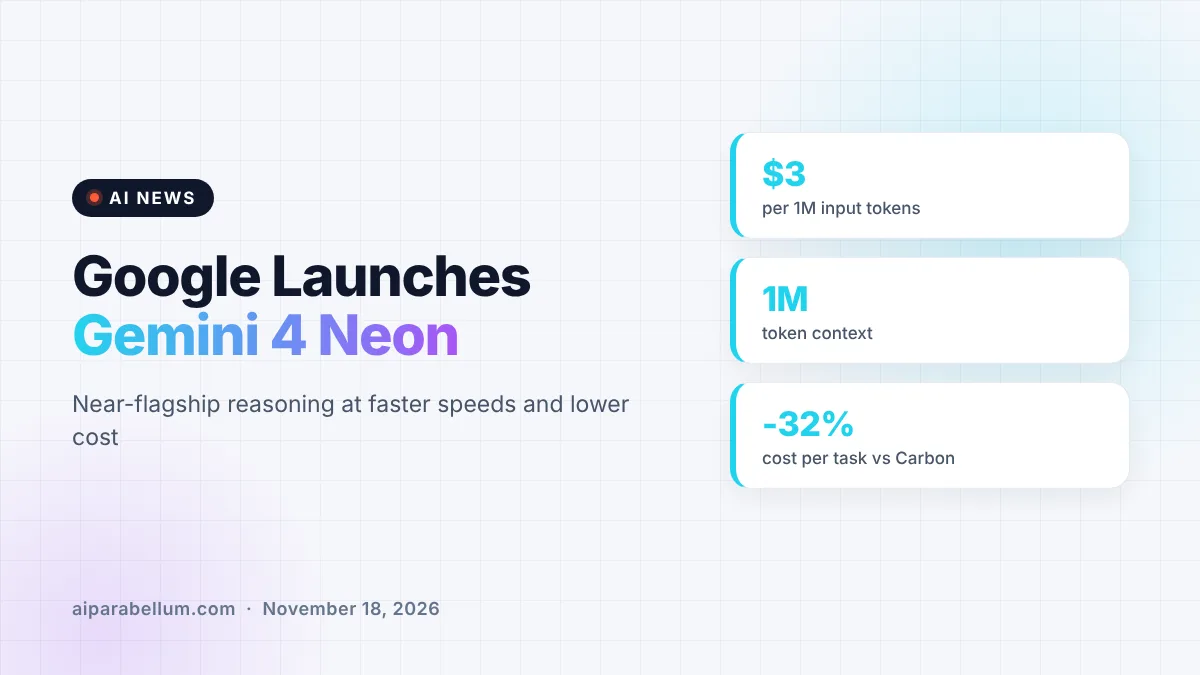
Google describes it as frontier-level reasoning for complex, high-frequency workflows, delivered faster and at a lower cost than its larger models. It can take in text, images, audio and video, and it works within a 1 million-token context window.
That large window matters for real business work. Google says Neon can pull together spreadsheets, PDFs, charts, audio and video in one go and turn them into structured reports.
Four Thinking Levels
Neon offers four thinking levels, so teams can trade intelligence for token spend depending on the job. Its default setting is “high,” while “xhigh” adds deeper multi-step reasoning for the toughest tasks.
Google says that at the default level, Neon costs 32% less per task than Carbon. At xhigh, the company claims it still costs at least 36% less per task than competing models at their highest settings.
Gemini 4 Neon Pricing and Benchmarks
The model is priced at $3 per million input tokens and $15 per million output tokens. Cached input drops to $0.15 per million tokens, a 95% discount that helps apps reusing the same long prompts.
Google is leaning heavily on independent leaderboards to make its case. Here are some of the results the company highlighted:
| Benchmark | Neon Result (Google’s Figures) |
|---|---|
| Artificial Analysis Intelligence Index (xhigh) | Score of 61, #3 overall |
| Artificial Analysis Coding Agent Index | 58.6, #1 overall |
| Vals Index | 70.9%, #2 |
| Agent Arena Index | 1336, #2 globally |
| Terminal-Bench 4.1 | 65.2% |
| Vending-Bench 2 | $16,843, #1 |
| SEC-bench Pro (finding vulnerabilities) | 90.5% |
Keep in mind these are the company’s own selected numbers. Real-world results will vary, and independent testing over the coming weeks will show how Neon holds up.
How It Compares on Price
Neon costs twice as much as Hydrogen, according to reporting on the launch. Argon and Carbon are on promotional pricing of $2 input and $10 output until November 30, after which they move to $4 and $20, which would make Neon 25% cheaper than those models.
Built for Coding Agents and Cyber Defense
Google says Neon was engineered for long agent sessions that use lots of tools. It can work alone or act as an “orchestrator” that directs parallel Hydrogen subagents inside Google Antigravity, the company’s agent-first coding platform.
The company also says Neon makes fewer redundant file reads, shares progress as it goes and handles context compaction reliably in long sessions. If you have tried an AI coding assistant that loses track halfway through a big refactor, that last point is aimed squarely at you.
A separate version, Gemini 4 Neon for cyber, will roll out to trusted defenders in the coming days through Google’s Fairwind Program. It follows the earlier Carbon cybersecurity launch and focuses on finding, validating and patching code vulnerabilities.
Safety Results Google Reported
Because Neon brings strong capabilities to a cheaper, faster model, Google says it paired it with real-time safeguards against cyber and biosecurity misuse comparable to Carbon’s. The company reports Neon refused just 1.98% of tasks on Terminal-Bench 4.0, meaning it declines far less legitimate work.
Other figures Google shared include:
- A 0.09% misaligned action rate on its agentic safety suite.
- A 99.2% pass rate on its agent honesty evaluation.
- Shortcuts on just 2.45% of tasks in its coding cheating test, the lowest of any Gemini 4 model.
- A 0.0% attack success rate on Gray Swan’s prompt injection benchmark at its highest thinking level with safeguards on.
Google says it recorded its lowest fabrication rate yet in internal testing. Fewer made-up results is good news for anyone relying on AI for research or reports.
What This Means for You
If you use the Gemini app, you may notice faster, more capable answers on harder questions. Google says Tasks in Gemini can now run on Neon, which builds on the recent Gemini task mode for multi-step chores like checking bills or receipts.
- Developers building agents should test Neon against Carbon, since Google claims similar quality at lower cost per task.
- Teams with long, repeated prompts can save a lot with the 95% cached input discount.
- Businesses can pick Neon in Gemini for business through the API or model drop-down.
- Security teams should contact their Google Cloud account team about Fairwind Program access.
For more on how Google has been building out this model family, see our coverage of Gemini 4 Hydrogen and the Argon launch. You can also follow every update on our AI news page.
Sources
Primary source: Google DeepMind’s Gemini 4 Neon announcement. Additional reporting from 9to5Google.
Conclusion
Gemini 4 Neon is Google’s bid to bring near-flagship intelligence to a faster, cheaper tier. At $3 per million input tokens with a 1 million-token context window, it targets developers and businesses running heavy agent and coding workloads. The benchmark claims are impressive, but they come from Google’s own selection of results. The next few weeks of hands-on testing will show whether Neon really delivers Carbon-level quality at a lower price.