Google has released Gemini 4 Hydrogen, a faster and cheaper member of its Gemini 4 family that is rolling out today across Google Search, the Gemini app, and the developer API. Google says the new model edges past its own Gemini 4 Argon on a popular intelligence index while costing $1.50 per million input tokens. It replaces the old “Flash” naming and is aimed at everyday work, from quick questions to routine coding jobs.
What Gemini 4 Hydrogen Is
Hydrogen is the speed-focused tier of Gemini 4. Google already offers Argon and Carbon as its heavy frontier models, and Hydrogen is meant to handle the large volume of everyday tasks that do not need the biggest model.
Google DeepMind describes it as a model that can stand on its own or act as a fast “execution engine” next to Carbon and Argon. In practice, that means a bigger model can plan the work while Hydrogen writes code, runs tests, and checks results.
The headline numbers
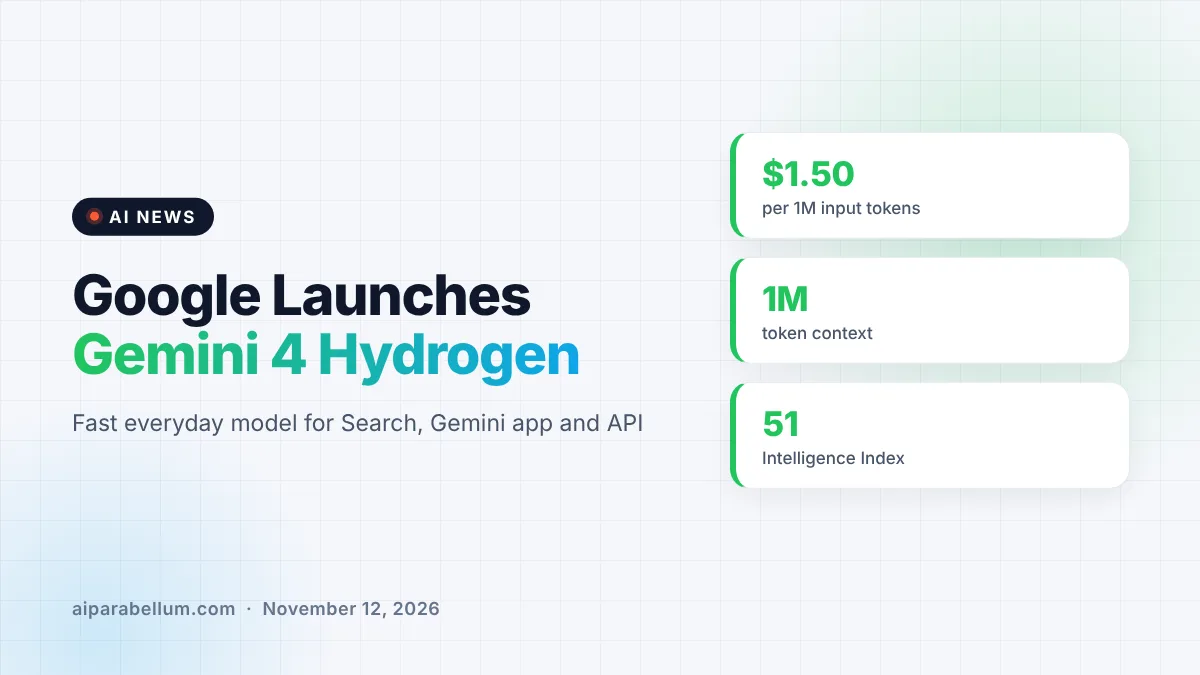
According to Google, Hydrogen scores 51 on the Artificial Analysis Intelligence Index at its default “high” thinking level, compared with 50 for Argon. At its new “xhigh” setting, Google says it reaches 54.
| Detail | What Google says |
|---|---|
| Input price | $1.50 per million tokens |
| Output price | $7.50 per million tokens |
| Context window | 1 million tokens, priced flat across the window |
| Thinking levels | Low, medium, high (default) and a new xhigh |
| Intelligence Index | 51 at high, 54 at xhigh (Argon: 50) |
| Terminal-Bench 4.1 | 57%, up from 18.2% for Gemini 3.8 Flash |
Gemini 4 Hydrogen Comes to Google Search
The biggest consumer change is in Search. Google calls this the biggest model upgrade to Search yet, and it is available globally for all users starting today.
Google says Hydrogen helps Search understand long, multi-part questions, even ones with typos or very specific requirements. It also says the model upgrades the “query fan-out” technique, which runs several related searches at once to surface a wider range of websites. If you follow how AI answers affect publisher traffic, that linking change is worth watching.
- Better handling of complex, multi-part questions in natural language
- More visual answers, including comparison tables, images and custom tools
- A broader set of links from simultaneous background searches
- More nuanced answers across all supported AI Mode languages
What Changes in the Gemini App
In the Gemini app, Hydrogen appears in the model picker as the option for everyday help. Google says it follows your tone and formatting rules more closely, so drafts and study guides need fewer rewrites.
The company also says Hydrogen calls the right tools more often, pulling context from Gmail, Google Drive and connected apps like Airtable and Dropbox. Free users will get it through automatic model selection when Gemini decides it is the right fit for a prompt.
Gemini 4 Hydrogen for Developers and Businesses
For developers, Google is positioning Hydrogen as a big step up from Gemini 3.8 Flash. The company claims it finishes tasks 2.5 times faster at its default setting and cuts fabricated claims by more than five times.
Google is also adding a feature called Orchestrator to its Antigravity coding tool. Orchestrator switches between Carbon and Hydrogen inside one session, and Google says it reached near-Carbon success on Terminal-Bench 4.0 while using 24% less quota and finishing 19% faster.
Where you can use it
- Google Search, for all users globally
- The Gemini app, including automatic selection for free users
- The Gemini API and Gemini for business
- Google Antigravity and Gemini in Google Sheets for eligible business plans
Safety Claims Behind the Launch
Google says Hydrogen uses the same safety stack as the rest of Gemini 4. The company reports that it cuts misaligned actions and task shortcutting in tool-use and coding tests by 12 times compared with 3.8 Flash.
Google also says the model is more than 2.3 times more resilient against indirect prompt injection attacks on the Gray Swan benchmark. These are company-reported results, so independent testing will matter, much like the scrutiny that followed the Argon safety report.
What This Means for You
If you use Google Search, you do not need to do anything; the upgrade is already rolling out. Try asking a longer, more detailed question than usual and see whether the answer and the links improve.
- Gemini app users can pick Hydrogen for quick everyday tasks and save heavier models for hard problems.
- Developers on 3.8 Flash should test Hydrogen, but note the higher price tier before moving big workloads.
- Teams already using Gemini 4 Carbon can try Orchestrator to cut costs on routine coding steps.
- Treat benchmark claims as a starting point and run your own tests.
How Hydrogen Fits the Gemini 4 Lineup
Hydrogen completes a quick run of Gemini 4 releases that started with the Argon launch and continued with Carbon reaching developers this week. Google’s bet is that most people do not need the most powerful model for most tasks, and a fast, capable default matters more for everyday use.
You can follow every release in this race on our AI news page, or compare options in our list of research AI tools.
Sources
Primary source: Google DeepMind’s Gemini 4 Hydrogen announcement. Additional details from Google’s Search announcement and reporting from 9to5Google.
Conclusion
Gemini 4 Hydrogen is Google’s attempt to bring near-frontier performance to the tools people use every day, starting with Search. The company claims it beats Argon on one key index while costing far less, and it is already live for everyone. Those numbers come from Google, so real-world testing will decide how good it is. For now, it is the model most Google users will meet first.