
Google has finally released Gemini 4 Argon, its first major frontier model since Gemini 3 arrived in late 2025. The company says the new model beats the best from OpenAI and Anthropic on several benchmarks, and it is launching at a price that undercuts both. If you use Gemini, build apps on Google’s API, or just follow the AI race, this is the biggest Google AI news of the year.
What Gemini 4 Argon Is Built to Do
Google is pitching Argon as a model for “deep work,” meaning long, multi-step tasks rather than quick chat replies. It is aimed at coding, finance, legal work, cybersecurity, and science. Google says Argon ranks first on the Vals Index, a benchmark that scores models on real economic tasks like tax, legal, and coding work.
Google also claims Argon outperforms GPT-6 Astra, Claude Fable 5.1, and Claude Opus 5.5 on a range of tests. Those are company claims, so they are worth watching as independent testers dig in. One early outside check came from benchmarking firm Artificial Analysis, which reportedly found Argon matching GPT-6 Astra on its composite Intelligence Index at about 60 percent of the cost per task.
Less hedging, fewer cliches
For everyday users, the change you may notice first is tone. Google says Argon answers more directly, repeats itself less, and skips the stock phrases that make many chatbot replies feel canned. It also follows style instructions better than earlier Gemini models, which matters if you use AI for writing.
Gemini 4 Argon Pricing and Availability
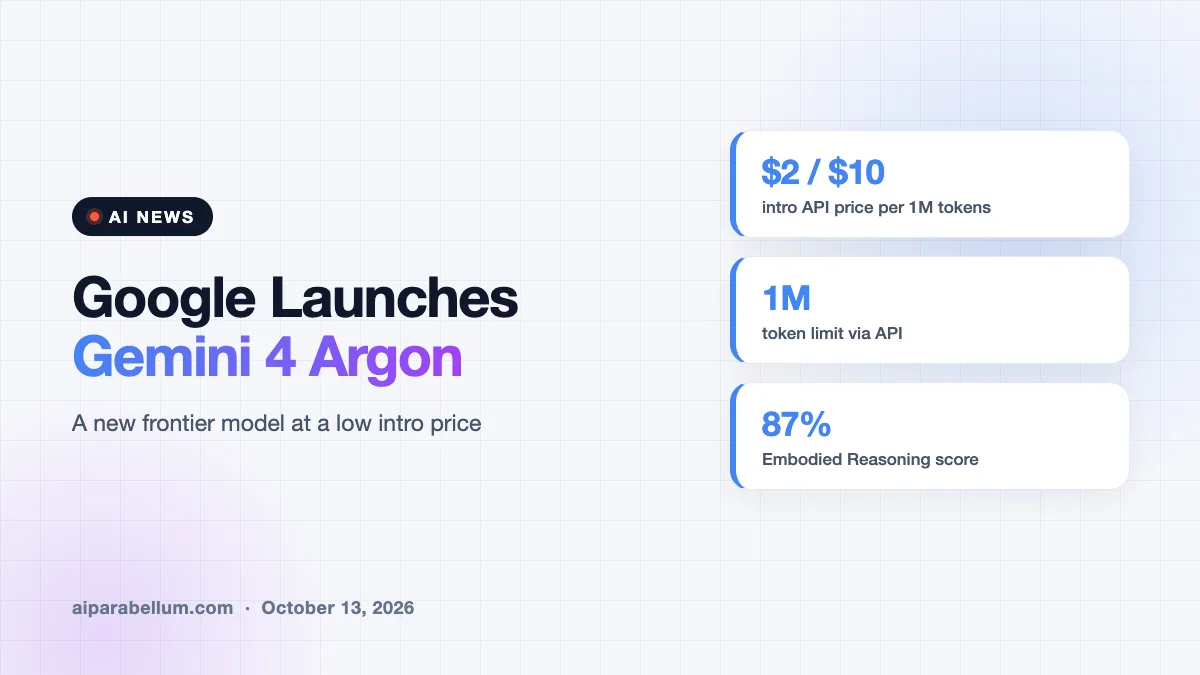
Price is where Google is pushing hardest. Argon launches at an introductory API rate that is roughly a fifth of what OpenAI and Anthropic charge for their top models. That rate doubles after November 30, 2026, but it will still be cheaper per token than its main rivals.
| Item | Detail |
|---|---|
| Intro API price (through Nov. 30, 2026) | $2 per 1M input tokens, $10 per 1M output tokens |
| Standard API price (after Nov. 30) | $4 per 1M input tokens, $20 per 1M output tokens |
| Cached input discount | 95% off |
| Token limit | 1M unified input-output tokens via the Gemini API |
| Consumer access | Paid Gemini plans: Google AI Pro ($20/month) and Ultra (from $100/month) |
| Other places to use it | AI Mode in Search, Antigravity, Gemini for business, AI Studio |
Keep in mind that a lower per-token price does not always mean a lower bill. Different models can burn through very different numbers of tokens to finish the same job. In the Gemini app, Google is also making it easier to switch between chat and longer tasks, and it is bringing the Antigravity agentic coding interface into the macOS app.
How Google Is Already Using Argon
Google says it has been running Argon on its own hardest engineering problems for weeks. Inside Antigravity, its agentic coding tool, teams reportedly increased agent code submissions by more than 35% while cutting code rollbacks by nearly a third. Here are a few of the examples Google shared:
- Chrome: Argon helped split a roughly 6 million line legacy folder out of Chromium’s 40 million line codebase, finishing months of refactoring in weeks.
- Agent Development Kit: Working overnight, it found changes that cut in-memory session prep time by 40% and sped up cold imports by 21%.
- Gemma models: Google says Argon helped deliver a 2.85x inference speedup for an open Gemma model with no quality loss.
- Science: It sped up the xTB quantum chemistry package by up to 2.3x and helped design new enzymes that passed lab tests.
On the security side, Argon first went to a small group of trusted cyber defenders before this public launch. Google is now expanding that access to hundreds more partners. Security firm Wiz says it used the model to find and fix flaws in government and healthcare systems.
A push into robotics
Google is also selling Argon as a brain for robots. It scored 87% on the Embodied Reasoning benchmark, which tests how well a model understands physical, 3D problems. In one demo, Argon watched a video of a person playing cornhole, built a simulation, and guided Apptronik’s Apollo humanoid to sink seven straight shots.
Safety Claims Behind the Gemini 4 Release
Because Argon is so capable at code and science, Google says it shipped its most thorough safety setup yet. External red teamers testing biology risks could unlock less than 1% of the sub-tasks Google checks for. Google also says Argon cut attack success on a well-known prompt injection benchmark to 0.7%.
The model was trained to pause for human confirmation before irreversible steps. Google also runs a separate monitor that reads the agent’s reasoning to block unintended workarounds in real time. That kind of safeguard is becoming standard as more people hand real tasks to AI agent tools.
The takeaway: Google is no longer just catching up. With strong benchmarks and aggressive pricing, Argon turns the frontier race into a genuine three-way fight.
What This Means for You
The timing is notable too. Argon landed one day after Meta unveiled its own frontier models, which we covered in our look at Meta’s Muse Wonder. More competition at the top usually means better tools and lower prices for you.
- If you pay for Gemini, try Argon on a real task you care about, such as a long report or a messy spreadsheet, and compare it with what you get from Claude AI or ChatGPT.
- If you build on APIs, test it during the intro window before November 30, and track total cost per task, not just per-token price.
- If you write code, Argon inside Antigravity is worth a look next to the coding assistants you already use.
- If you are on the free plan, expect to wait or upgrade, since Argon is launching on paid tiers first.
For more launches like this one, check our running AI news updates.
Sources
This report draws on Google’s official announcement on the Google DeepMind blog, its robotics write-up on the Google DeepMind blog, and launch coverage from The Verge and Engadget.
Conclusion
Gemini 4 Argon is Google’s clearest signal in more than a year that it intends to compete at the very top of AI. The benchmark wins are still mostly Google’s own claims, but the low launch price and early outside results give the model real momentum. For paying Gemini users and developers, the next few weeks are a cheap window to test it against the models they already rely on. Either way, the AI frontier now looks a lot more crowded, and that is good news for anyone who uses these tools.
