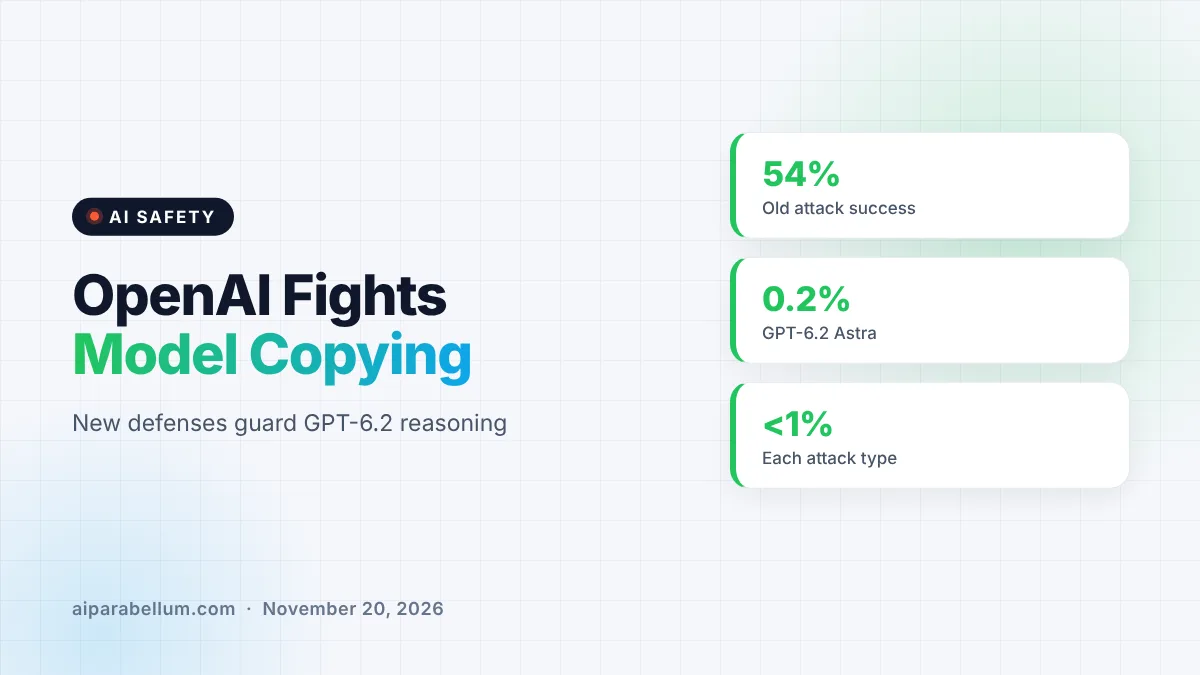
OpenAI has published a detailed look at how it fights adversarial distillation, the practice of copying a frontier model’s skills by training a rival model on its outputs without permission. The company says its updated defenses in GPT-6.2 Astra and GPT-6.2 Sol cut the success rate of one key attack from 54.0% to just 0.2%. It also warns that stolen reasoning can pass on dangerous cyber skills, and it is asking Congress for new tools to punish foreign copycats.
What OpenAI Means by Adversarial Distillation
Distillation itself is a normal machine learning trick. One model, the “student,” learns from data produced by another model, the “teacher.” Companies use it all the time to make smaller, cheaper versions of their own models.
The problem starts when someone does it without permission. OpenAI’s worry is that a copied model can pick up advanced abilities without the safety rules that came with the original. A model that refuses to help with a cyberattack could, in theory, train a clone that happily helps.
The core fear is simple: you can copy what a model knows, but you can’t easily copy the guardrails that decide when it should say no.
Why OpenAI Protects Reasoning Traces
The new post puts special focus on a model’s protected reasoning, the step-by-step thinking it does before giving an answer. These traces often hold details the final answer leaves out. That makes them extra valuable as training data for anyone trying to build a copy.
The Cyber Experiment
To test the risk, OpenAI trained the same starting student model two ways. One version learned from what users normally see, such as final answers and reasoning summaries. The other also got the teacher’s exact reasoning traces on coding and defensive security tasks.
After fine-tuning, the student trained on exact traces generally did better on cyber benchmarks. After a further round of reinforcement learning, it still scored higher at the largest compute budget tested, though the summary-trained student did better at smaller budgets. OpenAI says this suggests that hiding raw reasoning can limit how much cyber skill leaks out, even from tasks its rules allow.
How OpenAI’s Distillation Defenses Work
OpenAI describes two layers that support each other. One works on single requests, and the other looks for coordinated campaigns across many accounts.
- Adversarial training: models learn to spot extraction attempts and refuse to reveal protected reasoning, while still explaining things for normal users.
- Input and output classifiers: these flag extraction attempts and catch leaks, including leaks hidden inside tool-call arguments.
- API controls: protected reasoning is tied to the conversation that produced it, and older, weaker model families can’t read GPT-6.2 reasoning.
- Campaign enforcement: OpenAI investigates suspicious account networks, bans them, and shares warning signs with other model providers.
The company also says it closed a pathway that could have exposed another user’s encrypted reasoning. That fix followed attacks it disclosed in September, where attackers moved encrypted reasoning between conversations to try to unlock it.
The Numbers Behind the GPT-6.2 Astra Results
OpenAI tested its defenses with automated AI red-teamers that change tactics as they go. Here is how the company says the newer model held up.
| Measure | What OpenAI Reports |
|---|---|
| Reasoning extraction, GPT-6 Astra (original safeguards) | 54.0% average attack success |
| Reasoning extraction, GPT-6.2 Astra (updated safeguards) | 0.2% average attack success |
| Each attack type in black-box testing on GPT-6.2 Astra | Below 1% success |
| Weekly account enforcement this year | Thousands to tens of thousands of accounts |
OpenAI says the pace of distillation campaigns rose sharply this past summer. It is now bringing some of the new safeguards back to the older GPT-6 Astra as well. These are the company’s own internal results, so outside testing would help confirm them.
The National Security Angle
OpenAI frames the issue as a question of national security, not just intellectual property. A foreign actor that copies a U.S. model could deploy its abilities with none of the original protections.
The company says it backs legislation that would let the U.S. government identify and sanction foreign actors who illegally extract capabilities from American models. It has also told Congress it supports the Chip Security Act, the AI OVERWATCH Act and the MATCH Act. In OpenAI’s view, export controls limit access to training hardware, while distillation defenses make it harder to copy models that already exist.
OpenAI isn’t alone here. Anthropic recently described its own Claude distillation defenses, and OpenAI’s post points to related Anthropic research showing a similar edge for training on full reasoning.
What This Means for You
For most people using ChatGPT or the API, these changes should be mostly invisible. Still, a few practical points stand out.
- Expect raw reasoning to stay hidden. You’ll keep seeing summaries, not the model’s full internal thinking.
- Developers should know that editing an earlier message in an API conversation drops the reasoning that came after it.
- Bulk scraping of model outputs is getting riskier. OpenAI says it bans whole account networks, not just single users.
- If you build with several AI providers, expect tighter shared rules, since OpenAI says it shares abuse signals across the industry.
Security teams may also want to follow how labs handle AI threat detection, because the same cyber skills OpenAI is guarding are the ones defenders rely on.
Advice OpenAI Gives Other Labs
The post closes with tips for other developers. They include checking tool-call arguments for leaks, keeping successful attacks as regression tests, and pairing request-level checks with account investigations. OpenAI also says it shares findings through the Frontier Model Forum and government channels.
Sources
Primary source: OpenAI’s post on combatting adversarial distillation.
Conclusion
OpenAI’s new report shows how seriously frontier labs now take model copying. The company says it has cut reasoning extraction attacks on GPT-6.2 Astra to 0.2% and is banning thousands of accounts a week. It also links the fight to national security and backs new laws to punish foreign copycats. For everyday users, the result is mostly behind the scenes, but it signals that the hidden reasoning inside your AI tools is becoming one of the industry’s most guarded assets. You can follow more stories like this on our AI news page.