
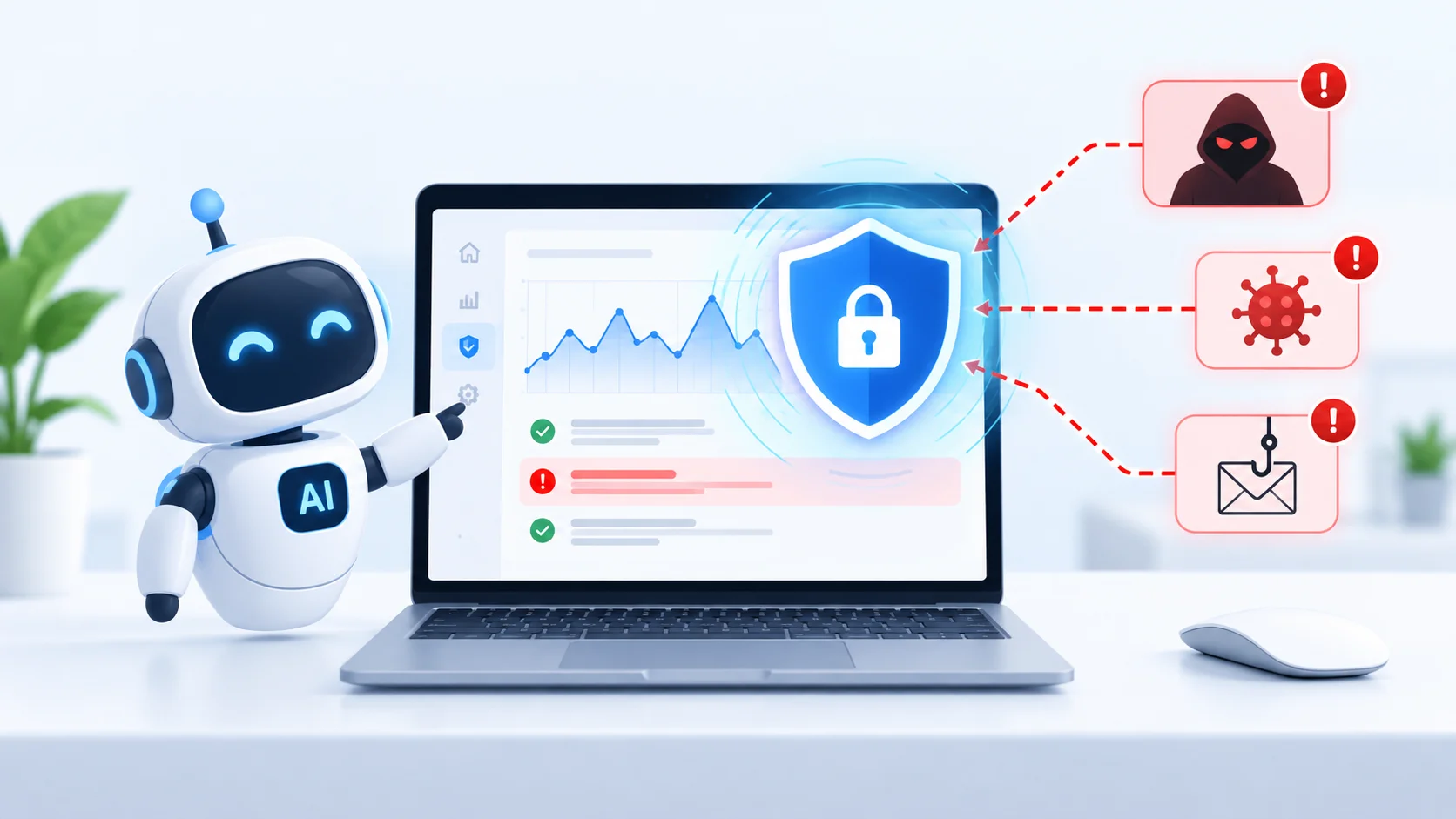
Cyberattacks are getting faster, smarter, and harder to catch. Traditional security tools rely on known threat signatures and predefined rules to identify attacks. The problem is that new threats do not follow old patterns. By the time a signature is written for a new type of malware or phishing attack, the damage is already done.
AI changes the equation by detecting threats based on behavior rather than signatures. Machine learning models analyze billions of data points across your network, learn what normal activity looks like, and flag anything that deviates from that baseline. This means AI can catch zero-day exploits, insider threats, and sophisticated phishing campaigns that slip past conventional defenses entirely.
Here is how to use AI for cybersecurity threat detection, which tools and techniques are leading the field, and how organizations of every size can implement AI-driven security today.
How AI Threat Detection Works
AI-powered cybersecurity systems operate on a fundamentally different principle than traditional tools. Instead of matching known bad signatures, they build behavioral models of what normal looks like for your specific environment and then identify anomalies that could indicate an attack.
The process starts with data collection. AI security platforms ingest logs from firewalls, endpoints, email servers, cloud services, network traffic, and user authentication systems. This data feeds into machine learning models that establish behavioral baselines for every user, device, and application on the network.
Once the baseline is established, the AI continuously monitors all activity against it. A user who normally logs in from New York at 9 AM suddenly accessing sensitive databases from Eastern Europe at 3 AM triggers an alert. A server that typically sends 50 MB of data per hour suddenly transmitting 5 GB raises a flag. These anomalies might not match any known threat signature, but the behavioral deviation signals that something is wrong.
According to IBM’s Cost of a Data Breach Report, organizations using AI and automation in their security operations identified and contained breaches 108 days faster than those without, saving an average of $3.05 million per breach.
The most dangerous threats are the ones nobody has seen before. AI does not need to have seen an attack to detect it. It only needs to recognize that something is not normal.
Types of AI-Powered Cybersecurity Detection
AI applies to multiple layers of cybersecurity, each addressing different attack vectors and vulnerability types.
| Detection Type | What It Monitors | Threats It Catches |
|---|---|---|
| Network traffic analysis | Data flows between devices and servers | Data exfiltration, lateral movement, C2 communication |
| Endpoint detection | Individual devices and workstations | Malware, ransomware, fileless attacks |
| User behavior analytics | Login patterns, access habits, file usage | Insider threats, compromised credentials |
| Email security | Inbound messages and attachments | Phishing, spear phishing, business email compromise |
| Cloud security | Cloud workloads and configurations | Misconfigurations, unauthorized access, data leaks |
| Vulnerability management | Software and infrastructure weaknesses | Unpatched systems, exploitable configurations |
Each detection layer works independently but shares intelligence with the others. When the email security system detects a phishing attempt, it alerts the endpoint detection system to watch for malware execution on the targeted user’s device. This interconnected approach creates a security mesh that is far more effective than isolated tools. Understanding how AI threat detection and response tools work provides the foundation for implementing these systems effectively.
AI Techniques Used in Cybersecurity
Several distinct AI and machine learning techniques power modern threat detection, each suited to different aspects of cybersecurity.
Supervised Learning for Known Threat Classification
Supervised learning models train on labeled datasets of known malware, phishing emails, and attack patterns. These models classify new data by comparing it to what they learned from historical examples. They are highly accurate for threats that resemble known attack types and serve as the first line of defense in most AI security platforms.
The limitation of supervised learning is that it requires labeled training data. It excels at catching variations of known threats but struggles with completely novel attack techniques.
Unsupervised Learning for Anomaly Detection
Unsupervised learning does not need labeled examples. Instead, it learns the normal patterns of network activity, user behavior, and system operations, then flags anything that falls outside those patterns. This is the technique that catches zero-day attacks and advanced persistent threats that have never been documented.
The challenge with unsupervised learning is false positives. Not every anomaly is a threat. A developer working late on a deadline might trigger the same behavioral alerts as a compromised account. Effective AI security systems combine unsupervised detection with contextual analysis to reduce false positive rates.
Deep Learning for Complex Pattern Recognition
Deep learning neural networks analyze complex, multi-dimensional data to identify subtle patterns that simpler models miss. In cybersecurity, deep learning powers advanced malware analysis by examining the actual behavior of executables rather than just their signatures or hashes. It also drives natural language processing systems that analyze email content for social engineering indicators.
Reinforcement Learning for Adaptive Defense
Reinforcement learning systems improve their detection capabilities through continuous feedback. When a security analyst confirms that an alert was a true positive or a false alarm, that feedback trains the model to make better decisions in the future. Over time, the system becomes increasingly accurate at distinguishing real threats from benign anomalies in your specific environment.
AI does not replace your security team. It gives them superhuman pattern recognition across billions of events so they can focus their expertise on the threats that matter most.
Implementing AI Threat Detection Step by Step
Deploying AI-powered cybersecurity does not require ripping out your existing security infrastructure. Most organizations implement AI as a layer on top of their current tools.
Step 1: Assess Your Current Security Posture
Before adding AI, understand what you already have and where the gaps are.
- Inventory your existing security tools (firewalls, antivirus, SIEM, email filters).
- Identify which data sources are currently monitored and which are blind spots.
- Review your incident history to understand which types of threats have bypassed your defenses.
- Document your compliance requirements (HIPAA, PCI DSS, SOC 2, GDPR) that AI tools must support.
- Evaluate your team’s capacity to handle and respond to AI-generated alerts.
Step 2: Choose the Right AI Security Platform
Select a platform that integrates with your existing tools and addresses your identified gaps.
| Platform | Focus Area | Best For | Key AI Feature |
|---|---|---|---|
| CrowdStrike Falcon | Endpoint protection | Enterprise endpoint security | AI-powered threat hunting and response |
| Darktrace | Network detection | Real-time network threat detection | Self-learning AI that models normal behavior |
| SentinelOne | Endpoint and cloud | Autonomous threat response | AI that detects and remediates without human input |
| Microsoft Sentinel | SIEM and SOAR | Microsoft ecosystem organizations | AI-driven incident prioritization |
| Vectra AI | Network detection | Hybrid cloud environments | AI attack signal intelligence |
| ZeroThreat | Web application security | Website vulnerability scanning | AI-powered web attack detection |
For small and medium businesses that cannot invest in enterprise platforms, cloud-native security tools from AWS, Azure, and Google Cloud include AI-powered threat detection as part of their standard security offerings. The AI tools for business operations increasingly include security features alongside productivity capabilities.
Step 3: Deploy and Establish Baselines
Most AI security platforms need two to four weeks of observation to build accurate behavioral baselines. During this learning period, the system monitors all activity without taking automated action. It learns what normal operations look like for your specific environment: typical login times, data transfer volumes, application usage patterns, and network traffic flows.
Resist the temptation to skip this baseline period. A system that has not learned your environment will generate excessive false positives, overwhelming your security team and undermining trust in the AI’s alerts.
Step 4: Tune Detection Rules and Thresholds
After the baseline period, configure how aggressively the AI flags anomalies. Start with higher sensitivity and gradually reduce it as you identify recurring false positives. Most platforms let you create exception rules for known benign activities that would otherwise trigger alerts.
- Whitelist known automated processes that generate unusual but legitimate traffic patterns.
- Adjust sensitivity thresholds for different network segments based on their risk level.
- Configure alert priorities so critical asset threats escalate immediately while lower-risk anomalies queue for review.
- Set up automated responses for high-confidence detections (isolating a compromised endpoint, blocking a malicious IP).
Step 5: Integrate With Your Incident Response Workflow
AI detection is only valuable if it connects to your response process. Integrate AI alerts with your ticketing system, communication channels, and incident response playbooks. When the AI detects a potential breach, the right people should be notified immediately with enough context to act decisively.
Building a personal cybersecurity assistant powered by AI complements enterprise-level detection by protecting individual users and their devices as part of a layered defense strategy.
Detection without response is just observation. The value of AI threat detection is measured not by how many threats it finds, but by how quickly your team can act on what it finds.
AI Against Specific Cyber Threats
Different threat categories require different AI approaches. Here is how AI tackles the most common and dangerous attack types.
Phishing and Social Engineering
AI analyzes email content, sender behavior, and communication patterns to identify phishing attempts that bypass traditional filters. It detects subtle indicators like unusual writing styles, domain spoofing techniques, and urgency manipulation that characterize social engineering attacks. Knowing how to spot and avoid AI-generated phishing emails is increasingly important as attackers themselves use AI to craft more convincing messages.
Ransomware
AI detects ransomware by monitoring file system behavior rather than scanning for known ransomware signatures. When a process starts encrypting files at unusual speed or modifying file extensions systematically, the AI recognizes the behavioral pattern and can isolate the affected system before the encryption spreads across the network.
Insider Threats
Insider threats are among the hardest to detect because the attacker already has legitimate access. AI monitors user behavior over time and flags deviations: an employee accessing files outside their normal scope, downloading unusual volumes of data, or accessing systems at irregular hours. These behavioral signals are invisible to rule-based security tools but clear to AI models that understand each user’s normal patterns.
Advanced Persistent Threats
APTs operate slowly and quietly, often dwelling in networks for months before executing their mission. AI detects APTs by correlating subtle anomalies across long time periods. A slightly unusual DNS query today, combined with a minor data transfer anomaly last week and an unexpected authentication event last month, might collectively signal an APT that no single event would reveal.
Challenges of AI in Cybersecurity
AI threat detection is powerful but comes with challenges that organizations must manage.
| Challenge | Impact | Mitigation |
|---|---|---|
| False positives | Alert fatigue overwhelms security teams | Proper baseline tuning and continuous feedback loops |
| Adversarial AI | Attackers use AI to evade AI detection | Multi-layered detection and regular model retraining |
| Data quality | Poor or incomplete data degrades AI accuracy | Comprehensive log collection and data normalization |
| Skill gap | Teams lack expertise to manage AI security tools | Managed detection services and vendor training programs |
| Privacy concerns | AI monitoring raises employee privacy questions | Clear policies, transparency, and data minimization |
The adversarial AI challenge deserves special attention. As defenders adopt AI, attackers also leverage machine learning to generate more convincing phishing content, evade malware detection, and automate attack reconnaissance. Understanding the role of differential privacy in AI helps organizations balance security monitoring with data protection requirements. This creates an ongoing arms race where both sides continuously improve their AI capabilities.
AI Cybersecurity for Small Businesses
Enterprise-grade AI security platforms can cost hundreds of thousands of dollars annually, putting them out of reach for smaller organizations. But affordable options exist that bring AI-powered protection to businesses of every size.
- Cloud-native security tools (AWS GuardDuty, Azure Defender, Google Security Command Center) provide AI-powered threat detection included with your cloud hosting costs.
- Managed Detection and Response (MDR) services combine AI tools with human analysts at a fraction of the cost of building an in-house security operations center.
- AI-enhanced email security platforms (Abnormal Security, Ironscales) protect against phishing and business email compromise with per-user pricing that scales for small teams.
- Next-generation antivirus tools (CrowdStrike Falcon Go, SentinelOne Singularity) bring AI endpoint protection to small businesses at accessible price points.
- Using AI-powered protection tools designed for individual users and small teams provides baseline defense without enterprise complexity.
The most important step for small businesses is not choosing the most sophisticated AI tool. It is implementing any AI-powered layer at all. According to Verizon’s Data Breach Investigations Report, the majority of breaches at small businesses exploit basic vulnerabilities that AI detection catches routinely.
The Future of AI in Cybersecurity
AI cybersecurity is evolving rapidly in several directions that will reshape how organizations defend themselves.
- Autonomous response systems that not only detect threats but automatically contain and remediate them without human intervention.
- Predictive threat intelligence that identifies attack preparations before they execute, based on dark web monitoring, vulnerability analysis, and attacker behavior modeling.
- AI-powered security copilots that assist human analysts by summarizing alerts, suggesting response actions, and automating routine investigation tasks.
- Federated learning models that improve detection accuracy by learning from threat data across multiple organizations without sharing sensitive information between them.
- Integration of AI security with broader AI productivity ecosystems that protect data across every tool and platform an organization uses.
The organizations investing in AI cybersecurity today are building the institutional knowledge and operational maturity that will separate the protected from the vulnerable in the years ahead. Protecting against emerging threats like AI-powered voice scams requires staying current with both the threats and the defenses.
Cybersecurity is no longer a fair fight between human defenders and human attackers. It is AI versus AI. The side with better data, faster learning, and smarter models wins.
Conclusion
Using AI for cybersecurity threat detection transforms security operations from reactive signature matching to proactive behavioral analysis that catches threats before they cause damage. AI monitors network traffic, user behavior, email content, and endpoint activity simultaneously, identifying anomalies that human analysts and traditional tools cannot see. Whether you deploy an enterprise platform like CrowdStrike or Darktrace, use cloud-native AI security tools, or start with managed detection services, adding AI to your security stack is no longer optional. The threats are using AI. Your defenses should be too.