Most businesses think they know their customers. They have a vague sense of who buys their products — age range, income bracket, maybe a job title. But vague is not useful. Vague buyer personas lead to marketing that tries to speak to everyone and ends up connecting with no one.
AI changes this by turning raw customer data into detailed, actionable buyer personas in minutes instead of weeks. AI software analyzes purchase histories, website behavior, survey responses, social media activity, and CRM records to identify distinct customer segments with specific motivations, pain points, and buying patterns. The result is not a fictional character sketch pinned to a whiteboard. It is a data-driven profile that tells you exactly who your customers are, what they care about, and how to reach them.
Here is how to generate buyer personas using AI software, which tools handle the process, and how to turn AI-generated personas into marketing strategies that actually convert.
What Is an AI-Generated Buyer Persona
A buyer persona is a semi-fictional representation of your ideal customer based on real data and informed assumptions. Traditional persona creation involves interviews, surveys, focus groups, and weeks of manual analysis. AI compresses this entire process by automatically identifying patterns across your existing customer data.
AI-generated personas go deeper than traditional ones because they process exponentially more data points. Instead of basing a persona on 20 customer interviews, AI analyzes thousands or millions of data records to find clusters of shared characteristics, behaviors, and preferences that human analysis would miss.
According to McKinsey, companies that excel at personalization generate 40 percent more revenue from those activities than average players. AI-generated buyer personas are the foundation that makes that level of personalization possible at scale.
A buyer persona is not a guess about who might buy your product. It is a data portrait of who already does and why they chose you over everyone else.
How AI Generates Buyer Personas
AI persona generation follows a systematic process that combines multiple data sources with machine learning analysis.
Data Collection and Integration
AI tools pull data from every available source: CRM records, website analytics, email engagement metrics, social media interactions, purchase histories, customer support tickets, and survey responses. The more data sources connected, the richer and more accurate the resulting personas become.
Most AI persona platforms integrate directly with popular tools like HubSpot, Salesforce, Google Analytics, Shopify, and social media platforms. This integration means the AI works with your actual customer data rather than generic industry averages. Using a CRM platform with AI capabilities gives the persona generation process even richer behavioral data to work with.
Pattern Recognition and Clustering
Once the data is collected, machine learning algorithms identify natural clusters within your customer base. These clusters group people who share similar characteristics: demographics, buying behaviors, content preferences, price sensitivity, purchase frequency, and engagement patterns.
The AI might discover that your customers naturally split into four distinct groups: budget-conscious researchers who read every review before buying, impulse purchasers who respond to limited-time offers, loyal repeat buyers who value quality over price, and enterprise decision-makers who need team-wide solutions. Each cluster becomes the foundation of a buyer persona.
Persona Profile Generation
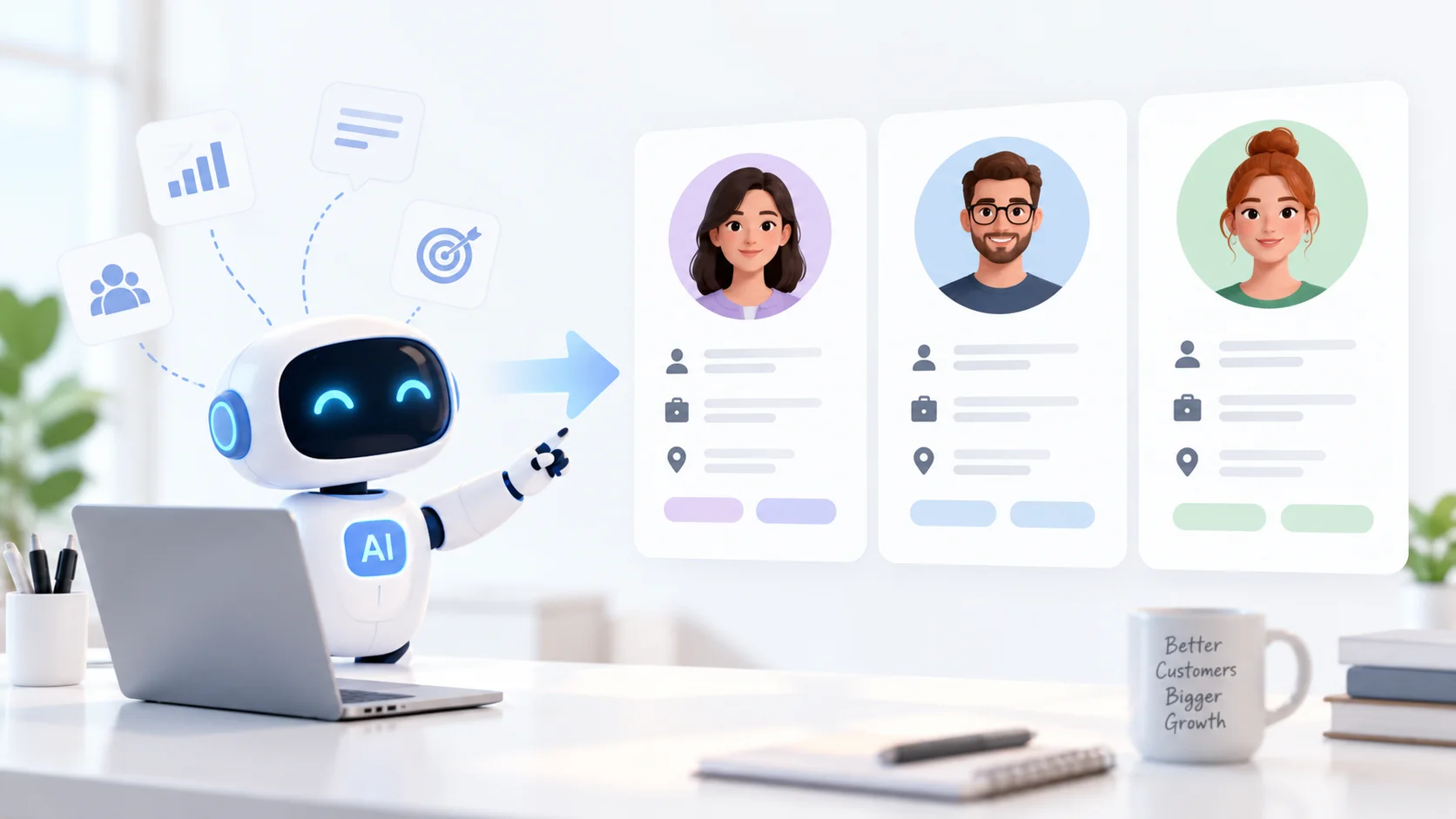
The AI synthesizes each cluster into a comprehensive persona profile that includes demographic details, psychographic characteristics, behavioral patterns, preferred channels, common objections, and purchase triggers. Some AI tools even generate narrative descriptions and visual representations of each persona to make them more relatable and actionable for marketing teams.
| Persona Element | Traditional Method | AI Method |
|---|---|---|
| Data sources | 5-20 customer interviews | Thousands of data points across multiple platforms |
| Time to create | 2-6 weeks | Minutes to hours |
| Number of personas | 3-5 based on assumptions | Data-determined, often revealing unexpected segments |
| Update frequency | Annually at best | Continuously updated as new data flows in |
| Bias risk | High (interviewer and selection bias) | Lower (patterns emerge from actual behavior data) |
AI Tools for Buyer Persona Generation
Several AI-powered platforms specialize in creating buyer personas, each with different strengths depending on your data sources and business type.
| Tool | Free Option | Best For | Key Feature |
|---|---|---|---|
| PersonaGen | Free tier available | Quick persona creation from prompts | AI-generated personas from business descriptions |
| Delve AI | Free basic personas | Website visitor analysis | Auto-generates personas from Google Analytics data |
| HubSpot Make My Persona | Free tool | Guided persona creation for HubSpot users | Step-by-step persona builder with templates |
| ChatGPT | Free tier available | Custom persona generation from any data | Flexible prompting for detailed persona narratives |
| Crystal | Free basic profiles | B2B sales personas | Personality prediction from LinkedIn profiles |
| SparkToro | Free limited searches | Audience research and media habits | Identifies where your audience spends time online |
For businesses just getting started with AI personas, ChatGPT combined with your existing customer data produces surprisingly detailed results. For deeper, data-driven persona generation, platforms like Delve AI and SparkToro connect directly to your analytics and audience data. The AI marketing tools available today make persona creation accessible to businesses of every size.
Step-by-Step Guide to Generate Buyer Personas With AI
Follow this process to create actionable buyer personas using AI, whether you use a dedicated persona tool or a general-purpose AI platform.
Step 1: Gather Your Customer Data
Before asking AI to generate personas, collect and organize the data it will analyze.
- Export customer demographics from your CRM (age, location, job title, company size, industry).
- Pull website analytics showing visitor behavior, popular pages, traffic sources, and conversion paths.
- Gather email engagement data: open rates, click patterns, and content preferences by segment.
- Collect purchase history data: average order value, purchase frequency, product preferences, and seasonal patterns.
- Export customer support tickets to identify common pain points, questions, and complaints.
- Compile survey results and customer feedback.
The quality of your personas depends directly on the quality and breadth of your input data. Missing data sources create blind spots in the resulting personas.
Step 2: Feed Data Into Your AI Tool
If you are using a dedicated persona platform, connect your data sources through the built-in integrations. For ChatGPT or similar AI assistants, structure your data into a clear prompt. Learning how to write effective AI prompts significantly improves the quality of personas generated through general-purpose AI tools.
A strong persona generation prompt includes your business type, products or services, target market, key data points about existing customers, and what you need the persona for (content marketing, product development, sales outreach, etc.).
Step 3: Review and Refine the Output
AI generates initial persona drafts that you should review against your business knowledge. Look for patterns that ring true based on your experience with actual customers, and flag anything that seems off or generic.
- Verify that demographic details align with your actual customer base.
- Check that pain points match what your sales and support teams hear from real customers.
- Ensure the buying motivations reflect your actual value propositions.
- Confirm that preferred channels match where you actually acquire customers.
- Add industry-specific nuances that the AI might have generalized.
The first AI output is a strong starting point, not a finished product. Your team’s domain expertise transforms a data-driven draft into a persona that genuinely represents your customers.
Step 4: Validate With Real Customer Interactions
Test your AI-generated personas against real customer behavior. Share them with your sales team and ask whether the profiles match the people they talk to every day. Run the personas by customer success managers who interact with existing clients. Compare persona predictions against actual conversion data.
This validation step catches blind spots that data alone cannot reveal. A persona might be statistically accurate but miss an emotional motivation or cultural factor that your frontline teams understand intuitively. Combining competitor research with persona development ensures your profiles account for the competitive landscape your customers navigate.
Data tells you what your customers do. Validation tells you why. The strongest personas combine both, and AI makes the data part effortless so you can focus on the why.
Using AI Buyer Personas for Marketing
Generating personas is only valuable if you use them to drive marketing decisions. Here is how AI-generated personas translate into practical marketing improvements.
Content Marketing Personalization
Each persona responds to different content types, topics, and messaging angles. A technical decision-maker persona wants detailed comparison guides and ROI calculations. A time-strapped small business owner persona needs quick how-to content with actionable steps. AI personas tell you exactly which content formats and topics to create for each segment.
Map your content calendar to your personas so every piece of content targets a specific audience segment with messaging tailored to their particular pain points and buying stage. The AI content creation tools available today can generate persona-specific content at scale once your personas are defined.
Email Campaign Segmentation
AI personas transform email marketing from one-size-fits-all broadcasts to segmented campaigns that speak directly to each audience group. Segment your email list according to your persona profiles and create messaging sequences tailored to each group’s motivations, objections, and preferred communication style.
A price-sensitive persona gets emails emphasizing value and comparisons. A quality-focused persona receives content about premium features and long-term benefits. A convenience-driven persona sees messaging about ease of use and time savings. The AI email marketing tools that automate campaign creation work even better when guided by well-defined buyer personas.
Ad Targeting and Messaging
AI personas provide the exact targeting parameters for paid advertising campaigns. Demographics, interests, online behaviors, and platform preferences translate directly into ad audience settings on Facebook, Google, LinkedIn, and other advertising platforms.
| Persona Type | Ad Platform | Message Focus | Creative Approach |
|---|---|---|---|
| Enterprise decision-maker | ROI and scalability | Case studies and data-driven proof | |
| Small business owner | Facebook / Google | Ease of use and affordability | Quick-win demonstrations and tutorials |
| Technical evaluator | Google / Reddit | Features and integrations | Detailed comparisons and documentation |
| Budget-conscious researcher | Google / YouTube | Value and savings | Reviews, testimonials, and free trials |
Sales Enablement
Share AI-generated personas with your sales team so they can tailor their approach to each prospect type. When a salesperson recognizes that a prospect fits the “technical evaluator” persona, they know to lead with feature comparisons and integration details rather than high-level benefits. Understanding the balance between AI and human sales approaches helps teams use personas effectively without over-automating the personal touch that closes deals.
Marketing without personas is guessing. Marketing with AI-generated personas is precision. The difference shows up in conversion rates, customer acquisition costs, and revenue growth.
Keeping AI Personas Updated
Static personas decay quickly. Customer behaviors, preferences, and market conditions change constantly. AI solves this by enabling continuous persona updates rather than annual refreshes.
- Connect your AI persona tool to live data sources so personas update automatically as new customer data flows in.
- Set quarterly reviews to check whether persona-based campaigns still perform well or need adjustment.
- Monitor for emerging customer segments that your current personas do not capture.
- Track which personas drive the most revenue and allocate marketing resources accordingly.
- Re-run persona generation after major product launches, pricing changes, or market shifts that might alter your customer profile.
The advantage of AI-generated personas over traditional ones is exactly this ability to evolve. A persona created from last year’s data might not reflect this year’s customers. AI keeps your understanding of your audience current without requiring a full research project every time something changes.
Common Mistakes With AI Buyer Personas
AI makes persona creation faster and more data-driven, but common mistakes can undermine the value of the output.
| Mistake | Why It Happens | How to Fix It |
|---|---|---|
| Too many personas | AI finds many clusters in data | Focus on 3-5 personas that represent the majority of revenue |
| Too generic | Insufficient or low-quality input data | Feed more specific, first-party customer data |
| Never validated | Treating AI output as final truth | Cross-reference with sales team feedback and real conversations |
| Created but not used | No process to integrate into daily work | Embed personas into content briefs, ad targeting, and sales playbooks |
| Never updated | Treating persona creation as a one-time project | Schedule recurring updates with fresh data |
The most damaging mistake is creating beautiful personas that sit in a slide deck and never influence actual marketing decisions. Every persona should have a clear owner on the team and directly inform content, campaigns, and sales approaches. According to Forrester, companies that use buyer personas effectively see higher engagement rates and shorter sales cycles because their messaging resonates with the specific concerns of each audience segment.
AI Personas for Different Business Types
The persona generation process adapts to different business models and industries.
B2B Companies
B2B personas focus on job roles, decision-making authority, company size, industry, and business challenges. AI analyzes LinkedIn engagement, content download patterns, webinar attendance, and sales conversation data to build profiles of the individuals who influence and make purchasing decisions. The AI business tools designed for B2B operations generate personas that reflect complex buying committees rather than individual consumers.
E-Commerce Businesses
E-commerce personas emphasize shopping behavior: browsing patterns, cart abandonment triggers, price sensitivity, brand loyalty, review dependence, and seasonal purchasing habits. AI analyzes transaction data, site behavior, and return patterns to create personas that directly inform product recommendations, pricing strategies, and promotional timing.
SaaS Companies
SaaS personas center on use cases, feature adoption, integration needs, team size, and technical sophistication. AI examines trial-to-paid conversion paths, feature usage data, support ticket themes, and churn indicators to build personas that inform both marketing messaging and product development priorities. The insights from content marketing strategies for SaaS become more effective when driven by well-researched AI personas.
Local Service Businesses
Local businesses generate personas based on geographic data, service type preferences, seasonal demand patterns, referral sources, and review behavior. Even small businesses with limited data can use AI to identify distinct customer segments that respond to different messaging and offers.
Every business has multiple types of customers. The ones that grow fastest are the ones that understand each type well enough to speak their language.
Conclusion
Generating buyer personas using AI software transforms customer understanding from an expensive, time-consuming research project into a data-driven process that produces actionable results in minutes. AI analyzes your actual customer data across every touchpoint — CRM records, website behavior, purchase history, and engagement patterns — to reveal distinct audience segments with specific motivations, pain points, and buying triggers. Whether you use a dedicated persona platform like Delve AI or craft detailed prompts in ChatGPT, the key is feeding the AI real customer data, validating the output with your team’s frontline knowledge, and then using the personas to drive every marketing, content, and sales decision. The businesses that know their customers best are the ones that win, and AI makes that knowledge accessible to everyone.