Amazon Polly voice cloning is now generally available, letting businesses turn a few minutes of a consenting speaker’s recordings into a custom text-to-speech voice. AWS announced the feature on November 19, 2026, as a gated release that starts in seven languages. If your company has wanted one recognizable voice across phone lines, apps and ads without booking a studio every time a script changes, this is aimed squarely at you.
What Amazon Polly Voice Cloning Does
You give Polly between one and ten recordings of a single person, and it builds a cloned voice that can read any text you send it. AWS says the cloned voices run on the Polly generative engine, so they should sound about as natural as the service’s other generative voices. Each clone speaks only the language it was recorded in.
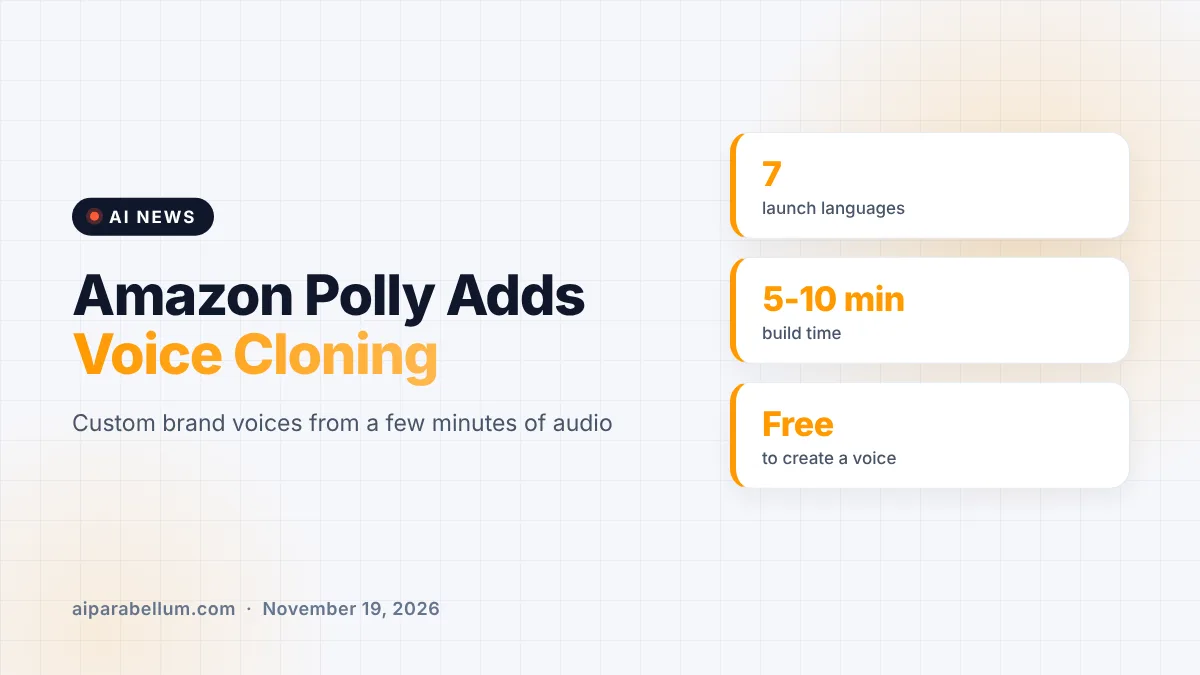
The launch languages are English, Spanish, German, French, Italian, Portuguese and Hindi. AWS notes that it tested US English, US Spanish and Brazilian Portuguese most closely. Other accents, such as British English or Canadian French, also work but have had less testing.
How the process works
AWS describes a simple four-stage lifecycle for every cloned voice. Building one is free, and you pay for usage the same pay-as-you-go way you pay for other Polly voices.
- Record: capture one speaker, ideally two to ten minutes of natural speech in takes of up to a minute.
- Create: send the recordings to Polly and confirm you have the speaker’s consent.
- Wait: Polly builds the voice in the background, which typically takes 5 to 10 minutes.
- Use: pass the new voice ID into normal speech requests, for short real-time audio or long-form jobs like audiobook chapters.
Key Details at a Glance
Here are the main numbers from the AWS announcement. They matter most if you are planning a rollout across several teams or regions.
| Detail | What AWS says |
|---|---|
| Status | Generally available as a gated release |
| Languages | 7 at launch |
| Recordings per voice | 1 to 10, up to 15 minutes total |
| Build time | Usually 5 to 10 minutes |
| Starting quota | 10 cloned voices per account, per region |
| Cost to create | Free; usage billed pay-as-you-go |
The feature works in every AWS region that supports the Polly generative engine, including GovCloud (US). Access is already switched on for select customers, and everyone else has to ask their AWS account team or apply.
Voice Cloning Safeguards: Consent and Watermarks
Voice cloning has a messy reputation, from AI voice scams to lawsuits over copied celebrity voices. AWS is leaning hard on guardrails here. You must confirm the speaker’s consent every single time you create a voice, and use falls under AWS’s biometric consent terms and responsible AI policy.
Audio generated with a cloned voice carries a watermark. Each voice belongs only to the AWS account that made it, and access is controlled with standard AWS permissions and optional customer-managed encryption keys.
AWS also says Polly does not keep a copy of your recordings once the voice is built and does not use them to train its models. If a speaker withdraws consent, AWS recommends deleting the voice, which removes its data right away.
Who Will Use Polly Voice Cloning
AWS pitches the feature at a few clear groups. Customer service teams can give phone menus and voice agents one branded sound and update prompts without new studio sessions. Publishers and studios can narrate audiobooks, courses, podcasts and game characters in consistent voices across a whole library.
Accessibility tools and reading apps are another target. A familiar, human-sounding voice can make assistive tech feel less robotic.
How it compares with other options
Consumer-friendly tools have offered cloning for a while, and our guide to ElevenLabs voice cloning covers that side of the market. Polly’s version is built for developers already on AWS, with access controls, regional deployment and audit-friendly consent baked in. If you are still comparing voice platforms, our voiceover tools comparison is a useful starting point.
What This Means for You
If you build on AWS, this removes a big reason to send voice work to an outside vendor. If you are a speaker being asked to lend your voice, it is worth knowing what you are agreeing to.
- Record clean audio: AWS warns that clones pick up room echo, fan noise and meeting-app filters, so use a quiet room and a decent mic.
- Pick one style: a clone copies the tone of its recordings and cannot blend upbeat and serious takes into one voice.
- Test with real content: have the voice read your product names, numbers and longest sentences before it goes live.
- Get written consent: keep a record for each voice, and plan for deletion if a speaker changes their mind.
- Tell listeners: AWS suggests disclosing synthetic voices where appropriate, which builds trust.
For more voice and audio tools, you can browse our latest AI news for ongoing coverage.
Sources
Primary source: AWS announcement of Amazon Polly voice cloning.
Conclusion
Amazon Polly voice cloning brings custom brand voices to AWS customers with a short recording session, a few minutes of processing and no creation fee. The gated rollout, consent checks, watermarking and account-level controls show AWS knows how sensitive this technology is. For companies that want one consistent voice everywhere, it is now a practical option inside the cloud they already use. The real test will be how well those safeguards hold up as more businesses start cloning voices at scale.