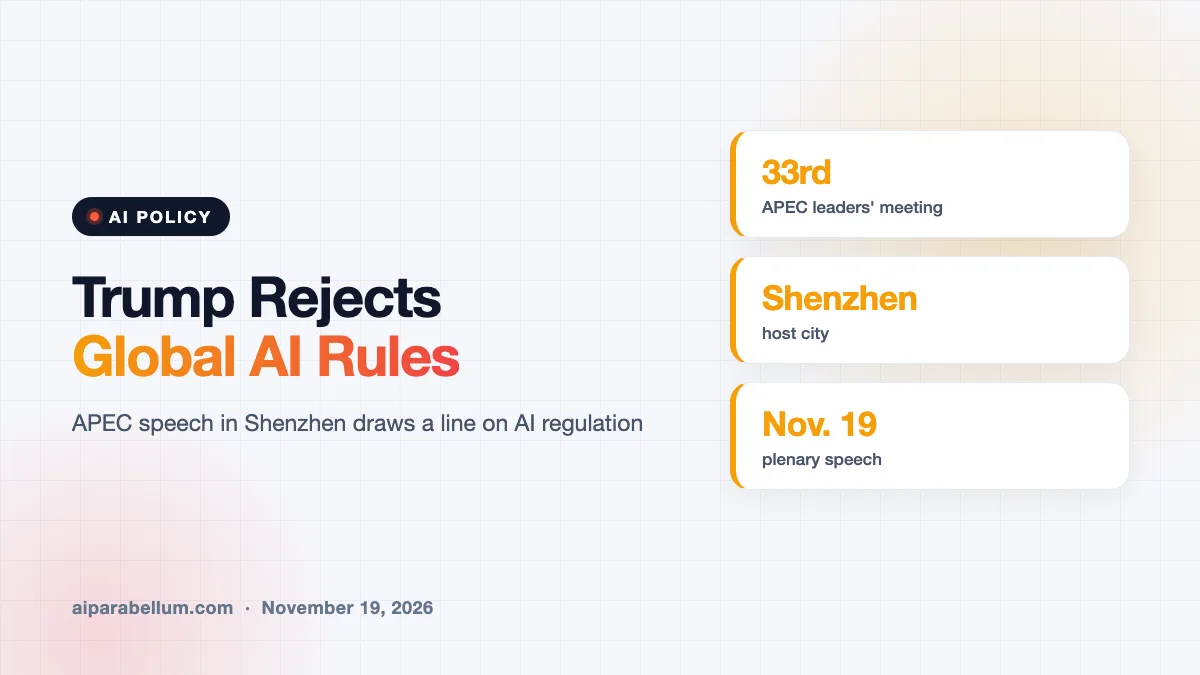
President Donald Trump used his speech at the Asia-Pacific Economic Cooperation summit in Shenzhen, China, on Thursday to reject any push for global AI regulation. He said the United States will not accept outside rules that try to control or slow the technology. At the same time, he admitted that advanced AI has some bad sides that need careful handling.
The remarks came at the leaders’ plenary session of the 33rd APEC Economic Leaders’ Meeting. They landed shortly after Chinese President Xi Jinping told business leaders at the same summit that countries should cooperate more closely on artificial intelligence. That contrast sets up a clear split between the world’s two biggest AI powers.
What Trump Said About Global AI Regulation
Trump’s message was short and direct. He said the US opposes any form of “globalist regulation” aimed at controlling or stifling the technology, and added that Washington won’t allow it to happen. He mostly called the technology SI, his shorthand for superintelligence.
He also framed AI as an economic engine. He described it as the biggest technological shift since the Industrial Revolution and said the US is proud to lead the world in it.
A Nod to the Risks
The speech was not pure cheerleading. Trump said the technology is almost entirely good but carries some bad elements that leaders must manage with care. He told the room the world has to watch it closely while still protecting its potential.
He did not say what those bad elements are or how the US plans to manage them. No new policy, executive order or agreement was announced alongside the remarks.
Two Visions on Display in Shenzhen
The timing makes the speech more pointed. Earlier this week, Xi opened the APEC CEO Summit by calling for greater international cooperation in AI and the digital economy, plus fewer trade and investment barriers. Trump’s answer was that cooperation must not turn into shared rules that limit American companies.
| Leader | When | Main AI message |
|---|---|---|
| Xi Jinping | Earlier this week, APEC CEO Summit | Deeper international cooperation on AI and the digital economy |
| Donald Trump | Nov. 19, APEC leaders’ plenary | No global rules that control or slow AI; manage the risks carefully |
Both men were set to meet later on Thursday, along with Russian President Vladimir Putin, in what Trump called a historic three-way summit. Trade is also on the table, since the US-China tariff truce expires on Jan. 10.
Why the Global AI Regulation Debate Matters
The US position is not new, but saying it on Chinese soil to a room of Asia-Pacific leaders gives it extra weight. It signals that Washington will keep favoring national rules and voluntary steps over any binding international framework. Other governments are moving the other way, such as Australia’s planned regulator and calls from tech leaders for binding UK rules.
Inside the US, the picture is mixed too. States like California keep pushing their own measures, including mandatory safety standards that would give officials emergency shutdown power over risky models.
Chips and Security in the Background
The summit follows a tense few weeks for US-China tech ties. Washington this week tightened AI chip export rules, including limits on renting computing power from data centers in third countries. The Nvidia leadership scandal tied to alleged chip diversion to China has also kept the issue in the headlines, with the board recently ruling out Huang’s return.
So the US approach has two sides. It resists shared global rules on how AI is built, yet it is tightening its own controls on who gets the hardware to build it.
What This Means for You
For most people, nothing changes overnight. No law or rule came out of this speech. Still, it gives a useful read on where things are heading:
- Expect US AI rules to keep coming from Washington agencies and individual states, not from an international treaty.
- If you run a business across borders, plan for different AI rules in different regions rather than one global standard.
- US-China tension over chips is likely to keep shaping prices and availability of AI computing.
- Watch the outcome of the Trump, Xi and Putin meeting for any joint statement on AI safety or incident sharing.
Earlier reports said the US and China have discussed a channel to share information when AI systems misbehave. If that moves forward, it would be a rare piece of practical cooperation despite the public split on rules. You can follow updates in our AI news coverage.
Sources
Primary source: none, as the White House had not posted a transcript of the APEC plenary remarks at the time of writing. Reporting from Yonhap News Agency, CBS News, Anadolu Agency and New Straits Times.
Conclusion
Trump’s APEC speech drew a firm line against global AI regulation while admitting the technology needs careful handling. It contrasts sharply with Xi’s call for closer international cooperation earlier in the week. No new policy came with it, but it confirms the US will keep setting its own AI rules. The next signal to watch is whether the leaders’ three-way meeting produces anything concrete on AI safety.