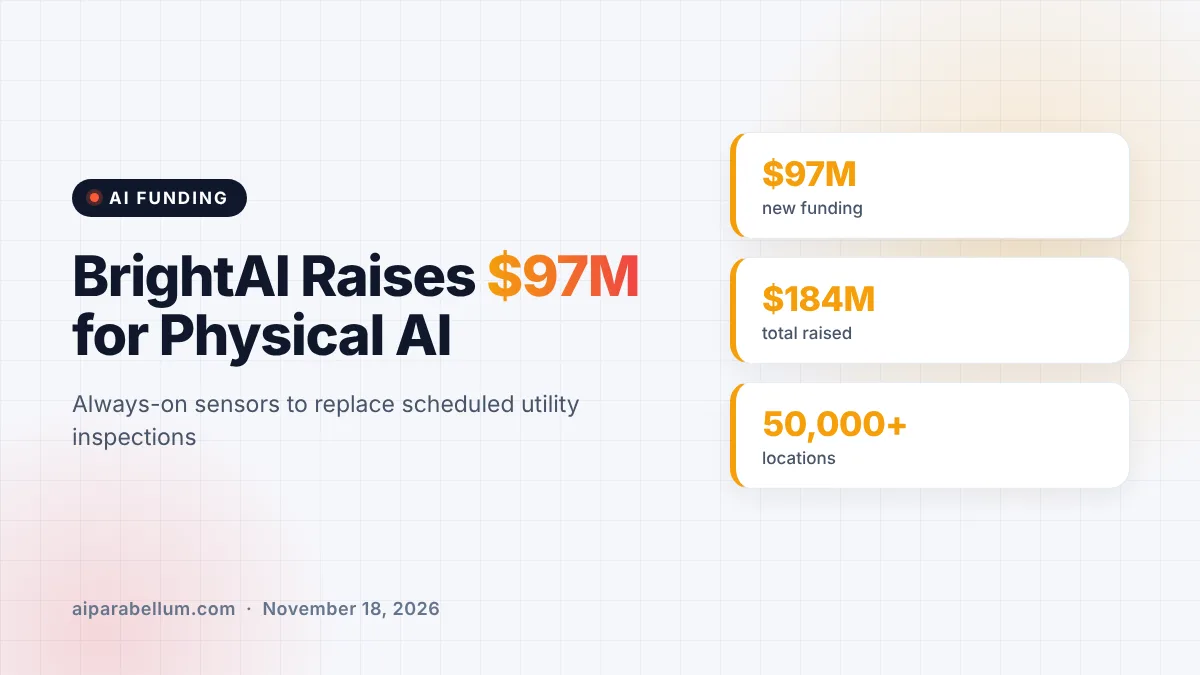
BrightAI, a physical AI company that watches power lines, pipes and pumps with sensors instead of sending crews out on a fixed schedule, said Wednesday it has raised $97 million. The round was led by Smith Point Capital, the growth firm started by former Salesforce co-CEO Keith Block, and it brings the company’s total funding to $184 million. The pitch is simple: stop paying for inspection trips that find nothing, and catch the failures that happen in between.
Inside the BrightAI Funding Round
Smith Point Capital led the round, and GE Vernova, which already uses BrightAI’s platform, joined as a strategic investor. Cobalt Capital, Marlinspike Partners and Zero Infinity Partners also came in, along with existing backers Khosla Ventures, Inspired Capital and Upfront Ventures.
The deal values BrightAI at $750 million, according to a person familiar with the matter cited in Fortune’s report. The company itself did not frame the raise around that number, and founder Alex Hawkinson said he does not care about reaching unicorn status.
| Detail | What we know |
|---|---|
| New funding | $97 million |
| Lead investor | Smith Point Capital |
| Strategic investor | GE Vernova (also a customer) |
| Total raised to date | $184 million |
| Reported valuation | $750 million (per a person familiar with the matter) |
| Founded | 2019, bootstrapped for its first four years |
Why Physical AI Targets Old-School Inspections
Hawkinson likes to say that utilities still check their assets the way the Romans checked their roads: by sending teams out on a schedule. He says frontline technicians told him that 50% to 70% of those trips turn up nothing to fix. BrightAI’s own release uses a more cautious figure, saying more than half of scheduled inspections are unnecessary.
The bigger problem is what happens between visits. A wooden power pole in the US may see a human inspector only about once every eight to 10 years, and a worn part can fail long before the next check. Sensors that report around the clock are meant to close that gap.
The real bet here is not the sensors themselves, but the data they collect over time: a running record of how equipment actually wears out.
The cost claims behind the pitch
BrightAI says it surveyed 12,158 operators across 16 industries and puts the yearly impact of wasted inspections, labor and preventable failures at more than $7.5 trillion. It also says 98% of those operators lack good visibility into their assets. These are the company’s own estimates, so treat them as a sales argument rather than an independent finding.
How the BrightAI Stateful Platform Works
BrightAI’s platform is called Stateful. It combines several kinds of hardware and software that feed one AI system.
- Edge sensors mounted on poles, pipelines, compressors and tanks
- Autonomous robots and drones for inspections
- Wearable AI copilots that guide field crews
- Models that predict which assets are likely to fail next
The company says it runs at more than 50,000 locations and has processed tens of trillions of sensor readings. Hawkinson says customers, on average, see trouble coming 51 days before what would have been a serious failure.
Named customers include GE Vernova, Reworld, Osmose Utilities Services, Azuria Water Solutions, Kodiak Gas Services and Diamondback Energy. GE Vernova plans to use BrightAI across its Power, Wind and Electrification businesses.
Where the money goes
Most of the new cash is earmarked for international growth. BrightAI says nearly 60% of its addressable market sits outside North America, and it is opening offices abroad after doubling its headcount in 2025. Hawkinson says signing a new customer used to take two to three years and now takes under six months.
A Founder With a Smart Home Background
Hawkinson is best known for SmartThings, the connected home hub he launched on Kickstarter and sold to Samsung in 2014. He says the idea came after his family’s mountain cabin lost power and the pipes froze and burst before anyone noticed.
BrightAI applies that same “know before it breaks” idea to much larger systems. It joins a busy wave of physical AI startups, from robot training data providers like Humyn Labs to construction players such as Origin’s drywall robot.
What This Means for You
Most people will never log into BrightAI, but you may feel its effects through your power and water bills. Here are the practical takeaways.
- If you work in utilities, energy or water, expect vendors to push continuous monitoring as a replacement for fixed inspection calendars.
- If you follow AI investing, physical AI is drawing large rounds, much like the recent robot AI raise at Dream Labs.
- If you run a business with field equipment, ask whether sensor data could cut wasted maintenance trips before you buy more hardware.
- Treat big market-size numbers with caution, since the $7.5 trillion figure comes from BrightAI itself.
You can follow more stories like this on our AI news page. For more tools that help companies put AI to work, see our guide to the best business AI tools.
Sources
Reporting from Fortune.
Conclusion
BrightAI’s $97 million round is a vote of confidence in a fairly unglamorous idea: watch infrastructure all the time instead of checking it once in a while. With GE Vernova both buying and investing, the company has a big-name backer as it moves from pilot projects to large utilities. The next year will show whether always-on sensors can really retire a habit that dates back to ancient Rome. If they can, fewer surprise failures and fewer wasted truck rolls could be the result.