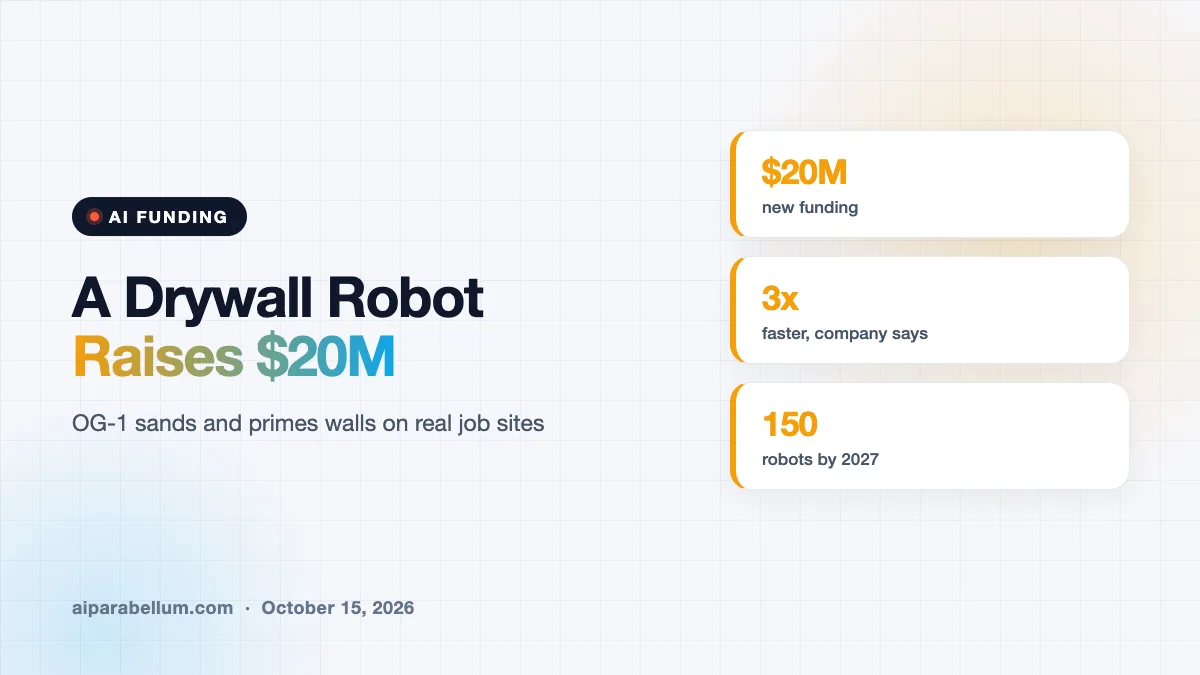
A construction robot startup called Origin has come out of stealth with $20 million in fresh funding and a robot that finishes drywall. Its flagship machine, OG-1, applies joint compound, sands and primes walls, and the company claims it works about three times faster than a human. The new money will go toward building a robot fleet and running pilots in the U.S. and Europe.
Meet the Construction Robot Called OG-1
OG-1 handles the dusty, repetitive part of interior work: getting walls smooth and ready for paint. Origin says it first put robots on job sites in New York within 10 months of its founding in 2025.
Since then, the company says, its robots have worked in commercial spaces, apartments, data centers, hotels and warehouses. Origin is based in San Francisco and is deploying robots on sites in the U.S. and Europe.
The Speed Claim
The headline number is speed. Origin says OG-1 is roughly three times faster than a human worker at wall finishing. That is the company’s own claim, and no independent test results have been shared yet, so it is worth treating as a target to watch rather than a proven fact.
The $20 Million Round at a Glance
Here are the key facts about the deal and the company behind it.
| Detail | What We Know |
|---|---|
| Funding | $20 million |
| Lead investors | Accel and Zacua Ventures |
| Other backers | Unilazer Ventures, Schema Ventures, Z21, plus angels from Anduril, Skild AI, 1X and Tesla |
| Founded | 2025 by Yogesh Ghaturle, Ashish Daga and Tushar Makkar |
| Headquarters | San Francisco |
| Fleet goal | 150 robots by the end of 2027 |
| Pilots | U.S. and Europe, with more planned in Germany, Sweden, France and Saudi Arabia |
As part of the deal, Zacua founding partner Vivin Hegde joined Origin’s board. Zacua is also expected to help with expansion through its network of contractors, developers and manufacturers.
Who Is Behind Origin
CEO Yogesh Ghaturle previously founded Perpule, a point-of-sale startup that Amazon bought in 2021. Tushar Makkar leads autonomy and came from Eightfold AI, while Ashish Daga leads hardware after working at Morphle Labs.
How the Robot’s AI Plans Its Work
Origin runs OG-1 on its own foundation model, which it calls a Construction Action Model. It is the same basic goal behind the push for general robot brains at bigger labs, including OpenAI with its humanoid robot plans.
The model has three parts that work together:
- A reasoning system that breaks a job into smaller steps and plans the order.
- An action policy that helps the robot move around the site on its own.
- A controller that turns those decisions into steady, feedback-driven movement.
The goal is a robot that can adapt as a messy job site changes from day to day. That is far harder than working in a clean factory, where nothing moves unless it is supposed to.
Why Construction Robot Startups Are Drawing Money
The big driver is a shortage of workers. A September 2026 survey from the Associated General Contractors of America found worker shortages delayed projects for 42% of the U.S. construction firms it surveyed.
Investors have been piling in. A report from Zacua, Hilti Ventures and 94 Ventures found construction robotics startups raised $1.36 billion in the first three quarters of 2025, up from $612 million in all of 2024. It fits a wider wave of AI startup funding aimed at real-world, hands-on work.
The Next Trades on the List
Wall finishing and painting are only the start. Origin plans to teach OG-1 taping, drywall installation, drilling and conduit installation. Ghaturle called the company “a time machine for construction” and said the long-term aim is to automate the full range of interior trades.
What This Means for You
If you work in construction or hire contractors, robots like this could start showing up on bigger projects over the next few years. Here is what to keep in mind:
- Watch the claims. The 3x speed figure comes from Origin, so look for independent results from the upcoming pilots.
- Labor gaps are the real story. With crews hard to find, robots are being pitched as help for short-staffed teams, not just a cost cut.
- New skills may matter. Someone still has to set up, supervise and maintain these machines on site.
- One robot, many jobs. If OG-1 can really add more trades, it stays busy longer, which is the true test of its value.
If you are exploring how AI fits your own company, our guide to the business AI tools is a good place to start. You can also follow more stories like this on our AI news page.
Sources
This article is based on reporting from Entrackr, which covered the investors, founders and industry data, and Inc42, which reported the speed claim, the AI model and the CEO’s comments.
Conclusion
Origin’s $20 million round puts an AI-driven robot at the center of one of construction’s most tiring jobs. The company has real job-site deployments, well-known backers and a plan to reach 150 robots by the end of 2027. Its speed claims still need outside proof, and adding new trades will take time and data. If the upcoming U.S. and European pilots go well, OG-1 could become an early sign of how robots will help fill the construction labor gap.