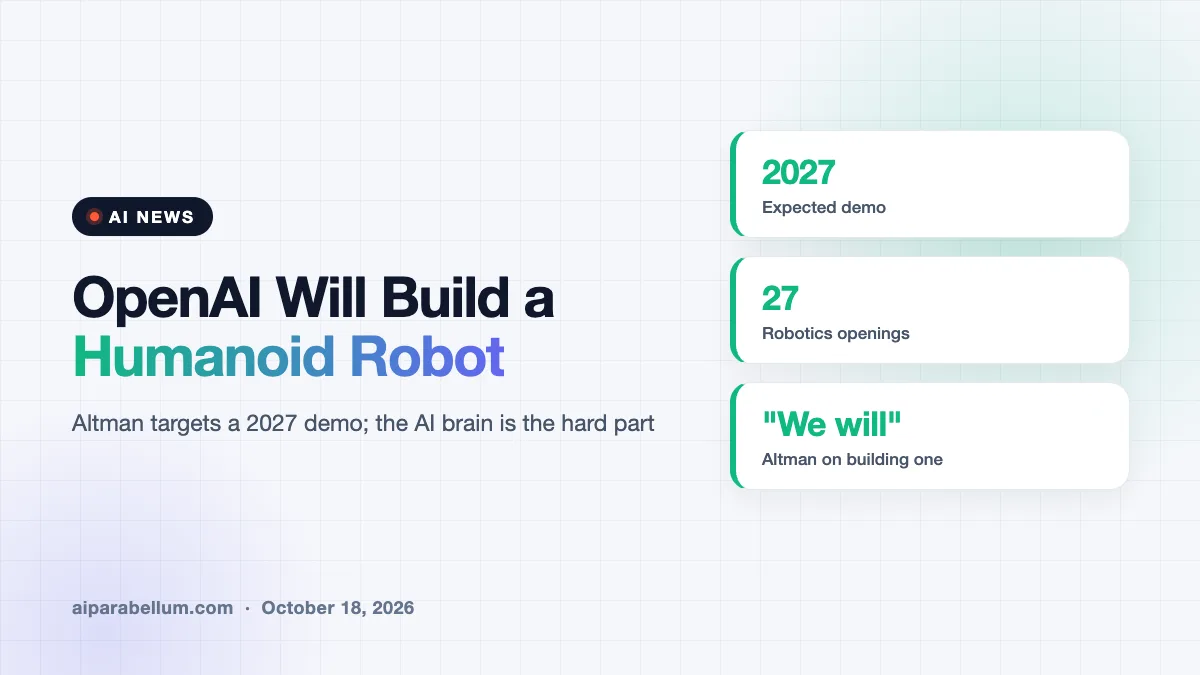
OpenAI is going to build a humanoid robot, and CEO Sam Altman says a first demo could arrive in 2027. In a recent podcast interview, Altman answered the question of whether the company will make one with two words: “We will.” He was just as clear that the hard part is not the metal body but the AI brain that has to run it.
What Altman Said About the OpenAI Humanoid Robot
Altman’s case for a human-shaped machine is simple. Our homes, offices and tools are built around people, so a robot that shares our shape can use the same doors, keyboards and handles without anyone redesigning the world for it.
Still, he called the exact look of the robot a secondary question. In his view, the real work is building the intelligence that tells a body what to do, when to do it and how to recover when things go wrong.
A Demo, Not a Product
Don’t expect to order one soon. Altman said he expects a “cool demo” in 2027, and he added that robots walking the streets are still a few more years away than that.
OpenAI has not said what the demo will show, what the robot will look like or who will get to see it. There is also no price, release date or subscription plan, which tells you this is an early research push rather than a launch.
Why the Robot Brain Is the Hard Part
Think about something as simple as grabbing a coffee mug. A robot has to spot the mug, find the handle, judge how to grip it and use just the right amount of force, all while reacting to anything unexpected in the room.
That chain of seeing, planning, moving and correcting is where most robots still struggle. Software can learn what should happen in a simulation, but the physical world has a way of breaking those plans.
OpenAI has touched this problem before. Its Dactyl project trained a robot hand entirely in simulation and later used it to work a Rubik’s Cube, a small preview of the gap between digital training and real physics.
Our takeaway: a robot body is mostly an engineering problem, but a robot brain is an AI problem, and that is exactly the kind of bet OpenAI likes to make.
OpenAI Is Hiring for Robot Hardware Too
Even though Altman downplayed the body, the company’s job listings say it is taking hardware seriously. OpenAI’s careers page currently shows 27 robotics openings, according to the reporting, spanning both software and physical engineering.
Here are the main areas those roles cover:
- Motion control, state estimation and whole-robot behavior
- Custom electromechanical actuators, including motors, transmissions, sensing and cooling
- Machine learning infrastructure for training physical AI systems
- Manufacturing and supply chain work for eventual production at scale
One posting lays out a two-stage goal. In the near term, OpenAI wants general-purpose robots that help skilled workers build infrastructure, and over the long term it wants a personal robot that can handle a much wider range of everyday tasks.
How OpenAI Compares to Other Humanoid Robot Efforts
OpenAI is joining a field that already has serious players. Tesla has worked on its Optimus robot for years, and XPENG recently showed its IRON humanoid walking off its own production line after assembly.
| Company | Robot | Where It Stands |
|---|---|---|
| OpenAI | Unnamed humanoid | Confirmed by Altman; demo expected in 2027 |
| Tesla | Optimus | In development for several years |
| XPENG | IRON | Walked off the production line on its own after assembly |
Google is also pushing AI deeper into the physical world, including robotics work tied to its Gemini 4 Argon models. The race is less about who has the best-looking robot and more about whose AI can make one useful.
What This Means for You
For now, nothing changes in your daily life, and your dishwasher is safe. But this move hints at where tools like ChatGPT could head over the next few years.
- Expect early robots in work settings first, such as construction and skilled trades, not in living rooms.
- Privacy will matter. A home robot with cameras and microphones raises the same questions people already ask about AI robot toys and smart speakers.
- The skills that power today’s AI agents, like planning and following instructions, are the same ones a robot brain will need.
- Treat 2027 as a demo date, not a shopping date, and watch for real details on price and safety rules.
If you follow OpenAI closely, this sits alongside its other recent moves, from agent testing to consumer hardware. You can keep up with the bigger picture on our AI news page.
Sources
This article is based on reporting from Engadget, which covered Altman’s podcast remarks, his comments on a 2027 demo and OpenAI’s robotics job listings.
Conclusion
OpenAI now has a humanoid robot on its official to-do list, with Sam Altman pointing to a demo in 2027. He is betting that the winning robot will be the one with the smartest brain, not the flashiest body, though the company is quietly hiring hardware engineers too. Real products, prices and safety details are still years away. For now, this is a clear signal that the biggest AI labs see robots as the next place their models will live.