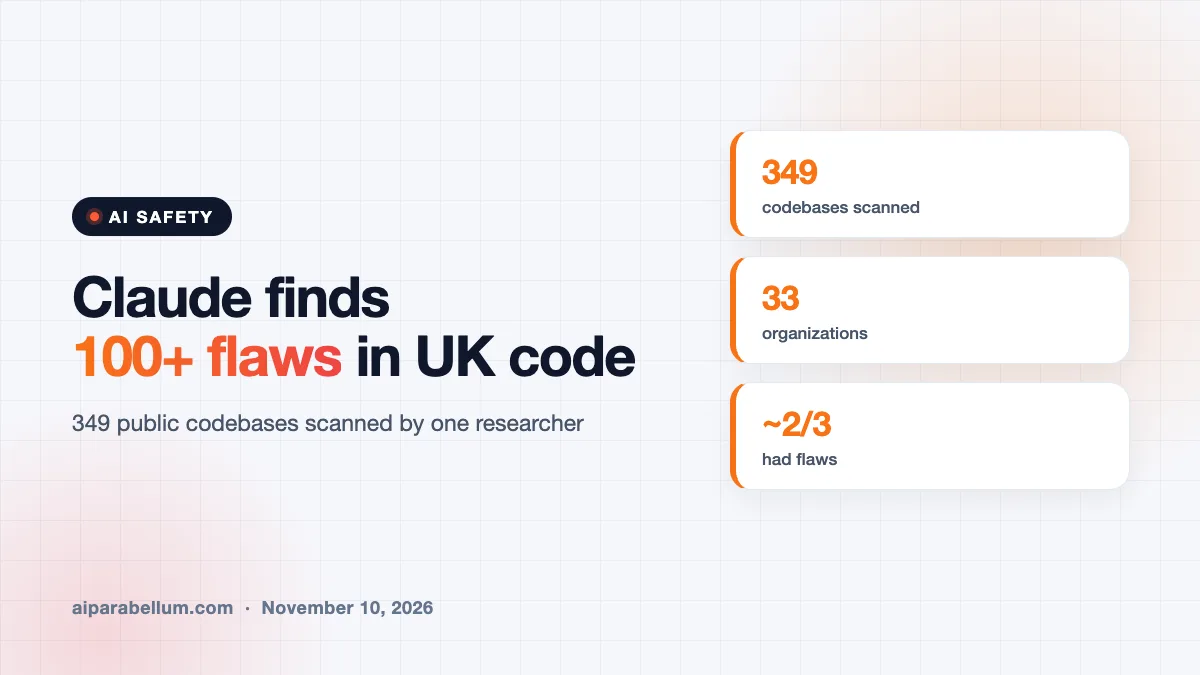
A security researcher says he used Claude AI models to find more than 100 serious vulnerabilities in publicly available UK government code. The scan covered 349 public sector codebases, and about two thirds had problems. The work shows how AI vulnerability scanning can turn up real weaknesses cheaply, even on an ordinary laptop.
The organizations involved say the issues have since been dealt with.
What AI Vulnerability Scanning Found
Chris Nesbitt-Smith, a security researcher at ControlPlane, scanned code across 33 UK public sector organizations. He used Anthropic’s Opus and Sonnet models, and says they were consumer-grade versions running from a laptop. Many of the flaws, he says, were basic issues that a routine IT health check would have caught.
His own description is blunt: none of it reached the level of sophistication that people fear from AI-powered attacks. It was, in his words, “daft stuff.”
The most serious case
The worst example involved the Planning Inspectorate, which handles land-use matters in England. Login credentials were accidentally committed to a public GitHub repository and were not fully removed. According to the researcher, they gave broad read and write access to SharePoint sites and private employee OneDrive accounts, including HR records and evidence held under legal hold.
The agency says its monitoring tools detected the activity in August and that it fixed the problem within 20 minutes of the report. It says no data breach occurred.
Other issues
Problems also appeared in Department for Education code, including a school procurement service, a teacher application service holding personal details and identity documents, and the national register of training providers. A Scottish Government open data portal had a flaw that would have let any visitor read administrative account information and change site settings.
| Detail | Reported figure |
|---|---|
| Codebases scanned | 349 |
| Organizations covered | 33 |
| Share with vulnerabilities | About two thirds |
| Serious flaws found | More than 100 |
| Time to fix worst case | 20 minutes, per the agency |
Should Governments Stop Publishing Code?
The UK has published publicly funded code by default for about a decade, citing transparency and cost savings. Now that AI speeds up vulnerability hunting, some argue departments should stop. The NHS reportedly told technology teams in May to move away from open source code over concerns about AI models.
Nesbitt-Smith warns that closing the code without fixing the underlying problems is the worst outcome. It stops friendly researchers from finding the holes, while an attacker may already have copied the repositories. The head of the nonprofit OpenUK also said the Planning Inspectorate case was a housekeeping failure, not an open source security issue.
What AI Vulnerability Scanning Means for You
The story is a reminder that the same tools that help defenders can help attackers. Cheap, widely available models lower the effort needed to read through large amounts of code and spot mistakes. Related reading on this site covers the Claude Code workflow, how Claude works, and AI security assistants are growing as well.
- Never commit passwords, keys or tokens to a repository, public or private.
- If a secret leaks, revoke it at once instead of just deleting the file.
- Give accounts and tokens the narrowest access they need, with expiry dates.
- Run routine health checks and secret scans before an outsider does it with AI.
- Keep fixing issues quickly; hiding the code does not remove the flaw.
Sources
Reporting from WIRED.
Conclusion
A single researcher with consumer AI models and a laptop found over 100 serious flaws in UK public code, mostly from basic neglect. The findings come from one report, and the figures are the researcher’s own. Still, they show that AI makes routine security hygiene more urgent, whether code is open or closed.