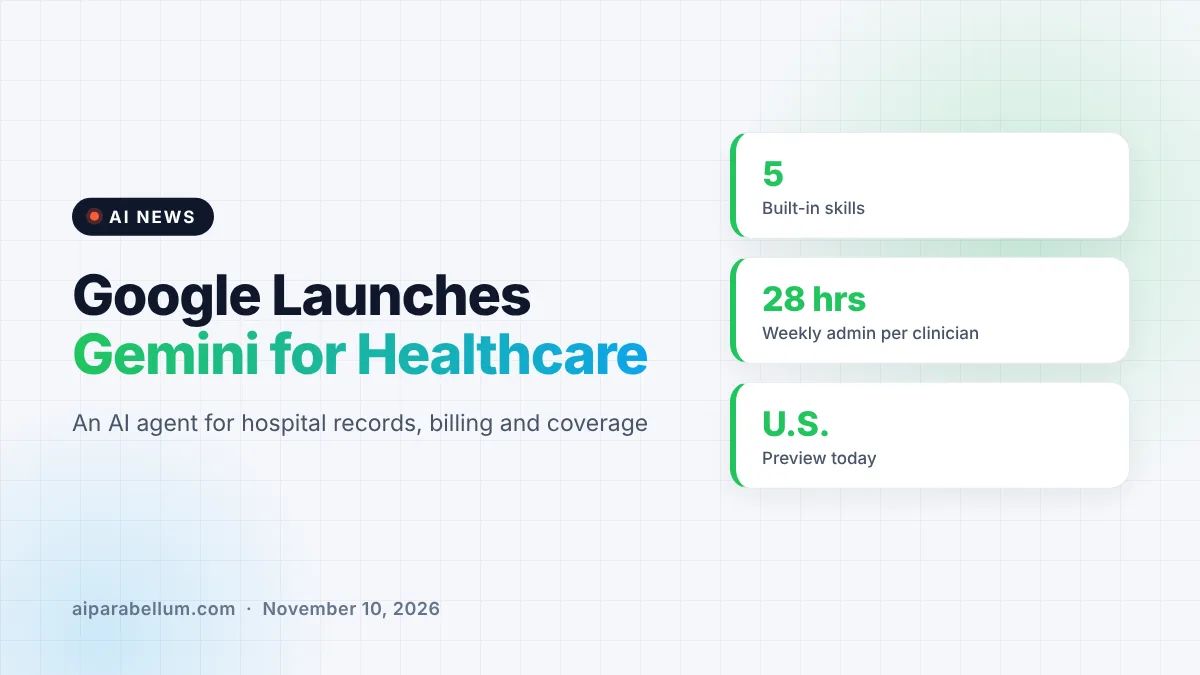
Google Cloud has launched Gemini for healthcare, an AI agent built to pull together patient records, insurance rules and clinical guidelines so doctors and health plans spend less time on paperwork. The product went live in preview in the U.S. on November 10, with big names like HCA Healthcare, Northwell Health and Highmark Health among its early partners. If you have ever filled out the same medical form twice, this launch is aimed squarely at that problem.
What Gemini for Healthcare Actually Does
Google describes the product as an orchestration layer that sits on top of the systems hospitals and insurers already use. Instead of a nurse jumping between an electronic health record, a billing tool and a coverage database, the agent reads across all of them and assembles the answer. Google says clinicians lose nearly 28 hours a week to administrative work, and that is the time it hopes to win back.
It is an industry version of the general Gemini agent that Google introduced last month. That agent takes a goal, plans the steps and routes work to different models, while respecting each user’s existing access permissions.
The five built-in skills
Gemini for healthcare ships with ready-made “skills,” which are reusable instructions written by domain experts. Organizations can also build their own. The launch skills cover these jobs:
- Medical records synthesis, which builds one timeline from scattered records and flags medication conflicts
- Pre-appointment prep, which readies a patient chart before a visit
- Prior authorization and appeals, which packages chart evidence against payer policy
- Payer review, which checks incoming requests against a plan’s medical policies
- Benefits and cost estimates, which explains coverage and likely out-of-pocket costs
Connectors, Partners and Safeguards
The agent links to a long list of outside systems through connectors. The table below groups some of the main ones Google named.
| Category | Examples | What it adds |
|---|---|---|
| Health records | Epic, Oracle Health, InterSystems FHIR | Read-only access to conditions, labs and notes |
| Coverage and eligibility | CMS Coverage, Optum, TriZetto | Medicare rules, benefits and co-pay checks |
| Clinical evidence | BMJ, ASCO guidelines, IMO Health | Cited guidelines and medical terminology |
| Pricing and workflow | GoodRx, Suki, UiPath, Salesforce | Drug pricing, ambient notes and automation |
| Office tools | Google Workspace, Microsoft 365 | Puts finished packets into Docs, Word or Outlook |
One design choice stands out: the Epic and Oracle Health connectors are read-only. The agent can surface findings and cite where each one came from, but a doctor or nurse still makes any change to the chart. Ambient scribe maker Suki, which recently raised $90 million, is among the connector partners.
Privacy and model choice
Google says the product is built to support HIPAA compliance, with audit logs and access controls. It also says clinical data, prompts and outputs stay inside the customer’s environment and are never used to train Google’s foundation models. Customers can mix models, using powerful ones for hard clinical reasoning and cheaper, faster ones for routine admin steps.
Why Hospitals Want Gemini for Healthcare
The pitch leans hard on cost. Prior authorizations, the approvals insurers require before some treatments, eat up roughly 13 hours of physician and staff time each week per doctor, according to the American Medical Association. Northwell CEO John D’Angelo told Fortune his system has about 400 employees whose only job is fighting insurance denials.
Launch customers named in coverage include Optum, Blue Cross Blue Shield of Massachusetts, Hartford HealthCare and Stanford School of Medicine. In a demo, Google showed the agent comparing an outside specialist’s report with an Epic chart and flagging a missed allergy and new lab results in about 35 seconds.
The real bet here is not a smarter chatbot but a tool that does the boring glue work between systems that never talked to each other.
The launch also fits a wider push by AI companies into medicine. Doctors’ groups have started setting rules of the road, such as the AMA agentic framework, while rivals are connecting chatbots to patient records too, as seen when athenahealth linked Claude to patient data.
What This Means for You
You will not download Gemini for healthcare yourself, since it is sold to hospitals, clinics and insurers. Still, the effects could reach you at the front desk and on your bill. Here is what to keep in mind:
- Fewer repeat questions: if your provider adopts it, staff may arrive at visits with your history already summarized.
- Faster approvals: better-prepared prior authorization packets could mean fewer denials and less waiting.
- Clearer costs: ask your provider or plan whether they can now estimate your out-of-pocket costs up front.
- Humans stay in charge: the system cannot edit your medical record, so decisions still rest with clinicians.
It is worth staying a little skeptical, too. This is a preview, and real savings will depend on how well hospitals roll it out. You can follow more launches like this on our AI news page, including Google’s recent Gemini 4 Argon model release.
Sources
Primary source: Google Cloud’s Gemini for healthcare announcement. Additional reporting from Google’s Keyword blog and Fortune.
Conclusion
Gemini for healthcare is Google Cloud’s most direct attempt yet to put an AI agent at the center of hospital and insurer operations. It reads across records, coverage rules and guidelines, cites its sources and leaves final decisions to clinicians. Big health systems have signed on for the preview, and their focus on prior authorization and costs shows where they see the payoff. Whether it truly lowers bills and frees up doctors will only become clear as those early partners put it to work. For now, it is one of the clearest signs yet that AI agents are moving from demos into the back offices of American healthcare.