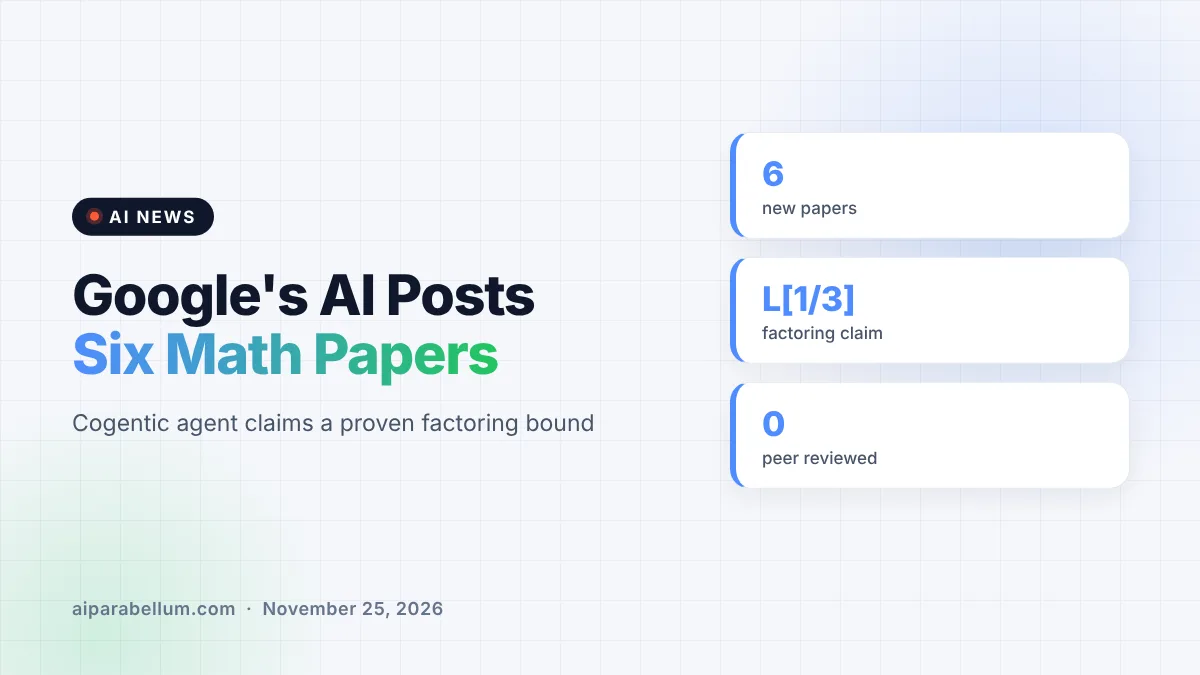
Google Research has posted six new Cogentic math papers to its public GitHub repository, and every one of them was written by an AI agent rather than a human team. The headline claim is a proven speed bound for breaking any whole number into its prime factors. None of the papers has been peer reviewed yet, so these are bold claims waiting for outside checks.
What Google’s Cogentic Math Papers Claim
Cogentic is an agent framework, or “harness,” built by researchers at Google Research and Google DeepMind. According to the paper pages, it runs on Gemini 4 and produced each result with no human help beyond the first prompt. The new batch landed in a single commit on November 25 at 10:11 UTC.
The six new titles, all listed in the folder, cover some famous corners of math and computer science. Here is the quick rundown of what each paper says it achieves:
- Integer factoring: a proven method that fully factors any whole number in the L[1/3] time class, the same class as the best practical method.
- Deterministic factoring: a method with no randomness that finds a factor faster than exponential time, in the L[3/4] class.
- Discrete logarithms: a proven speedup for this related problem in finite fields of small characteristic.
- Game theory: a polynomial-time way to find strategies within 1/5 of a Nash equilibrium in two-player games.
- Log-rank conjecture: an improvement over the long-standing square-root bound on this communication puzzle.
- Graph reconstruction: a claimed proof of Harary’s 1964 edge-reconstruction conjecture for dense graphs.
The factoring result in plain words
Mathematicians have long believed factoring can be done in L[1/3] time, because the number field sieve works that fast in practice. But that speed rested on unproven assumptions, and the best proven bound was L[1/2] from Lenstra and Pomerance in 1992. The Cogentic paper says it closes that gap with a real proof.
There is a catch that matters. The paper’s guaranteed constant is 105, far larger than the sieve’s assumed constant of roughly 1.92. So this is about proving what experts already suspected, not about a faster way to crack codes.
Takeaway: an AI proving a decades-old assumption is a big deal for math, but it does not make your encrypted data any less safe today.
How the Cogentic Papers Compare
The folder now lists ten Cogentic papers in total, including earlier batches. Here is how the six new ones line up against the older bounds the papers cite.
| Topic | Previous bound or status | Cogentic’s claim |
|---|---|---|
| Integer factoring | Proven L[1/2] (1992) | Proven L[1/3], constant 105 |
| Deterministic factoring | No subexponential method | L[3/4] with no randomness |
| Nash equilibria | About 1/3 approximation | 1/5 approximation |
| Log-rank conjecture | Square-root bound | Polynomial improvement |
| Edge reconstruction | Partial results since 1977 | Proof for dense graphs |
Why Verification Is the Real Story
Each paper page says its Lean 4 formalization was also produced by Cogentic. Lean is a proof checker, a program that confirms every logical step is correct. Google says those computer-checked proofs will come in a companion submission, so they are not public yet.
That makes this release a claim, not a settled result. The folder itself carries the line “This is not an official Google product,” and the papers live on GitHub rather than in a journal. Until the Lean files appear or experts review the work, the honest stance is cautious interest.
The release also lands in a busy week for AI math. OpenAI has also been posting AI-generated math results, like the work we covered in OpenAI’s math push. The race is now shifting from who claims results to who can prove them in a checkable way.
The model behind the agent
Cogentic runs on Gemini 4, Google’s latest model family. If you want background on the model itself, see our coverage of the Gemini 4 launch and its safety report details.
What This Means for You
Most people will never touch an L[1/3] algorithm, but this story still shows where AI is heading. Agents are moving from answering questions to producing research that experts must then check.
- If you work in security, there is no need to panic: the proven constant is far too large to threaten real encryption.
- If you are a student or researcher, the PDFs are public, and they are a good look at what AI-written math looks like.
- If you use AI tools for learning, try AI math helpers or browse our list of research AI tools while treating any AI “proof” as a draft to verify.
- Watch for the Lean files: once they are posted, anyone can check the results by machine.
You can follow how this develops on our AI news page, where we track new AI research as it lands.
Sources
Primary source: Google Research’s Cogentic research papers folder. Paper details from the Cogentic integer factorization paper page.
Conclusion
Google’s Cogentic agent has put six ambitious math claims on the table, led by a proven L[1/3] bound for factoring whole numbers. The results are striking because an AI produced them almost entirely on its own. They are also unreviewed, and the promised Lean proofs are not out yet. The next step that matters is verification, and that will decide whether this is a milestone or just a headline.