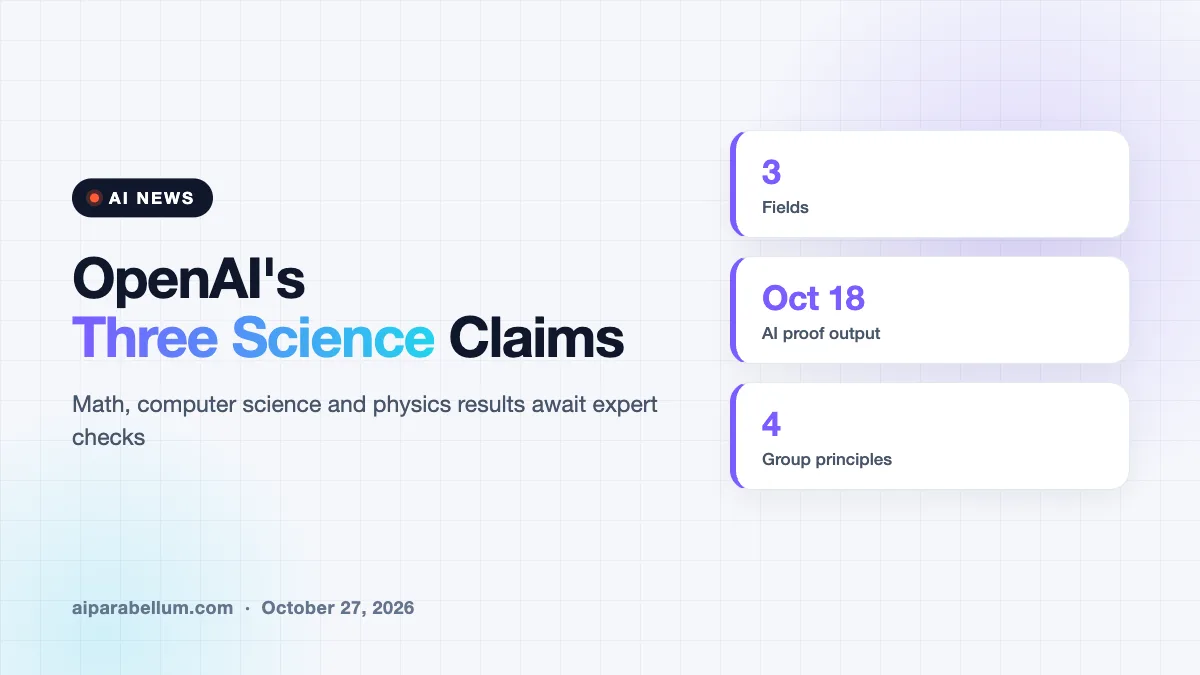
OpenAI says its models have produced three new AI science discoveries in math, computer science and physics. The twist is how it is sharing them: outside experts, which the company calls shepherds, will help the research world understand and test the results before anyone treats them as settled.
The announcement lands less than a month after OpenAI dumped hundreds of AI-written math manuscripts on October 6. This time the company wants a slower, more careful path from raw output to real understanding.
Three AI Science Discoveries Explained
OpenAI describes each result as raw research data that people still need to digest. The three claims cover very different fields, so here is a quick snapshot.
| Field | Claimed result | Release approach |
|---|---|---|
| Mathematics | Proof of the local smoothing conjecture in every dimension, which also settles the Kakeya and Stein restriction conjectures | AI output and a Lean proof published, no formal group |
| Computer science | The Exponential Time Hypothesis is false | Expert group explains it; proof and Lean files public on GitHub |
| Physics | Existence proof for certain quantum field theories, including QCD | Expert group decides what to release |
These are company claims. None has been through peer review yet, and that is exactly why the checking step matters.
The Math Result on Waves and Kakeya
The math claim is about how waves focus. In 1991, Sogge conjectured that the most extreme focusing of a wave is short-lived. Researchers proved a two-dimensional version in 2019, and the Kakeya conjecture was proved in three dimensions in 2025.
OpenAI says its models proved the local smoothing conjecture in every dimension, using a new auxiliary partial differential equation. If it holds up, it would also resolve the Kakeya and Stein restriction conjectures in all dimensions. The company says the AI output arrived on October 18 and was formalized in Lean the next day.
Why the Exponential Time Hypothesis Matters
The Exponential Time Hypothesis, or ETH, is a long-held belief about how hard it is to solve Boolean satisfiability problems. Hundreds of papers lean on it to show that tasks in graph theory, databases and computational biology are hard.
OpenAI says its system proved the ETH false, and that the proof was checked in Lean. A group led by Russell Impagliazzo and Ramamohan Paturi of UC San Diego and Ryan Williams of MIT will examine and explain it. Impagliazzo and Paturi helped propose the ETH in the first place.
OpenAI adds that the finding reopens questions about how fast these problems could be solved. It also says that turning the theory into practical algorithms will take significant further research.
The Physics Claim on Quantum Field Theory
The physics result is a mathematically rigorous existence proof for certain interacting quantum field theories with gauge fields and fermions in four dimensions. That includes quantum chromodynamics and a unified completion of the Standard Model.
David Gross will lead the group shepherding this work, with Michael Douglas, Arthur Jaffe, Igor Klebanov and Nikita Nekrasov. The group chose to hold back the AI-produced files and write up the result themselves first.
How AI Science Discoveries Get Checked
OpenAI says the outside groups follow four principles. The list below is how the company describes them.
- Transparency: no nondisclosure agreements, and members can share and publish freely.
- No academic credit: OpenAI says it does not seek credit for what its models produce.
- Recognition: the group gets credit for the understanding and writeups it creates.
- Independence: members are unpaid volunteers and do not speak for OpenAI.
OpenAI admits the approach has limits. Choosing the first shepherds shapes who gets involved early, which creates an information gap. A panel of math advisers the company assembled reportedly advised just a day earlier against designating early recipients, and suggested posting output on scholarly repositories with Lean proofs.
What This Means for You
You do not need to follow wave equations to feel the impact. The bigger story is how new AI-made research should be trusted and credited.
- Treat these as claims, not facts, until independent experts confirm them.
- Watch for the expert groups’ writeups, which will be the real test.
- If you use ChatGPT for study or work, keep checking its answers yourself.
- Expect more labs to publish AI research output, and more debate about credit.
For everyday readers, our guide to AI research tools shows what these systems can already do today. You can also see how OpenAI is pushing models into other fields in our report on its COBOL benchmark.
Sources
Primary source: OpenAI’s announcement on working with academic communities. Additional reporting from The Verge.
Conclusion
OpenAI is betting that big AI discoveries earn trust only when respected outsiders examine them in the open. The claims are bold, but until the expert groups report back, they remain unverified. The release process may end up mattering as much as the results.