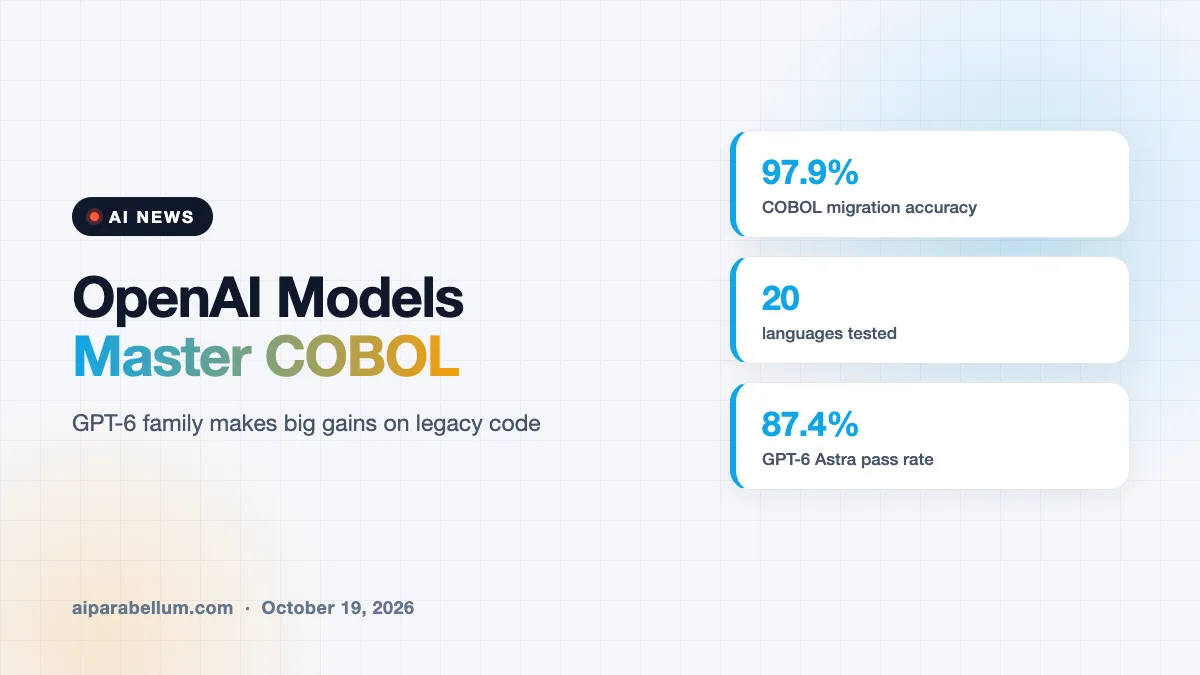
OpenAI says its latest GPT-6 family models have made a huge jump in AI COBOL migration and other work in older, less common programming languages. In a research post published on October 19, 2026, the company shared results from two new tests and released one of them as an open benchmark. The headline number: on a COBOL migration test, accuracy went from about 5% with an older model to nearly 98% with the newest one.
Why AI COBOL Migration Matters So Much
COBOL, Fortran and Visual Basic are often called “low-resource” languages. There is far less public code and documentation for them than for Python or JavaScript, so AI models get less practice. That has made coding assistants noticeably weaker when you point them at an old mainframe program.
Yet these languages still run a lot of the world. OpenAI points to estimates that COBOL supports more than 40% of online banking systems, 80% of in-person card transactions and 95% of ATM transactions. Fortran still shows up in weather forecasting and nuclear safety analysis.
The problem for companies is that the people who wrote this code have often retired or moved on. Documentation can be thin, and key business rules may live only inside the code itself.
Two New Tests for Legacy Code
To measure progress, OpenAI built two evaluations that check different skills. One asks whether a model can build new software, and the other asks whether it can move old software without breaking it.
MultiLangBench: Build a Database From Scratch
MultiLangBench asks a model to write a SQLite-compatible database engine in one of 20 programming languages. The model has to organize a codebase, track state, handle errors and add features without breaking what already works. Tests adapted from SQLite’s own test suite check the results, so every language is graded the same way.
The target is SQLite version 3.40.1, and the public repository says about 24,000 of SQLite’s original test cases were converted into this format. A test fails if the program crashes, times out or uses the wrong language.
OpenAI is publishing the MultiLangBench setup, test suite and per-language results on GitHub. That means developers can check how the models do in the exact languages they use.
The COBOL Migration Test
The second test asks models to translate COBOL programs into C++, Java, Kotlin, Python or Rust. Hidden tests demand byte-for-byte matching output, and a migration only counts if every test passes.
This is harder than it sounds. COBOL’s fixed-point math drops extra decimal digits unless rounding is requested, so a rewrite that rounds “helpfully” can run fine and still produce different financial numbers.
OpenAI’s COBOL Results at a Glance
Here is how the newer models compare with GPT-5.6 Sol, the older baseline OpenAI used, according to the company’s own numbers.
| Test | Model | Result | GPT-5.6 Sol |
|---|---|---|---|
| MultiLangBench (avg. of 20 languages) | GPT-6 Astra | 87.4% pass rate | 26.8% |
| MultiLangBench (avg. of 20 languages) | GPT-6 Luna | 40.3% pass rate | 26.8% |
| MultiLangBench, COBOL only | GPT-6 Astra | 72.1% | 10.9% |
| COBOL migration, low effort | GPT-6.1 Sol | 86.6% accuracy | 5.4% |
| COBOL migration, higher effort | GPT-6.1 Sol | 97.9% accuracy | Not reported |
A few other details stand out from the post:
- GPT-6 Astra scored above 83% in 19 of the 20 languages, with COBOL still the hardest.
- Fortran jumped from 21.4% to 83.5%, and Visual Basic from 27.5% to 89.4%, with Astra.
- GPT-6 Luna improved on the old model in every language at an estimated $0.77 per sample, versus $3.48, or roughly 78% cheaper.
- GPT-6.1 Sol’s low-effort COBOL migration result came at about 61% of the older model’s API cost.
The big shift isn’t just accuracy. It’s that legacy-code help is getting cheaper at the same time it’s getting better.
What Still Needs a Human
These are OpenAI’s own benchmarks, not independent tests, so it’s worth some healthy caution. The company itself says real production migrations still need expert review and testing against each system’s business rules and dependencies.
A benchmark program is also much smaller and cleaner than a 40-year-old banking system. Still, releasing MultiLangBench publicly lets outside developers check the claims and run rival models through the same tasks, including tools like Claude for coding.
What This Means for You
If you work with older systems, or just inherited a messy codebase, here are some practical takeaways:
- Try it on a small piece first. Pick one well-tested COBOL or Fortran module and compare the AI rewrite’s output line by line.
- Write tests before you migrate. The whole point of OpenAI’s test is matching behavior exactly, and you need your own tests to prove that.
- Use AI to explain before it rewrites. Our guide on how to explain legacy code with an assistant is a safer first step.
- Watch the rounding. Financial logic is where silent differences hide, so check decimal handling closely.
- Compare tools. Browse other code assistant tools or a code converter to see what fits your stack.
For developers on mainstream stacks, the takeaway is simpler. Models that get better at hard, unfamiliar languages usually get better at reading unfamiliar repositories in general, which is what most of us actually need. You can follow more model updates on our AI news page.
Sources
This article is based on OpenAI’s October 19 research post, “Advancing Coding in Low-Resource Programming Languages,” which contains the benchmark results (its page blocks automated link checks, so it is credited here in plain text), and on the MultiLangBench repository on GitHub, which documents how the test works.
Conclusion
OpenAI’s new results suggest AI COBOL migration has gone from nearly useless to surprisingly strong in a single model generation, at least on the company’s own tests. GPT-6.1 Sol’s jump from 5.4% to as high as 97.9% on COBOL migration, and GPT-6 Astra’s strong scores across 20 languages, point to real help for teams stuck maintaining aging systems. The open MultiLangBench release is a good sign, because it lets others verify the claims. Even so, banks and agencies should treat these tools as fast assistants, not replacements for careful testing. If you manage legacy code, now is a good time to run a small, well-tested pilot and see the results for yourself.