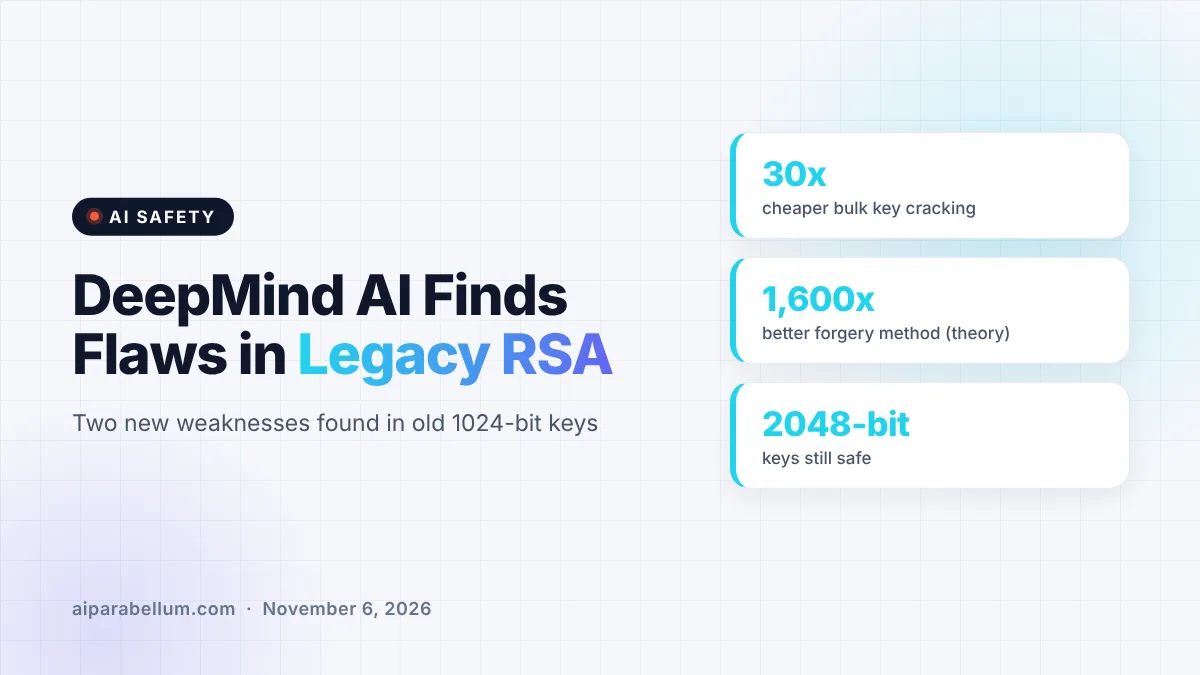
Google DeepMind has shared new RSA research showing that AI agents, guided by human experts, found two ways to weaken old 1024-bit RSA encryption in just weeks. DeepMind says the results only affect obsolete 1024-bit systems, and that modern 2048-bit keys remain secure. Still, the finding is a clear sign that AI is starting to speed up the slow, careful work of testing how strong our encryption really is.
The work was announced on November 6, 2026, by Pushmeet Kohli, DeepMind’s VP of Science. It covers two separate results: one about forging digital signatures and one about cracking many RSA keys at once.
What DeepMind’s RSA Research Found
RSA security rests on a simple idea. Multiplying two huge prime numbers is easy, but working backward to find those primes from their product is extremely hard. Security experts call this computational “hardness,” and much of the internet’s trust depends on it.
DeepMind says its AI agents showed that legacy 1024-bit RSA can be compromised with less computing power than experts thought. The team led by Dj Dvijotham and Abhradeep Thakurta worked with outside cryptographers Nadia Heninger of UC San Diego and Inria and Emmanuel Thomé of Inria.
Here is a quick look at the two results and the numbers DeepMind reported.
| Result | What it targets | Reported gain |
|---|---|---|
| Signature forgery (attacker controls half the block or more) | Padding in digital signatures | Padding adds no protection; demo ran with 3.5x less CPU time |
| Signature forgery (short 32-byte fingerprint) | Harder forgery cases | About 1,600x better than the previous best method, in theory |
| Batch factoring | Cracking many 1024-bit keys at once | About 30x lower average cost per extra key |
Result One: Padding Stops Helping
Digital signatures prove that a software update, document or website really comes from who it claims. Many signature standards add preset filler data, called padding, before signing a message. Experts knew padding helps, but not how much protection it gives when an attacker can feed chosen inputs to a signing device.
DeepMind says the answer depends on how much of the signed block the attacker controls. Once that reaches about half or more, padding offers no extra protection at all. In a sandboxed test on an already-solved benchmark key, the agents reproduced an earlier academic result using 3.5 times less CPU time, without touching any live systems.
Result Two: Cheaper Bulk Key Cracking
RSA keys usually come in standard sizes, such as 1024 or 2048 bits. That means an attacker can pay for one big up-front computation and spread its cost across many keys. DeepMind says its agents discovered a new algorithm that cuts the average cost of factoring each additional 1024-bit key by about 30 times compared with earlier batch methods.
Why This RSA Research Matters for Security
Big advances in cryptanalysis have historically taken years or even decades. That gave defenders time to retire weak standards before attackers caught up. DeepMind’s point is that AI agents can now probe these assumptions much faster, so experts should not treat hardness as a fixed fact.
This fits a wider trend of AI being aimed at security work. Google recently launched a cybersecurity-focused model, and many teams already use AI for threat detection work. The same tools that help defenders find weak spots could, in other hands, help attackers, which is why DeepMind framed this as a reason to test standards early.
The company stresses that RSA-1024 was used as a safe proving ground because it is already retired. Security researchers often use such old systems to measure progress without putting real users at risk.
What This Means for You
For most people, nothing changes today. Modern websites, banking apps and messaging services almost universally use 2048-bit keys or stronger encryption, which DeepMind says are not affected.
If you manage systems, devices or software, a few practical steps make sense:
- Check for any remaining 1024-bit RSA keys in old servers, VPNs, embedded devices or code-signing setups, and replace them.
- Use 2048-bit RSA or larger, or modern alternatives, for any new keys.
- Review signing systems that let outside users influence large parts of the signed data.
- Follow guidance from standards bodies as the security community digests these papers.
- Keep an eye on how AI agent security tools evolve, since they are changing fast.
Old encryption that felt “good enough” is now a real liability, and AI is making that gap close faster than before.
What Comes Next
DeepMind says it has published full technical papers on both the signature and factoring results so the wider security community can check and build on them. Independent review by cryptographers will be the real test of how much these methods matter in practice.
You can follow more updates like this in our AI news section, where we track how labs such as DeepMind apply AI to science and security.
Sources
Primary source: Pushmeet Kohli’s DeepMind cryptanalysis announcement. Additional details from Google DeepMind’s announcement post.
Conclusion
Google DeepMind’s AI agents found two new weaknesses in legacy 1024-bit RSA, making signature forgery easier in some cases and cutting the cost of cracking many keys at once. Modern 2048-bit encryption is not affected, so everyday users can stay calm. The bigger lesson is speed: AI can now stress-test encryption in weeks rather than years. Organizations still running old 1024-bit keys should treat this as a strong reminder to upgrade now.