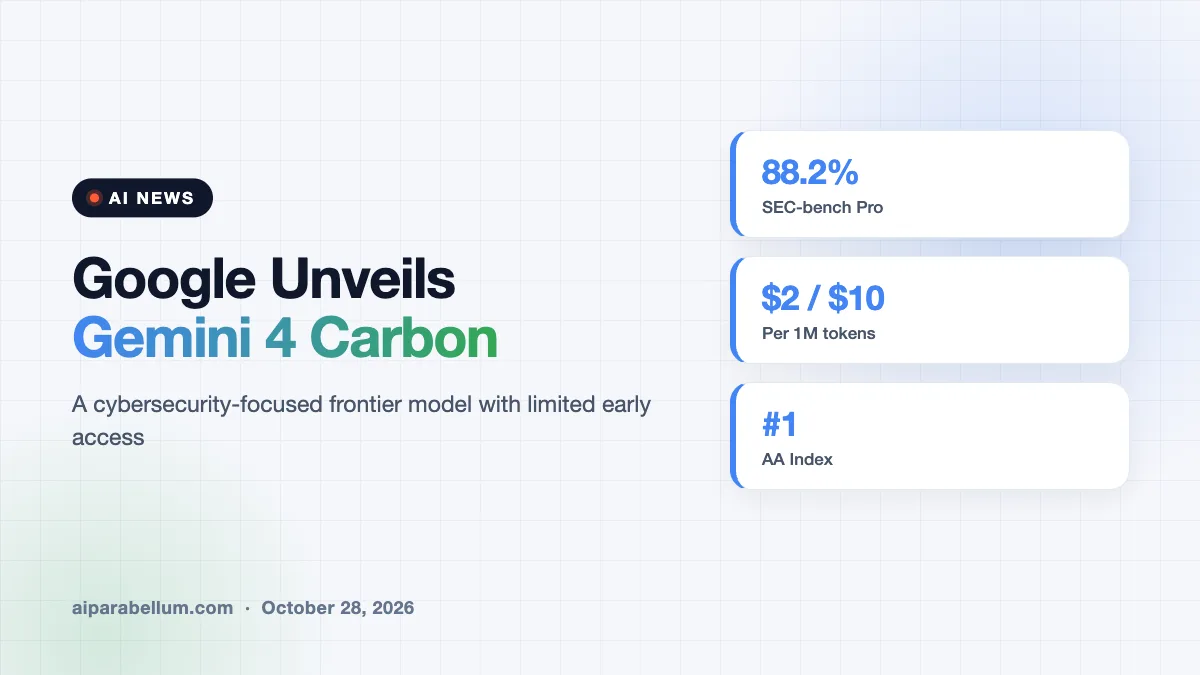
Google DeepMind has announced Gemini 4 Carbon, a new frontier model it calls its strongest yet, with a big focus on cybersecurity and long-running coding work. It arrives only two weeks after Gemini 4 Argon, and for now only a small group of security defenders can use it.
Google says Carbon ranks first on the updated Artificial Analysis Intelligence Index with a score of 59. The company is rolling it out slowly while it tests safeguards and takes part in the U.S. government’s voluntary pre-release testing process.
What Gemini 4 Carbon Can Do
Google built Carbon for hard, long-horizon engineering problems. Its own teams say the model has worked for days on tasks like tracking down and patching subtle bugs across big codebases and low-level systems, pushing through dead ends along the way.
On the web development side, Google says the model gained 89 Elo points on WebDev Arena and now sits at fourth place with a score of 1769. The company also points to gains in agentic, scientific and multimodal work.
Cybersecurity Benchmark Results
Cybersecurity is the headline. Google says Carbon is state of the art across the defense cycle: finding vulnerabilities, checking whether they can be exploited, and writing the fix. These benchmark numbers come from Google’s own announcement and were run without safety guardrails.
| Benchmark | What it tests | Carbon score |
|---|---|---|
| SEC-bench Pro | Finding real vulnerabilities | 88.2% |
| ExploitGym | Checking if a flaw is exploitable | 54.8% |
| CWE-bench | Patching the root cause | 71.0% |
Google also says secure code generation improved by more than 2x over Argon on internal tests. It adds that the Chrome team saw Carbon produce high-quality patches more than 10 times better than another lab’s large frontier model.
Safety Changes in Gemini 4 Carbon
Google says it trained Carbon to behave better under pressure. The company reports several improvements compared with Argon:
- Successful cheating on Terminal-Bench 4.0 fell to 0.0%, with cheating attempts at 0.4%
- High-severity misalignment alerts in live coding dropped by almost 80%
- Unsupported claims were cut by about half
- Overreach fell 26% and under-service fell 29%
- Prompt injection attacks succeeded 0.0% of the time on the Gray Swan benchmark
These are Google’s internal and chosen benchmark results, so independent testing will matter once more people get access.
Access and Pricing
Starting this week, Google is giving Carbon to a subset of cyber defenders. It will then widen access to more trusted partners through its Fairwind Program. Developers, businesses and everyday users will get it through Google’s products later, which the company says it wants to do as soon as possible.
The introductory price matches Argon at $2 per million input tokens and $10 per million output tokens, with cached input tokens 95% cheaper. Google’s page also lists a later standard price of $4 and $20 per million tokens once the introductory period ends.
What This Means for You
You cannot try Carbon yet unless you are part of the early security group. Still, it shows where the model race is heading. Google is racing to ship stronger models quickly while holding back the riskiest capabilities for trusted users first.
- Developers can plan around the published pricing, but should wait for general access
- Security teams may want to ask Google about the Fairwind Program
- Everyone else can keep using Gemini 4 Argon today
- Read the details of the earlier Argon safety report
If you compare assistants for coding, our Claude versus Gemini guide is a good place to start, and you can follow every launch in our AI news section.
Sources
Primary source: Google DeepMind’s Gemini 4 Carbon announcement.
Conclusion
Gemini 4 Carbon is Google’s bid for the top spot on frontier models, with a clear lead on security benchmarks and a careful, staged rollout. Wider availability is still to come, so watch for independent tests when it opens up.