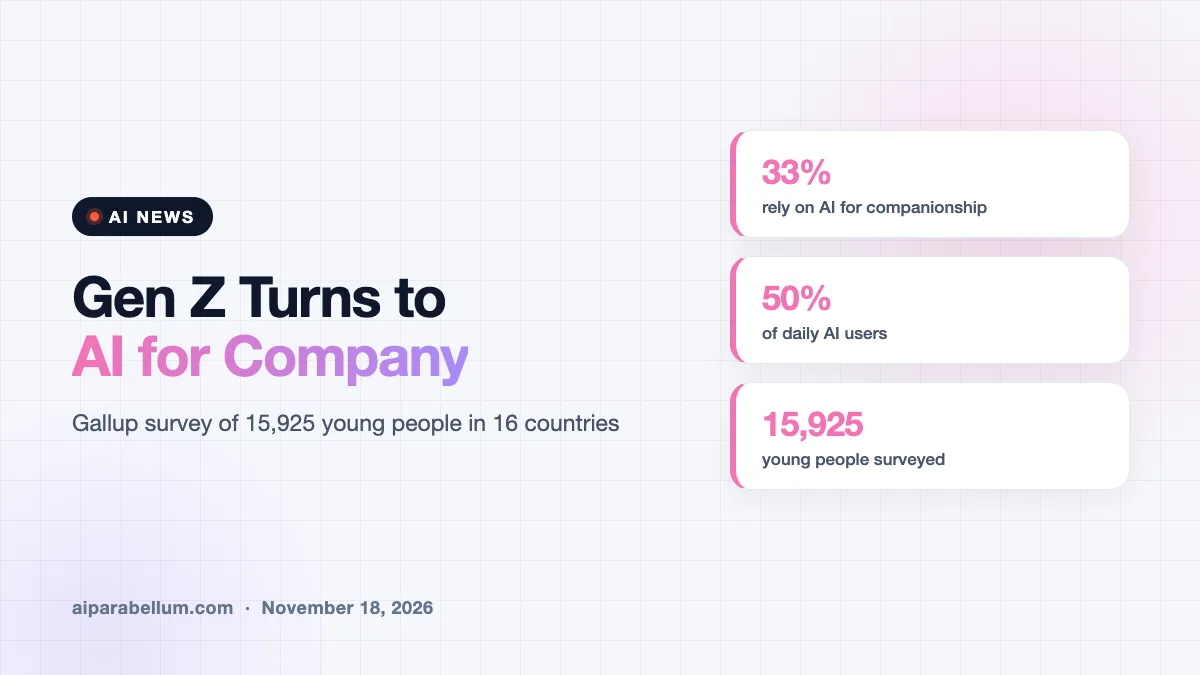
A new global survey on AI companionship among Gen Z found that 33 percent of young people ages 15 to 22 lean on AI for social connection. The research, run by Gallup with the Digital Wellness Lab at Boston Children’s Hospital, also suggests that teens and young adults who turn to chatbots for company may face higher odds of loneliness. Here’s what the study found and why it matters for families and anyone who uses AI every day.
What the Gen Z AI Companionship Survey Found
The report is titled “Friendship in an Online-Offline World: Digital Life, Connection and Wellbeing.” Researchers surveyed 15,925 people ages 15 to 22 across 16 countries between May and August of this year. It is the first phase of a larger study called Belonging by Design.
The headline number is that about one in three young people say they rely on AI for companionship. That share rises sharply among heavy users.
| Group | Share relying on AI for companionship |
|---|---|
| All Gen Z respondents (ages 15-22) | 33% |
| Young people with online-only friends | 42% |
| Daily AI users | 50% |
In other words, half of young people who use AI every day also treat it as a social companion. That’s a big shift for tools that most adults still think of as search or writing helpers, like ChatGPT and similar assistants.
Gen Z Still Gets the Most From In-Person Friends
The study looked at three kinds of close friendship. It compared friends young people see in person, friends who started offline but now mostly talk online, and online-only friends they have never met.
In-person friendships scored highest for strength and support. They were also tied to the most positive emotions. The authors write that in-person and digital friendships “coexist within the same social life,” so AI hasn’t replaced real-world bonds.
The Loneliness Question
Young people who rely on online-only friends or AI companions may have higher odds of loneliness than those who don’t. The researchers stress that the findings show links, not cause and effect.
Gallup principal researcher Andrew Dugan said the open question is whether young people turn to AI because they already feel lonely, or whether AI companionship deepens those feelings. That uncertainty is exactly why parents and policymakers are watching this space closely.
How Young People Find Friends Online
The survey also mapped where online friendships begin. Patterns split clearly by gender and platform.
- Young men were more likely to have digital friendships, and many met new friends through gaming.
- Young women most often met online friends through social media or messaging apps.
- In the US, Instagram and Discord topped the list for staying in touch with online-only friends, ahead of TikTok.
- Nearly half of young Americans have at least one close friend they know only online.
David Bickham, research director of the Digital Wellness Lab, said lonely kids tend to keep reaching out for connection. For socially anxious boys, that can mean chatting with AI instead of people.
Why This AI Companionship Data Matters Now
The report arrives as governments push harder on youth online safety. Australia and the UK put social media limits for minors into effect this year, and US states are weighing rules on addictive design. New York recently passed an AI chatbot safety law aimed at protecting kids.
Companion apps are also under pressure. Apple now requires an 18+ age rating for romantic AI companions, and several states have taken legal action over child safety concerns with popular chatbots.
Meanwhile, investors keep backing the category, with startups like Tolan’s AI companion raising fresh funding. That mix of rapid growth and rising scrutiny makes solid data like this survey more valuable.
Takeaway: AI is already part of how many young people socialize. The open question is whether it helps them connect or quietly keeps them isolated.
What This Means for You
If you’re a parent, teacher or young adult, these findings offer a few practical points.
- Ask how, not just how long. The researchers argue that the quality of online relationships matters more than raw screen time.
- Watch for loneliness signals. Heavy reliance on a chatbot for comfort can be a sign someone needs more human contact.
- Encourage in-person time. Real-world friendships showed the strongest link to wellbeing in the study.
- Check app settings. Many AI tools now offer teen modes, age checks and content limits worth reviewing.
If you use AI daily yourself, it’s worth noticing when a chat turns from task help into emotional support. That isn’t automatically harmful, but it’s a habit to be aware of.
Gallup expects AI companionship to become more common over the next five years as these tools spread. A second phase of the study, built on focus groups in six countries, is planned for spring 2027. You can follow more updates in our AI news coverage.
Sources
Reporting from WIRED, which reviewed the Gallup and Digital Wellness Lab report and interviewed its researchers.
Conclusion
A third of Gen Z now leans on AI for companionship, and half of daily AI users do. In-person friends still deliver the strongest support, but the link between AI companions and loneliness raises real questions. The researchers can’t yet say which comes first. For now, the smartest move for families is to talk openly about how young people use these tools and to keep real-world connection front and center.