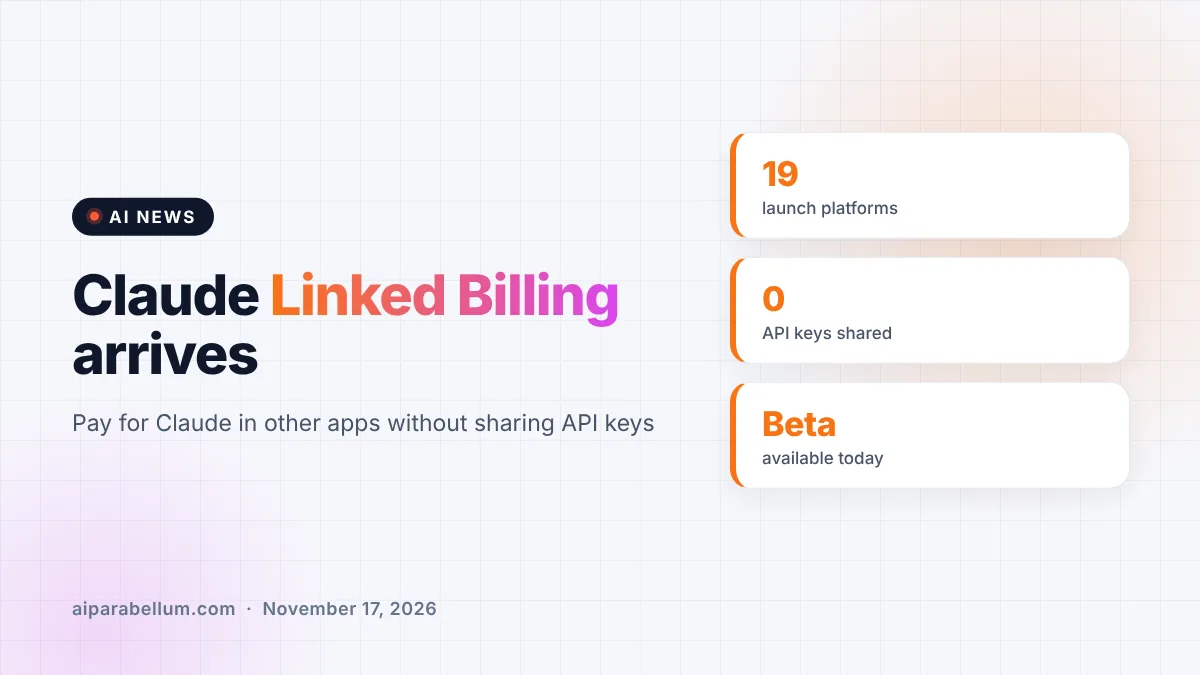
Anthropic has launched linked billing on the Claude Platform in beta, a new way to pay for Claude API usage inside third-party apps without handing over an API key. Instead of pasting a key into a coding agent or automation tool, you link your Claude Platform organization, set a spend limit and get billed directly by Anthropic. Nineteen platforms, including Linear, Asana, Warp, Ramp and Railway, support it at launch.
How Claude Linked Billing Works
Today, using Claude inside another company’s product usually means sharing an API key. Anthropic compares that key to a password: anyone holding it can run requests billed to you, so the platform has to guard it carefully. With linked billing, no key changes hands at all.
A Console user with an Owner, Admin or Billing role approves the link once for the whole organization, using a flow that Anthropic hosts. From then on, Claude API usage on that platform is billed straight to your Claude organization. You can draw down an existing Anthropic commitment or pay as you go.
One catch on settings
Anthropic notes that requests run inside the platform’s organization, not yours. That means settings in your own organization, such as IP allowlists, encryption keys and data retention rules, do not apply to that traffic. Security teams should keep that in mind before approving a link.
What Customers and Platforms Each Get
Linked billing splits the work in a way that suits both sides. Here is a quick look at the main controls Anthropic describes.
| For customers | For platforms |
|---|---|
| Approve each platform and unlink any time | No customer keys to store, encrypt or rotate |
| Monthly spend limit per platform, or a default | Anthropic hosts the approval flow and billing |
| Console shows spend for each linked platform | Usage per customer: requests, tokens and models |
| Use existing Anthropic commitment or pay as you go | Choose per request whether platform or customer pays |
Platforms can pull each customer’s usage in Console or through the Usage and Cost Analytics API, which is also in beta. The per-request payer choice lets a company pass Claude costs to customers or cover some features itself.
Launch Partners for Claude Platform Linked Billing
Anthropic lists 19 platforms that support linked billing today. Many are coding agents and workflow tools, the kinds of apps where people most often paste API keys.
- Coding and dev tools: Factory, Kilo Code, Warp, Harness, Niteshift, Railway and Mintlify
- Work and automation: Asana, Linear, Gumloop, Tines and Major
- Data and finance: ClickHouse, Omni, Ramp and Tessera
- Creative and security: Higgsfield AI, OpenArt and Runlayer
Partners quoted by Anthropic mostly stress security. Linear says copying API keys by hand is “inherently insecure,” and Runlayer calls the change one less attack vector. Other platforms can add support by creating an app in Console, and customers can find supported tools on Claude Marketplace.
What This Means for You
If your team already pays for Claude and uses it through other tools, linked billing could clean up a messy setup. It fits neatly with recent moves like self-hosted managed agents that push Claude deeper into company workflows.
- Audit where your Anthropic API keys are pasted today, and switch supported tools to linked billing.
- Set a monthly cap for each platform so one runaway agent cannot drain your budget.
- Check with security first, since your org’s IP allowlists and retention settings will not cover linked traffic.
- Revoke old keys once a tool is linked, so leftover copies stop working.
Developers building with Claude models may also find this useful if they run their own platform. It removes the need to build metering and invoicing, and it pairs well with lessons from incidents like the OpenCode API key breach. For more updates like this, see our AI news coverage.
Sources
Primary source: Anthropic’s linked billing announcement on the Claude blog.
Conclusion
Linked billing gives Claude customers a safer way to use their API spend inside other apps, with no keys to share and clear limits per platform. Platforms get billing and approval handled for them, plus usage data for each customer. The feature is still in beta, and the gap in organization-level settings is worth checking first. For teams juggling Claude keys across many tools, though, it is a welcome fix.