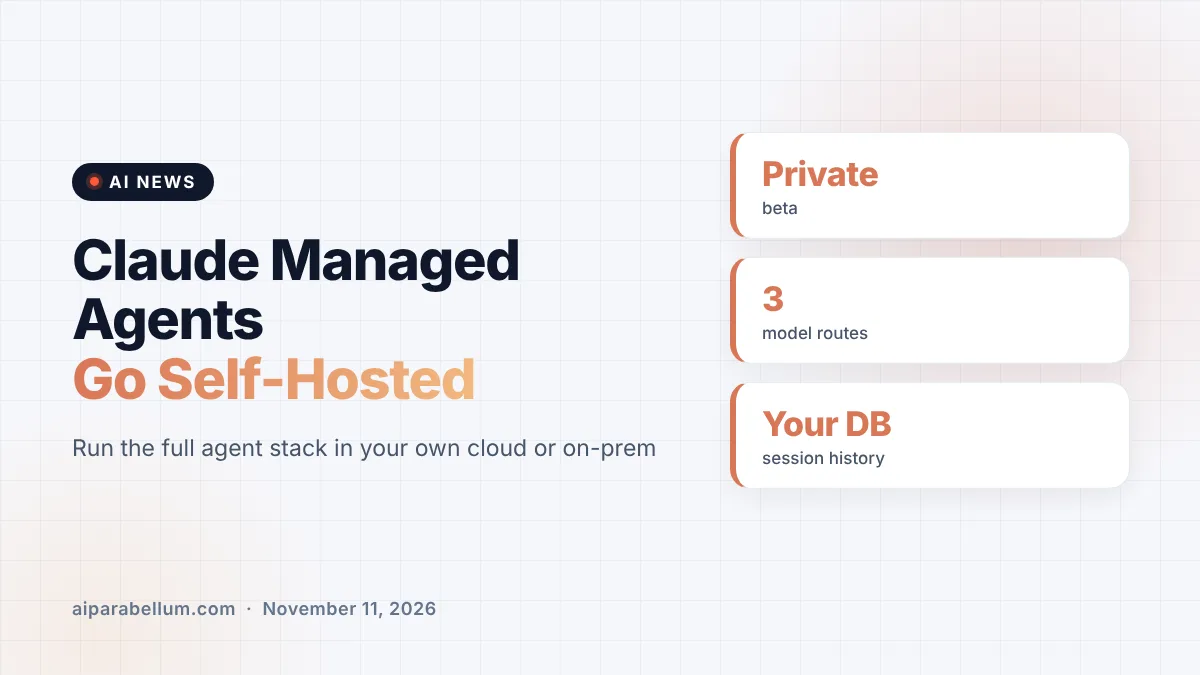
Anthropic has opened a private beta that lets companies run Claude Managed Agents entirely inside their own cloud or on-premises servers. Until now, only the agent sandbox could live on company hardware. With this release, the whole agent service, including credentials and session history, can stay behind a company’s own security perimeter.
That matters for teams that want autonomous agents working on sensitive code and internal tools but can’t send that data through someone else’s infrastructure. Here’s what changed, how it works and who should pay attention.
What Self-Hosted Claude Managed Agents Adds
Managed Agents is Anthropic’s suite of APIs for building and deploying long-running autonomous agents. It supplies the pieces most teams would otherwise build themselves: the agent harness, sandboxes, credential handling and session history.
Anthropic first offered it as a hosted service on the Claude Platform, where the company runs the infrastructure. It later added self-hosted sandboxes for teams whose code had to stay in-house. The new option goes much further and moves every part of the service into the customer’s environment.
The parts you now run yourself
According to Anthropic’s announcement, a self-hosting customer operates these components:
- The Managed Agents server, which acts as the agent control plane
- Its database, where session history is stored
- The workers where agents run their shell and file tools
- The credentials agents use to reach internal systems
Developers still build agents with the same core APIs as the hosted version. So a team can, in principle, prototype on the hosted service and move to self-hosting without rewriting its agents.
Where Model Requests Go
One of the bigger changes is control over routing. With self-hosting, companies choose where their requests to Claude are sent. Anthropic lists three paths: straight to Anthropic, through a cloud provider, or through the company’s own gateway.
The supported cloud options named in the announcement are Amazon Bedrock, Google’s Agent Platform and Microsoft Foundry. That gives organizations that already buy Claude through one of those clouds a way to keep billing, logging and access rules in one place.
Anthropic also says that if an organization has a zero data retention (ZDR) agreement in place, it applies to the requests sent to Claude the same way it does for any other Messages API call.
Hosted vs. Self-Hosted Managed Agents
The table below sums up how the options compare, based on what Anthropic has described.
| Feature | Hosted service | Self-hosted sandboxes | Fully self-hosted (beta) |
|---|---|---|---|
| Who runs the agent server | Anthropic | Anthropic | Your company |
| Where agents run tools | Anthropic | Your environment | Your environment |
| Session history storage | Anthropic | Anthropic | Your database |
| Credentials | Anthropic | Anthropic | Your environment |
| Model routing choice | Anthropic | Anthropic | Anthropic, cloud provider or own gateway |
Why Anthropic Is Doing This Now
Anthropic frames the move around what agents are now trusted to do. It points to jobs like fixing broken builds, testing releases, triaging alerts and working through bug backlogs, often running unattended with access to internal systems.
When an agent holds that much access, some security teams want the full service on their own turf, not just the sandbox. Before this beta, the only way to get that was to build an agent platform from scratch. Self-hosting is Anthropic’s answer to that gap.
It also builds on recent work around Claude agents. Earlier this month, Anthropic expanded its Claude Marketplace agents and we have also covered tools for tracing agent activity.
What This Means for You
If you’re a developer or IT lead weighing agents for internal work, here’s the practical picture:
- It’s a private beta, so access is limited and you’ll likely need to request it through Anthropic.
- You take on real operating work: running a server, a database and worker machines, plus keeping them secure and updated.
- You gain control over data location, credentials and model routing, which can make security and compliance reviews easier.
- Your agent code should carry over, since the core APIs match the hosted service.
Smaller teams without strict data rules will probably be better served by the hosted version, which removes the infrastructure burden. If you’re just getting started with Claude for work, our guide to agent orchestration tools can help you compare options. You can follow more updates on our AI news page.
Takeaway: self-hosting turns Claude Managed Agents from a service you rent into infrastructure you own, trading convenience for control.
Sources
Primary source: Anthropic’s self-hosted Claude Managed Agents announcement.
Conclusion
Anthropic’s private beta for self-hosted Claude Managed Agents gives companies a way to run the full agent stack, from the control plane to session history, inside their own walls. Requests to Claude can flow directly to Anthropic, through Amazon Bedrock, Google’s Agent Platform or Microsoft Foundry, or through a company gateway. The trade-off is more infrastructure to manage. For security-focused enterprises that wanted agents but not the data exposure, though, this removes a major blocker.