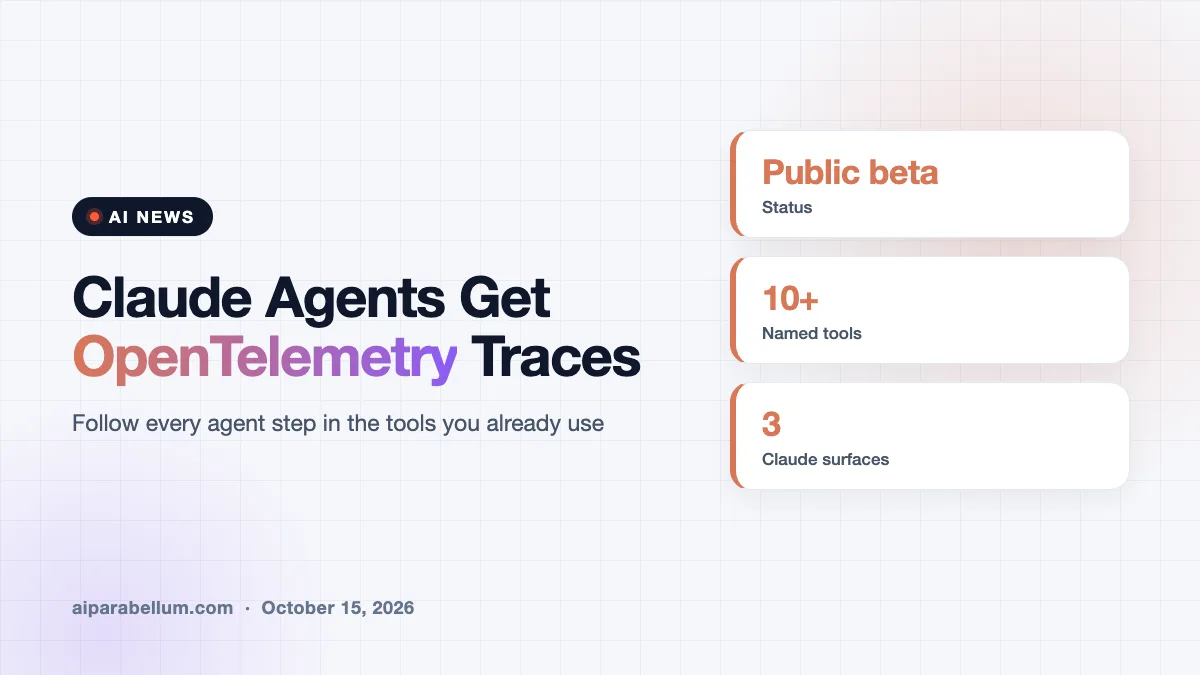
Anthropic has added Claude OpenTelemetry support to the Claude Platform, so developers can follow every step their AI agents take. Traces from Claude Managed Agents, the Messages API, and Claude SDKs can now flow into almost any observability tool. The feature launched in public beta on October 14, 2026.
What Claude OpenTelemetry Support Adds
OpenTelemetry, often shortened to OTel, is an open standard for recording what software does. A trace is the full record of one request, and each step inside it, like a model call or a tool use, is called a span.
With this update, every agent turn, model call, and tool use can show up in your monitoring tool as a standard trace. Each one carries latency, token counts, and IDs, so you can see where time and money go.
Anthropic says the traces follow the OpenTelemetry GenAI semantic conventions. In plain terms, data from Claude and from other AI providers can live side by side in the same dashboards.
Two Ways to Turn It On
Managed Agents and the Messages API need a destination added in the Claude Console. Claude SDKs export traces automatically once tracing is set up in code.
According to Anthropic’s documentation, the Console route needs Admin permission, while the SDK route does not. Setting up both puts a request’s SDK and API steps in one combined trace.
Which Monitoring Tools Work With Claude Traces
Anthropic grouped its launch partners by what teams want to do with the data. Any other tool that accepts a standard OTLP endpoint should work too.
| Goal | Named tools |
|---|---|
| Debug agents next to the rest of your stack | Grafana Cloud, Honeycomb, Sentry, Splunk |
| Improve agents with real production data | Arize AI, Braintrust, Datadog, Langfuse, LangSmith, New Relic, PostHog |
| Track token usage across a company | Databricks Unity Gateway |
If your team already sends Claude Code or Cowork traces to a monitoring tool, agents built on the Claude Platform can now appear in the same place. That makes it easier to see a whole workflow, not just one piece of it.
Privacy Controls in Claude Agent Tracing
Each destination has a content mode. The default, metadata only, records IDs, timing, status, and token counts without your prompts or responses.
A full content mode adds the prompts and model answers, which is handy for debugging but more sensitive. The documentation says each span holds up to about 0.75 MB of content by default, and longer content gets trimmed and flagged.
Organizations with HIPAA, FERPA, or K-12 data restrictions only export metadata from Console destinations, whatever setting they pick. That guardrail matters for health and education teams testing AI agent tools on real data.
What Early Customers Are Seeing
Anthropic shared comments from several early users. The examples show how tracing can feed straight into making agents cheaper and faster.
- Ramp says its internal system that scores traces and suggests fixes has cut token use by 10% to 20% on some agents and made sessions 30% faster.
- Foxglove, which builds agents for robotics teams, studies agent behavior in PostHog next to product usage data.
- FloQast, an accounting software company, keeps each model call in the same timeline as the bookkeeping task it ran inside, so it can answer auditor questions.
- Sterling Labs streams traces from its market-analysis agents into Langfuse with no custom setup.
Giving an agent more access is a lot less scary when you can replay exactly what it did last time.
Anthropic frames tracing as a trust-building step. Its advice is to review an agent’s traces first, then widen its access as it proves reliable.
What This Means for You
If you build on the Claude API, you no longer need custom code to see inside your agents. Here are a few practical next steps.
- Start with the default metadata mode so you can track speed and cost without storing sensitive prompts.
- Switch to full content only for testing or debugging, and check your data policies first.
- Count tokens from one source per request, since SDK and API spans can overlap.
- Use traces to set clear rules before giving an agent more permissions.
If you mostly use the coding tool, our guide to Claude Code permissions pairs well with this. New to the assistant? Our Claude AI overview covers the basics.
You can see how other developers use it in our story on Linux kernel patches. For more updates, visit our AI news page.
Sources
This article is based on Anthropic’s announcement, Agent observability on the Claude Platform, and a summary of the related documentation from Unite.AI.
Conclusion
Claude agents can now send standard OpenTelemetry traces to tools like Datadog, Grafana Cloud, Langfuse, and Sentry. The public beta covers Managed Agents, the Messages API, and Claude SDKs, with a privacy-first default that skips prompts and responses. Early users say the data is already helping them cut costs and speed up agents. If you run Claude agents in production, this is one of the simplest ways to see what they are really doing before you trust them with more.