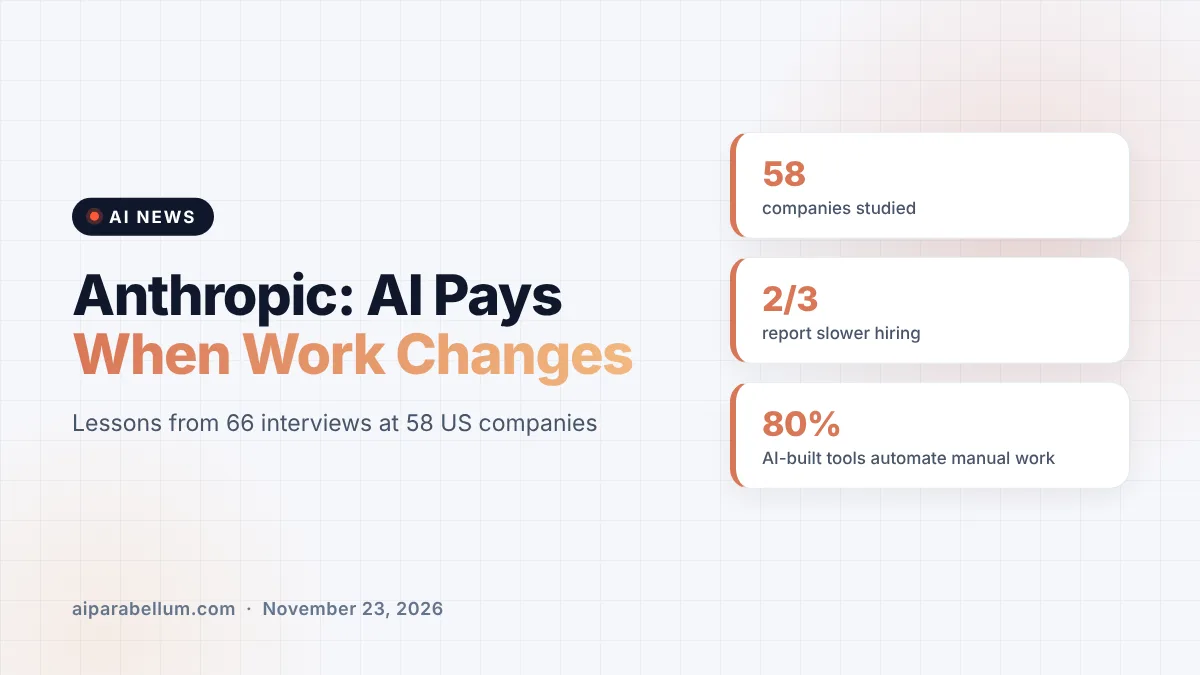
A new Anthropic study on AI adoption at work suggests the biggest payoff doesn’t come from handing out chatbots or automating one task at a time. After 66 interviews with people at 58 of its US business customers, Anthropic’s economists say the companies getting the most value are the ones reshaping jobs around what AI still can’t do. The report, titled “Working with AI,” was published on November 23, 2026.
What the AI Adoption Study Looked At
The research team, Nathan Wilmers, Maxim Massenkoff and Peter McCrory, spoke with executives, managers and individual contributors. The mix ran from AI-native startups to 100-year-old firms, including law offices, dentists, accountants, hedge funds, manufacturers, a trucking company and a publisher.
Anthropic is upfront about the limits. The interviews were anonymous, every company is an Anthropic customer, and the sample was picked for variety rather than to represent the whole economy. The value ratings are mostly what interviewees told the researchers, not results from controlled tests.
Even so, the scale of the material is useful. The team coded close to 300 specific AI applications and around 140 pieces of software that people said they built with AI.
Key Numbers From the Report
Here are the figures that stand out most from the study.
| Finding | What Anthropic Reported |
|---|---|
| Interviews and companies | 66 interviews across 58 US companies |
| AI-built software that automated manual work | 80% of 100 categorized tools |
| AI-built software that replaced existing tools | 20%, often products bought from vendors |
| Companies reporting slower hiring due to AI | About two-thirds |
| Companies hiring more because of AI | 10, mainly AI implementation and IT roles |
| Cases where automation fully cut a job | 2 companies |
| Startups’ estimate without AI | About 4 times as many employees needed |
Where AI Adds Value at Work
Most interviewees said AI added value by raising output, not by cutting costs. Roughly half of those gains came from speeding up existing work, while the other half came from better or entirely new products and services. One dental company, for example, added an after-hours AI answering service so late-night calls no longer went to voicemail.
Coding agents showed up everywhere, and not just with engineers. Nontechnical experts, such as an accountant who built a 401(k) audit tool with Claude’s help, often got the most out of them. In about one in ten use cases, workers themselves captured the benefit through less tedious work or more free time.
Top-Down vs. Bottom-Up AI Adoption
The report describes two common approaches, and both have problems. Top-down automation, where leaders pick a workflow and replace it, often led to cut contractors, slower hiring and closer monitoring of staff. It also tended to be brittle, since vendor tools built for a narrow task could look outdated within months as models improved.
Experts asked to build those systems also pushed back. One employee quoted in the report said that being open to automating their own work felt like building their own coffin.
Bottom-up adoption, where a company simply hands out AI tools, created “pockets” of impressive work but rarely changed the whole business. Common bottlenecks included:
- Too much AI output for people to review carefully
- Other teams, like sales or legal, unable to keep pace with faster coding
- Uneven use, where power users flood skeptical coworkers with AI-written material
- Homemade apps that still need upkeep from technical staff
- Missing data and infrastructure for AI tools to work with
Customer pushback and regulation, by contrast, were rarely named as roadblocks.
The Third Path: Reorganizing Around AI
The companies that described the highest value took a different route. They broadened roles so one person or a small team owns a whole workflow, which cuts down on handoffs. Some merged designer, product manager, engineer and QA duties into a single role.
They also moved people toward the tasks AI still struggles with, such as talking to customers, making judgment calls and reviewing code. A third step was building shared data and secure infrastructure so nontechnical staff could run their own analysis and build apps safely.
What This Means for You
If you’re leading AI adoption on a team, this study offers some practical lessons. It also fits a broader pattern of companies treating AI agents as core systems rather than side tools.
- Don’t stop at buying licenses. Plan how roles and handoffs will change once some tasks speed up.
- Find the new bottleneck. If coding gets faster, look at review, testing and sales next.
- Give people access to clean company data, since AI is only as useful as the context it gets.
- Share the gains with staff. Anthropic suggests this makes experts more willing to help redesign workflows.
- Avoid locking into one fixed setup, because model abilities keep moving.
For individual workers, the message is to lean into the parts of your job that need people, like judgment, relationships and strategy. You can also explore our roundup of business AI tools to see what fits your workflow.
How This Fits Anthropic’s Research Push
Anthropic has been publishing a steady stream of studies on how people use Claude, including an earlier look at how scientists use Claude. This report leans more on interviews than usage data, and the authors say follow-up quantitative work should test their framework.
The report closes by saying model developers like Anthropic should support businesses with training and help as they reorganize. You can follow more stories like this in our AI news section.
Sources
Primary source: Anthropic’s “Working with AI” research report.
Conclusion
Anthropic’s interviews paint a clear picture: AI adoption delivers the most when companies change how work is organized, not just which tools people use. Pure automation can save money but often sparks resistance and breaks as models improve. Letting individuals experiment helps, yet those wins stall without wider support. The firms doing best are broadening roles, moving people toward the tasks AI can’t handle and opening up their data. The study is small and not fully representative, but it gives business leaders a useful roadmap.