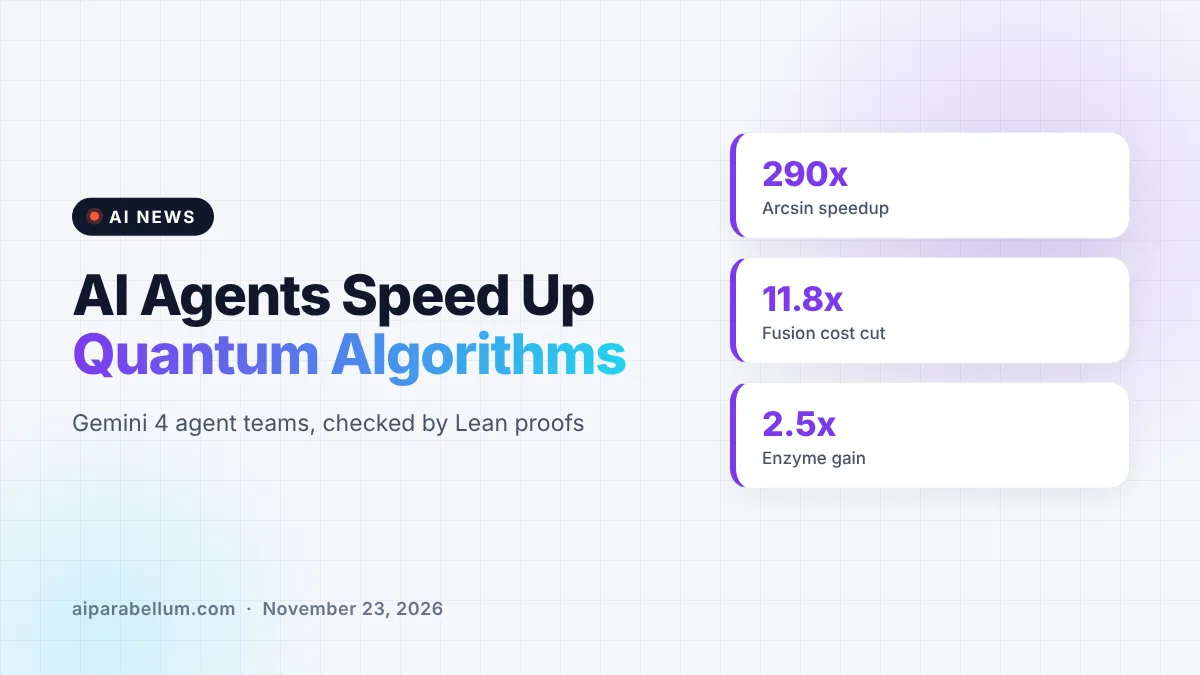
Google DeepMind says teams of Gemini 4 agents have found faster quantum algorithms for problems tied to fusion energy, drug design and basic quantum math. Every improvement was checked with Lean, a formal theorem prover, so the gains rest on mathematical proof instead of trust. The work comes from a joint project with Google Quantum AI, and the code is being released as open source.
How the Agents Improved Quantum Algorithms
Quantum computers promise to handle problems that stump today’s supercomputers. The catch is cost: even the best known quantum algorithms for useful tasks often need more qubits and operations than early machines will have. Shrinking those requirements is one of the main ways researchers can bring useful quantum computing closer.
DeepMind tackled that problem by giving each target task to several separate teams of Gemini 4 agents. Each team searched for ways to make a known quantum circuit cheaper, which means fewer qubits, fewer operations, or both. A quantum circuit is basically the step-by-step recipe a quantum computer follows to run an algorithm.
A Virtual Conference Every Four Hours
The setup borrowed an idea from human science. Every four hours, agents from the different teams met at a virtual conference to swap, debate and compare their ideas. Over time the best ideas spread between teams, and the computing cost of the circuits kept dropping until the experiment ended.
Why Formal Proofs Matter Here
There is a practical problem with testing new quantum circuits: you can’t simply run them. Large circuits are too heavy for classical computers to simulate and too big for today’s small quantum chips. So the only way to know an improved circuit works is to prove it mathematically.
That is where Lean comes in. The agents had to prove each result in Lean before it could enter a shared notebook that all teams used. DeepMind built a new open-source Lean library for quantum algorithms to make this possible, and it is publishing that library, the problem specifications and the verified solutions on GitHub.
The big idea is not just speed. It’s AI doing real research while a proof checker keeps it honest, so humans can trust results they can’t easily test.
The Quantum Algorithm Results in Numbers
DeepMind picked problems linked to clean energy and medicine, but says the method could work in other fields too. Here are the headline results it reported:
| Problem | What It Models | Reported Improvement |
|---|---|---|
| Inertial confinement fusion | Lasers compressing hydrogen fuel to ignition | 11.8x lower computing cost; qubits cut from 5,650 to 4,338 |
| Light-sensitive molecule | Photochemical reactions | 8x cheaper simulation |
| Cytochrome P450 | Enzyme that breaks down most medicines | 2.5x improvement; qubits cut from 481 to 333 |
| Grover’s algorithm (one implementation) | Searching an unsorted list | 2.57x speedup |
| Arcsin routine | Loading numbers into quantum states | 290x speedup |
The fusion and enzyme cases also cut memory, measured in error-corrected qubits. For the enzyme, the agents got there by replacing bulky memory lookups with a leaner approach.
Still Beyond Today’s Hardware
DeepMind is upfront about the limits. Even with these gains, running these simulations would still need more resources than the first error-corrected quantum computers are likely to offer. The company still calls the improvements significant, since every cut brings real-world use a bit closer.
What This Means for You
You won’t run a quantum chemistry simulation on your laptop anytime soon. But this project shows where AI research tools are heading, and that affects anyone who uses or builds with AI. Here are the practical takeaways:
- Agent teams are doing real science. Multiple AI agents working together, like the Gemini agent teams in earlier experiments, are now producing results that experts care about.
- Verification is the key safeguard. Pairing AI with a proof checker means results can be trusted even when nobody can test them directly.
- Open tools help everyone. The Lean library and solutions on GitHub let other researchers check and build on the work.
- Drug design and energy could benefit later. Cheaper algorithms for enzymes and fusion lower the bar for useful quantum computing.
If you follow AI in science, this fits a wider pattern. Anthropic has also shown Claude designing quantum circuits, and quantum software startups are drawing big money, such as Q-CTRL’s $290M round. For broader picks, see our guide to the best research tools.
A Shift in How Research Gets Done
DeepMind argues that proof-checked AI search can compress work that once took years of manual design. In that model, human researchers choose the problems and interpret the results, while agents grind through the search. The company says its own quantum expertise, plus the way it set up the agent teams, is what produced the results.
This builds on a line of DeepMind projects that mix AI with formal math, including work where its agents verified Signal protocol code. You can catch more stories like this on our AI news page.
Sources
Primary source: Google DeepMind’s announcement on faster quantum algorithms.
Conclusion
Google DeepMind used teams of Gemini 4 agents, checked by the Lean theorem prover, to make several important quantum algorithms much cheaper to run, with gains from 2.5x up to 290x. The results still exceed what early quantum computers can handle, but they move useful quantum simulation a step closer. Just as important, the project shows a working recipe for AI-driven research: let agents search, make them prove their answers, and keep humans in charge of the questions. With the code going open source, other labs can now test that recipe for themselves.