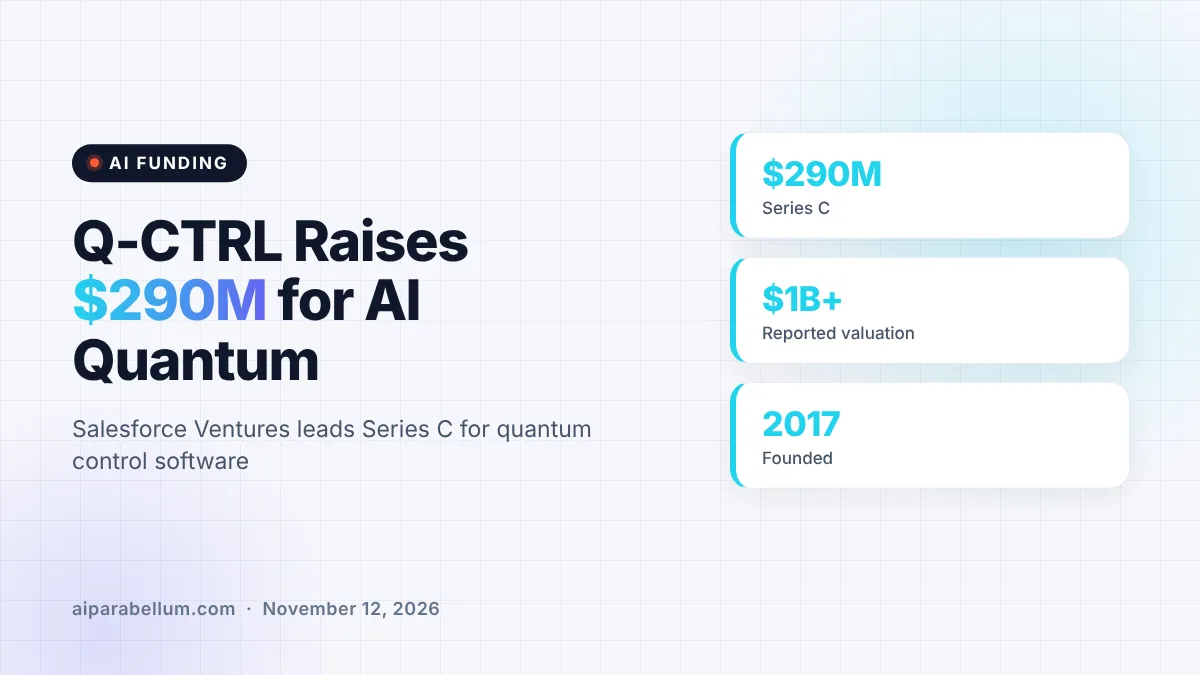
Q-CTRL, a quantum software company that uses AI to make quantum machines work better, has raised $290 million in a Series C round led by Salesforce Ventures. The AI quantum software maker says the money will help it grow its software platform, expand around the world and keep pushing its GPS-free navigation system into aircraft and autonomous vehicles. It is one of the biggest private rounds yet for a quantum company focused on software rather than hardware.
The $290M Q-CTRL Funding Round at a Glance
The company announced the round on November 12, 2026. In Australian dollars, the raise comes to about A$415 million. Bullhound Capital and Affinity Partners also took significant roles alongside Salesforce Ventures.
The round values Q-CTRL at more than $1 billion, according to Bloomberg reporting cited by Quartz. That puts the Sydney-founded company in unicorn territory, a rare spot for a firm that sells software for quantum hardware.
| Detail | What We Know |
|---|---|
| Amount | $290 million (about A$415 million) |
| Round | Series C |
| Lead investor | Salesforce Ventures |
| Other major backers | Bullhound Capital, Affinity Partners |
| Reported valuation | More than $1 billion |
| Founded | 2017, by Michael J. Biercuk |
| Flagship product | Ironstone Opal quantum navigation |
Who Else Is Backing the Company
The investor list mixes tech, defense and government money. New backers include:
- AMD Ventures, the chipmaker’s venture arm
- Affinity Partners and EDGE Group
- MPower Partners and SPARX Asset Management
- Australia’s National Reconstruction Fund Corporation
Returning investors include DCVC, In-Q-Tel, Lockheed Martin Ventures, Main Sequence, Square Peg and Salesforce Ventures itself, among others. That blend hints at where Q-CTRL sees demand: data centers, defense and aviation.
How Q-CTRL Uses AI for Quantum Computing
Quantum computers are powerful in theory, but they are also very noisy. Tiny disturbances cause errors, which makes it hard to get useful answers out of them. Q-CTRL builds what it calls “AI for quantum” software, a control layer that helps reduce those errors and works across different hardware makers.
CEO Michael J. Biercuk compared the software to noise-canceling headphones, according to Bloomberg. The company says its approach can make quantum machines thousands of times more powerful, though that is its own claim.
Salesforce Ventures partner Robert Keith pointed to concrete results. He noted that a Q-CTRL materials simulation now runs on IBM hardware and that developers can call it directly from the IBM Quantum Platform.
GPS-Free Navigation Is the Headline Product
Q-CTRL’s best-known product is Ironstone Opal, a quantum navigation system built to work when GPS is jammed, spoofed or simply unavailable. The company says it is being deployed on commercial aircraft with Airbus, in autonomous platforms with Lockheed Martin and on unmanned drones.
According to Bloomberg, the system can fix its location within about 10 meters, and Q-CTRL’s contract customers include DARPA and the navies of Australia and Britain. Jamming of satellite signals has become a real problem in conflict zones, which helps explain the defense interest.
Where the AI Quantum Software Money Goes
The company says it will double down on its software-first strategy and focus on the point where AI and quantum meet. It also plans to scale globally to meet customer demand in finance, energy, autonomy and aerospace.
One investor, MPower Partners, said it expects to help expand Q-CTRL’s footprint in Japan. The company already runs offices in Sydney, Los Angeles, San Francisco, Huntsville, Berlin and Oxford.
Our takeaway: investors are betting that the software layer, not just the hardware, will decide when quantum computing becomes useful for everyday business.
What This Means for You
You probably will not use a quantum computer anytime soon, but this round shows where big money is heading. AI is increasingly being used to make other hard technologies practical, and quantum is a clear example. If you want a primer, our explainer on quantum and AI covers the basics.
- Developers can already try quantum workloads through cloud platforms like IBM’s, often with software layers like Q-CTRL’s handling error reduction.
- Businesses in finance, energy and logistics should watch for quantum tools that plug into existing cloud setups rather than needing new hardware.
- GPS-free navigation could matter for future drones, aircraft and delivery robots, especially where satellite signals are unreliable.
AI is also showing up on the research side of quantum. Anthropic recently showed Claude helping with quantum circuit design, another sign the two fields are moving closer together.
How This Fits the Bigger AI Funding Picture
Large rounds for AI infrastructure companies have been coming quickly this year. Chip and compute startups such as Tenstorrent have drawn big checks too, as seen in its Series E round. Q-CTRL’s raise suggests that “AI plus another deep technology” is becoming its own investment category.
For companies trying to sort out which tools matter today, our list of business AI tools is a more practical starting point. You can follow more stories like this one on our AI news page.
Sources
Primary source: Q-CTRL’s Series C announcement. Additional reporting from Quartz and The Quantum Insider.
Conclusion
Q-CTRL’s $290 million Series C, led by Salesforce Ventures, gives the company a reported valuation above $1 billion and a big war chest for its AI-powered quantum software. The money will go toward scaling its hardware-agnostic platform and its GPS-free Ironstone Opal navigation system. Backers from AMD to Lockheed Martin suggest demand is coming from data centers and defense alike. Whether quantum reaches everyday business this decade may depend on software like this, and investors are clearly placing that bet now.