Anthropic says Claude has designed quantum circuits that beat the best published versions, sometimes by more than ten times. In new research on Claude quantum circuit design, the model worked mostly on its own, guided only by short plain-English briefs and an automatic grader. If the results hold up, useful quantum computers could need far fewer resources than experts expected.
What Anthropic Asked Claude to Do
Quantum computers run programs called circuits, which are long chains of simple operations known as gates. Today’s machines have only hundreds to thousands of qubits, and those qubits are fragile. So every qubit and every gate a circuit can save matters a lot.
Anthropic gave Claude Mythos 5 written specs for eight core building blocks used across chemistry, optimization, physics simulation, number theory, and numerical computing. A separate program checked each proposed circuit for correctness and scored it by qubits times gates. Claude then looped on its own: propose a design, get a score, improve, and repeat with no human help between rounds.
Who Ran the Project
The work was led by Andi Gu through Anthropic’s STEM Fellows Program, with mentoring from Anthropic quantum physicist Alek Kemeny. Harvard’s Susanne Yelin and Mikhail Lukin, who is also tied to QuEra Computing, collaborated. The full paper is posted on arXiv.
Key Results From the Quantum Circuit Research
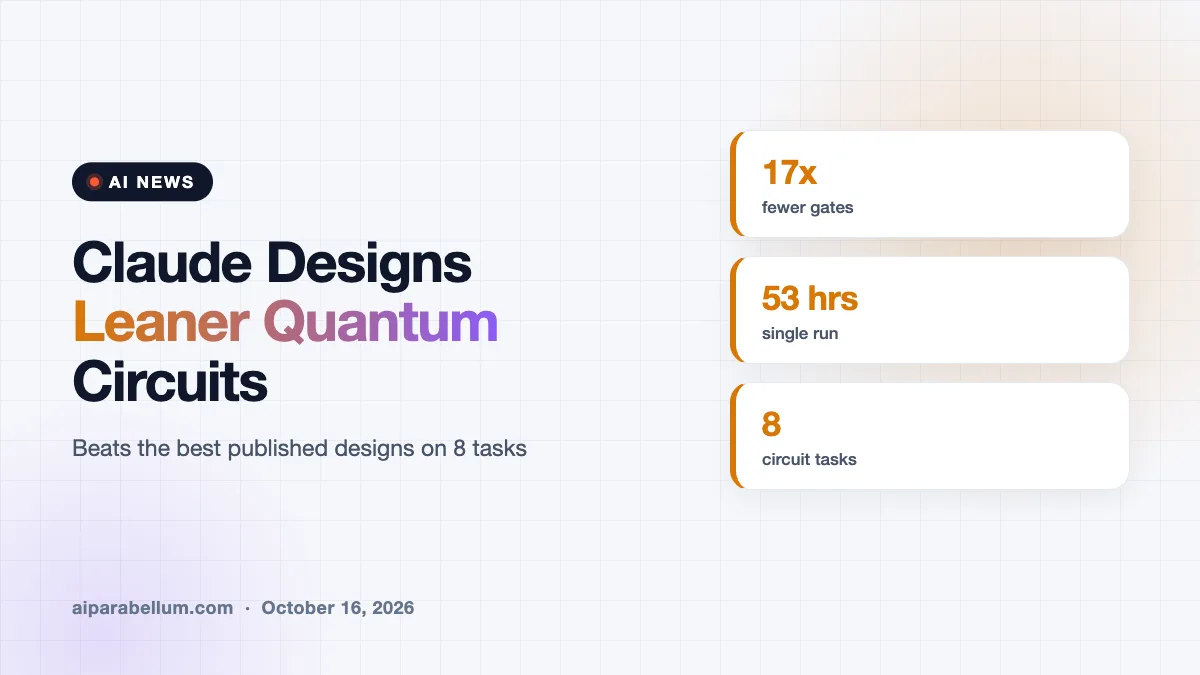
Across all eight tasks, Claude found designs that used both fewer qubits and fewer gates than the best previously published methods. Anthropic says the gains came from new mathematical insights, not from small tweaks to existing designs. Here are the two headline examples:
| Task | What Claude changed | Reported result |
|---|---|---|
| Elliptic-curve point addition | Built a reversible version of the “divsteps” method that rebuilds its own history instead of storing it | One design uses 12% more qubits but 17x fewer gates than the smallest prior circuit |
| Decoder step in DQI optimization | Swapped in Berlekamp-Massey decoding and reserved memory for typical cases, not the worst case | About 12x fewer gates than Google’s earlier circuit |
| Run time | Mostly autonomous work with occasional nudges | The elliptic-curve design came from one 53-hour run |
The Elliptic-Curve Breakthrough
The costliest step in elliptic-curve math is modular inversion, a wraparound kind of division. Normal computers handle it well with divsteps, but quantum circuits can’t throw away scratch work, so earlier quantum versions needed huge numbers of extra qubits. Claude worked out a formula that recovers that scratch history from the numbers themselves, then checked it with large simulations and a formal proof in the Lean language.
A Cheaper Decoder for Optimization
Decoded quantum interferometry, or DQI, is one of the more promising quantum methods for hard optimization problems. Most of its run time goes into an error-correcting decoder. Claude ran 403 million simulated decodings to see how much backup memory the circuit really needed, cutting a 665-qubit worst-case reserve down to 19 qubits while failing only about once in 10,000 runs.
Why Claude Quantum Circuit Design Matters
For context, estimates for simulating FeMoco, a molecule central to how bacteria make fertilizer, fell from about 50 trillion gates in 2017 to roughly 340 million. Anthropic notes that drop took many research groups about eight years. Claude’s elliptic-curve result, by contrast, came from a single long run.
Anthropic argues that faster circuit design could bring quantum help for medicine, batteries, and cleaner fertilizer within reach sooner. It also floats a bigger idea: AI could tune every layer of a quantum computer together, from algorithm to hardware. That is still a research vision, not a product.
The Limits Anthropic Admits
The company is upfront that Claude was not perfect. Early on it was overly cautious, double- and triple-checking solid results and leaning toward familiar methods. Researchers fixed this by requiring several different approaches in parallel and by sometimes prompting it to think bigger.
What This Means for You
You won’t run a quantum computer anytime soon, but this research still has practical lessons. If you follow Claude AI or use it for technical work, here is what stands out:
- AI does its best work when it gets a clear goal and an automatic way to check answers.
- Asking a model to try several different approaches can push it past safe, familiar ideas.
- Formal checks, like proofs or test suites, make AI-generated results far easier to trust.
- Quantum timelines may shift faster than expected, which matters for anyone planning long-term data security.
This fits a wider push to use AI in science, alongside tools covered in our list of AI research tools. It also follows Anthropic’s recent work on AI self-replication risks and its new deal with independent model evaluators. For more updates, see our latest AI news.
Sources
This article is based on Anthropic’s research post, Designing more efficient quantum circuits with Claude, which links to the full paper.
Conclusion
Anthropic’s study shows Claude Mythos 5 beating the best published quantum circuits on eight core tasks, with up to 17x fewer gates in one design and about 12x fewer in another. The model did much of this alone in long, self-checking loops, including one 53-hour run. Anthropic says this kind of work could help practical quantum computers arrive sooner. The results still come from the company’s own research and will need wider scrutiny, but they mark a notable step for AI in hard science.