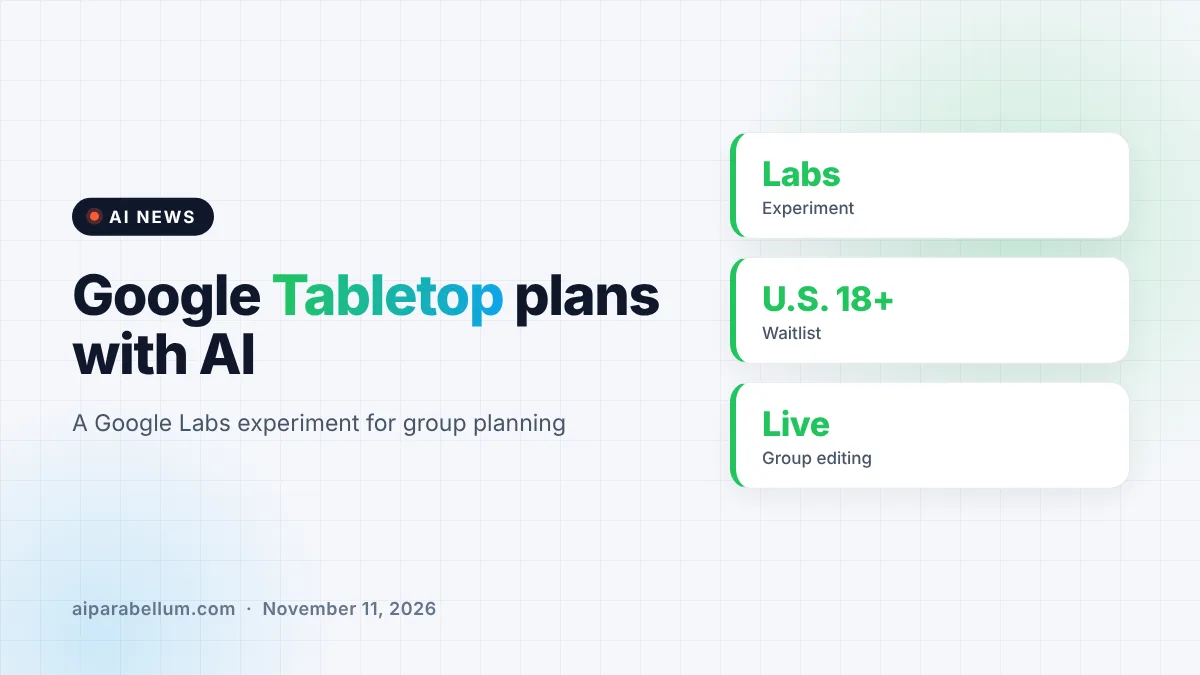
Google Tabletop is a new Google Labs experiment that lets a group build a shared planning space with AI, then work in it together in real time. You drop in links, files and ideas, ask the built-in assistant for what you need, and invite everyone through a single link. Google announced it on November 11, 2026, and it is opening in the U.S. through a waitlist.
What Google Tabletop Actually Does
The idea is simple: group planning usually lives in a messy mix of chats, spreadsheets and shared docs. Tabletop tries to pull all of that into one space that everyone can edit at once. Google pitches it for things like a family trip, a rec league or a neighborhood potluck.
Inside a space, you can type a request to @tabletop or start from a ready-made template. The AI then builds small interactive tools that fit the job. Google’s own examples include:
- Trip itineraries that the whole group can adjust
- Dinner polls for picking a place or a date
- Expense splitters for shared costs
- Tournament brackets for games and leagues
Early coverage also points to tools like savings trackers, chore charts and event plans. In practice, this is a light form of “vibe coding,” where you describe a tool in plain words and the AI builds it for you. Google has been leaning into that idea lately, including with personal vibe-coded apps on Android.
Built for Real-Time Collaboration
Once a space is ready, you share an invite link in your group chat. Everyone can then jump in and use it at the same time, much like editing a Google Doc together. That shared, live editing is the core of the product, not just a side feature.
How Google Tabletop Compares to Work Apps
Visually, Tabletop has been compared to project tools such as Asana and Monday. The big difference is the audience and the AI layer. Those apps are made for teams at work, while Tabletop is aimed at friends and family who just want to get something organized.
| Feature | Google Tabletop | Typical work planning app |
|---|---|---|
| Main audience | Friends, families, clubs | Teams and companies |
| How tools get made | Ask the AI or pick a template | Set up boards and fields by hand |
| Collaboration | Everyone edits live via one link | Invites, seats and permissions |
| Availability | U.S. waitlist, adults 18+ | Generally available |
| Status | Google Labs experiment | Finished product |
Google Labs design and engineering lead Roman Nurik introduced the project, describing a space where you can “drop the invite link in your group chat” and let everyone join at once. Because it is a Labs experiment, features may change, and Google has not said whether it will become a full product.
Who Can Try Tabletop Right Now
Access is limited for now. Tabletop is rolling out to people in the U.S. who are 18 or older, and you have to join a waitlist on the Google Labs site to get in. Google did not share a timeline for wider access or other countries.
The age limit stands out because many of the example uses, like chore charts and family plans, would naturally involve kids or teens. Some early coverage suggests the limit may only apply during public testing, but Google has not confirmed that. For now, plan on adults running the space.
What This Means for You
If you are the person who always ends up organizing the group trip or the team dinner, Tabletop is aimed squarely at you. It could replace the long chat thread plus the shared spreadsheet plus the separate poll app. Here are a few practical points to keep in mind:
- Join the waitlist early if you are in the U.S. and over 18, since access is rolling out gradually.
- Start with a template the first time, then ask the AI to tweak it once you see how it works.
- Treat it as an experiment and keep key details, like payments or bookings, somewhere you trust as well.
- Think about what you share, since group members can see and edit the same space.
Tabletop also fits a wider trend of AI tools that build small, custom apps on demand. If you want to compare it with other options, our list of AI productivity tools is a good place to start.
Takeaway: Tabletop is less about chatting with an AI and more about letting it quietly build the planning tools your group needs.
Why Google Is Testing This Now
Google has been moving its AI features deeper into everyday tasks, from documents to shopping. It has also rolled out tools like its AI document checker aimed at regular users. Tabletop pushes that same idea into social and family life, where planning is often the most chaotic.
Google Labs is where the company tests ideas before deciding what to keep. Some Labs projects grow into full products, and others quietly disappear. How people use Tabletop during the waitlist phase will likely shape what happens next.
You can follow more updates like this on our AI news page.
Sources
Primary source: Google’s Tabletop announcement. Additional reporting from The Verge.
Conclusion
Google Tabletop is an early but interesting take on AI for everyday group life. Instead of one more chat assistant, it gives a group a shared space where the AI builds polls, itineraries, brackets and expense trackers on request. Access is limited to U.S. adults on a waitlist for now, and it is still just an experiment. If it works as promised, though, it could make the group organizer’s job a lot easier.