Databricks has relaunched Databricks Genie as an autonomous AI coworker that takes on long-running business work instead of answering one question at a time. The new Genie can watch metrics, chase missing inputs and act when something changes, all within guardrails set by your company. Databricks says thousands of customers, including Zillow, Unilever, adidas, Atlassian and AstraZeneca, already use Genie in production.
What the New Databricks Genie Can Do
The big shift is from chat assistant to delegated worker. You give Genie a job and access to the tools it needs, and it keeps working on it, checking in when it needs your input or approval. It can run on a schedule or react to triggers, such as a metric dipping or more than 10 customers asking for the same feature.
Databricks offers a few examples. Genie could watch insurance claims for new fraud patterns and send a case file to underwriters when something drifts. In marketing, it could manage campaigns around the clock and propose weekly budget changes for a person to approve.
Proactive help and finished work
Genie also tries to spot work before you ask. It notices tasks you repeat, like a weekly update, and offers to take them over. It can build slide decks, dashboards and interactive web pages right in the chat, then keep them current as data changes.
How Genie Ontology and Genie Search Fit In
Autonomy only works if the agent understands your business. That is the job of Genie Ontology, a map of company definitions, metrics, relationships and know-how. Agents build most of it automatically from the dashboards, queries and notebooks people already use, while people set the official definitions.
Genie Search is a new hybrid search tool that pulls from an index of apps like Google Drive, SharePoint, Jira, Confluence and Workday, plus live lookups through MCP connectors. It checks each source’s access rules before showing results. Databricks says nobody will see a document in Genie that they could not open in the original app.
| Component | What it does |
|---|---|
| Genie | Autonomous coworker for ongoing jobs |
| Genie Ontology | Shared map of business terms and data |
| Genie Search | Permission-aware search across apps and data |
| Genie Agents | Team-specific agents for sales, finance and more |
| Unity Gateway | Admin controls for tools, tracing and spending |
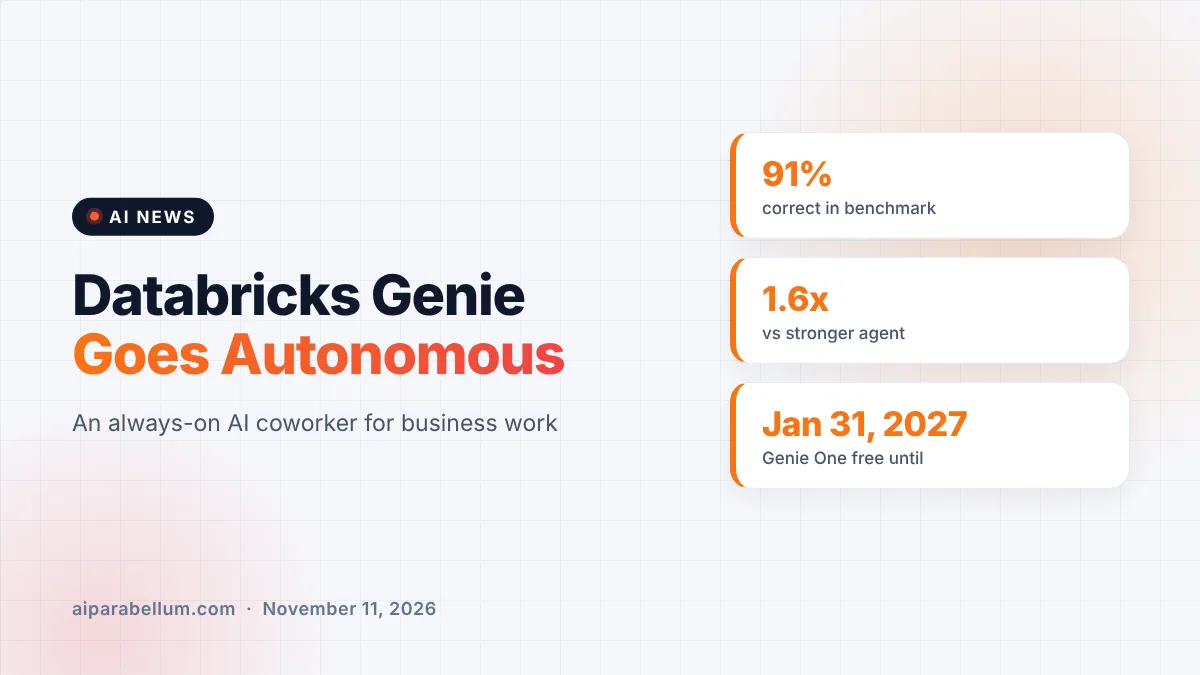
Databricks also shared a benchmark it built with Turing. In that test, Genie answered correctly in 91% of task runs, 1.6 times the rate of the stronger of two frontier agents it was compared with, while using less than half as many tokens. That is a company-run test, so treat it as a claim until outside testers weigh in.
Where You Can Use Genie
Genie meets people in the tools they already use. Here is where it shows up:
- Genie One, plus email, Slack and Microsoft Teams
- Browser, desktop, iOS and Android apps
- Plugins for ChatGPT, Claude, Microsoft Copilot and Grok Bot
- MCP connectors for Slack, Zoom, Microsoft 365, Jira, GitHub and calendars
Teams can also turn a repeatable workflow into a shared skill. Those skills live in Unity Catalog and run with the permissions of whoever uses them. Databricks says Genie One is free for users through January 31, 2027, with more detailed cost controls coming before then.
The CEO’s own use case
CEO Ali Ghodsi showed a reporter how he uses his own Genie agent at a company of 12,000 people. He uses it to surface bad news that rarely reaches the top, like a sales pitch that went poorly or weak spots in an employee survey. He argued that any company with more than 150 employees can benefit, a nod to Dunbar’s number.
Keeping an Autonomous Agent in Check
Handing ongoing work to AI raises fair questions about access and cost. Databricks says Genie acts with your identity and only sees data you are allowed to see. When you need more access, it drafts a request for you to review, and data owners keep the final say.
Admins control which connectors and tools Genie can use and which actions need approval. Every action is traced, and admins can set workspace and per-user budgets, spending caps and alerts. Ghodsi also said companies can swap in cheaper open-weight models through Unity Gateway to keep bills down.
This focus on guardrails matches a wider trend. We have covered similar efforts like ServiceNow’s AI Passport and new agent security tools from Microsoft. Databricks itself recently added agent memory features to its platform.
What This Means for You
If your company already runs on Databricks, Genie could take repetitive reporting and monitoring off your plate. The free period through January gives teams time to test it before costs kick in. Here are a few practical tips:
- Start with a narrow, low-risk job, like a weekly metrics summary, before giving Genie wider access.
- Set clear approval rules for any action that spends money or contacts customers.
- Have admins set per-user budgets early, since always-on agents can burn tokens quietly.
- Check that your official business definitions are set, so Genie works from the right numbers.
For more on how agents are changing office work, see our guide to the best business AI tools and our latest AI news.
Takeaway: Databricks is betting that the next step for workplace AI is not a better chatbot, but an agent you can hand a whole job to, with company rules and budgets built in.
Sources
Primary source: Databricks’ new Genie announcement. Additional details from Databricks’ Genie One post and reporting from TechCrunch.
Conclusion
The new Databricks Genie turns a data assistant into an always-on coworker that can own ongoing business tasks. Genie Ontology and Genie Search give it business context, while Unity Gateway keeps access and spending under control. The company’s own benchmark looks strong, but real-world results will matter more. With Genie One free until January 31, 2027, Databricks customers have an easy window to find out.