Google DeepMind has released AlphaGenome 2, a new AI model that predicts how small changes in your DNA play out inside specific human cell types. The first AlphaGenome looked at broad tissue averages, while AlphaGenome 2 zooms in on individual cells, like a heart muscle cell or a gut immune cell. It is available today for non-commercial research through the AlphaGenome API.
What AlphaGenome 2 Actually Does
Every cell in your body carries the same DNA, but each cell type switches different genes on and off. That means one tiny genetic variant can be harmless in one cell and trouble in another. AlphaGenome 2 is built to predict those cell-specific effects.
The model reads a DNA sequence one million letters long. Unlike its predecessor, it also takes a target “condition” as input, such as a tissue, a cell type or a cell state. DeepMind calls this a conditional design, and it lets the model learn how the same stretch of DNA is read differently from cell to cell.
New readouts and a smarter design
AlphaGenome 2 predicts the same core signals as the original, including gene expression, histone changes and chromatin accessibility. It adds DNA methylation, which DeepMind says researchers often asked for. Because it separates a cell’s state from its outputs, it can also fill in missing lab data, which may help scientists decide which experiment to run next.
How AlphaGenome 2 Compares to the Original Model
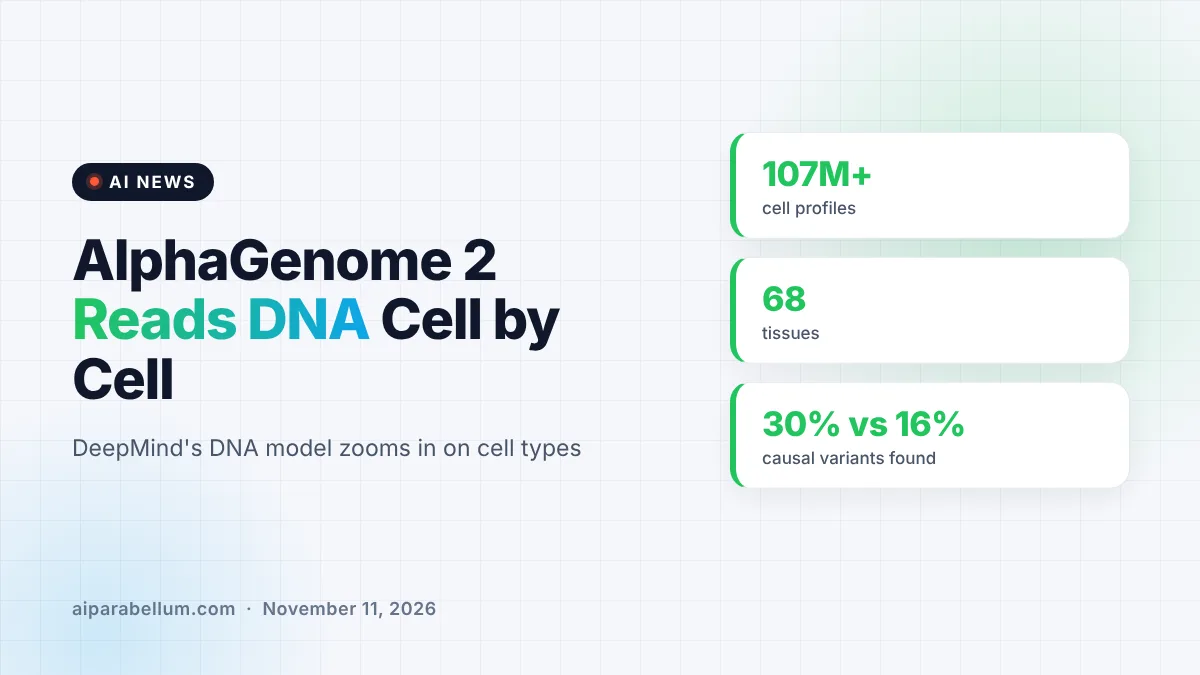
DeepMind trained the new model on bulk and single-cell data from human and mouse samples. That includes more than 107 million individual cell profiles across 68 tissues. The company says the result finds nearly twice as many variants that change gene expression in cells as its earlier model.
| Feature | AlphaGenome (2025) | AlphaGenome 2 |
|---|---|---|
| Level of detail | Broad tissues and cell lines | Specific cell types and states |
| Design | Fixed parallel outputs | Conditional, one condition at a time |
| DNA methylation | Not predicted | Predicted |
| Causal variants found (TenK10K test) | 16% | 30% |
| Directional gene effects (TenK10K test) | 23% | 43% |
| New cell states | Needs fine-tuning | Works without retraining |
The TenK10K figures come from a large single-cell map of 28 immune cell types, and the comparison is with the original model fine-tuned on single-cell data. DeepMind also says AlphaGenome 2 reproduced a known finding about inflammatory bowel disease. It picked out the variant that boosts the ETS2 gene in gut immune cells called macrophages, while leaving other cells largely unaffected.
New cells without retraining
One standout feature is how the model handles brand-new data. A scientist can upload a single-cell RNA snapshot from just a few dozen cells. The model compresses that into a cell-state summary and makes predictions for it, matching or beating models trained directly on that data, according to DeepMind.
Why Cell-Level Detail Matters for Disease Research
Genome-wide association studies flag stretches of DNA linked to traits and diseases, from height to type 2 diabetes. The hard part is finding the exact variant, the gene it controls and the cell where it acts. DeepMind has precomputed AlphaGenome 2 scores for trait-linked variants across hundreds of cell and tissue conditions to help with that.
DeepMind genomics lead Žiga Avsec explained the drug angle simply: drugs target specific proteins in specific cell types, so knowing which cells a variant affects is vital. The model also extends enhancer mapping, which links distant DNA “switches” to the genes they control, to real human cell types such as brain astrocytes.
There is a tradeoff, though. Avsec said the detailed predictions are more expensive to compute than the original model’s, so AlphaGenome 2 will not replace its predecessor anytime soon. That cost is why the genome-wide AlphaGenome Atlas, covering every possible single-letter change in the human genome, still relies on the first model.
Who Can Use the New DNA Model Today
Here is how access works right now:
- Non-commercial researchers can use AlphaGenome 2 today through the AlphaGenome API.
- Commercial research access is in private preview.
- Interactive Colab tutorials are available for expression conditioning.
- DeepMind says AlphaGenome 2 Skills are coming soon to Google Antigravity, its agentic development platform.
- Both models are for research only and are not approved for clinical or diagnostic use.
DeepMind is also asking researchers to share use cases by November 30, with selected projects possibly getting extra quota and credits. It plans to keep working with groups like the Wellcome Sanger Institute to profile more cell types. We have tracked this push before, including when Google Antigravity helped with antibiotic discovery.
What This Means for You
You will not run AlphaGenome 2 on your phone, but it could shape the medicine you get years from now. Better maps of which cells a variant affects can point drug makers toward the right targets faster. Here are the practical takeaways:
- If you work in biology or genetics, the free research API is worth testing on your own single-cell data.
- If you follow health tech, watch how drug discovery firms adopt it, since at least one said it plans to build it into its platform.
- If you are a patient, remember these tools are research aids, not diagnostic tests.
The release also fits a wider pattern of AI labs moving into science. Google recently launched the Gemini 4 Carbon model, and smaller players are building tools like Carbon-X DNA questions for plain-English genome queries. For more stories like this, browse our latest AI news.
Takeaway: AlphaGenome 2 trades extra computing cost for a much sharper, cell-by-cell view of how DNA variants work, which is exactly the detail drug research needs.
Sources
Primary source: Google DeepMind’s AlphaGenome 2 announcement. Additional reporting from The Verge.
Conclusion
AlphaGenome 2 moves DeepMind’s genome AI from tissue averages to individual cell types, and the early numbers show a clear jump in finding meaningful variants. It costs more to run, so the original model stays in service for genome-wide work. For researchers, the free non-commercial API makes it easy to try today. For everyone else, it is another sign that AI is becoming a serious tool for understanding disease at its roots.