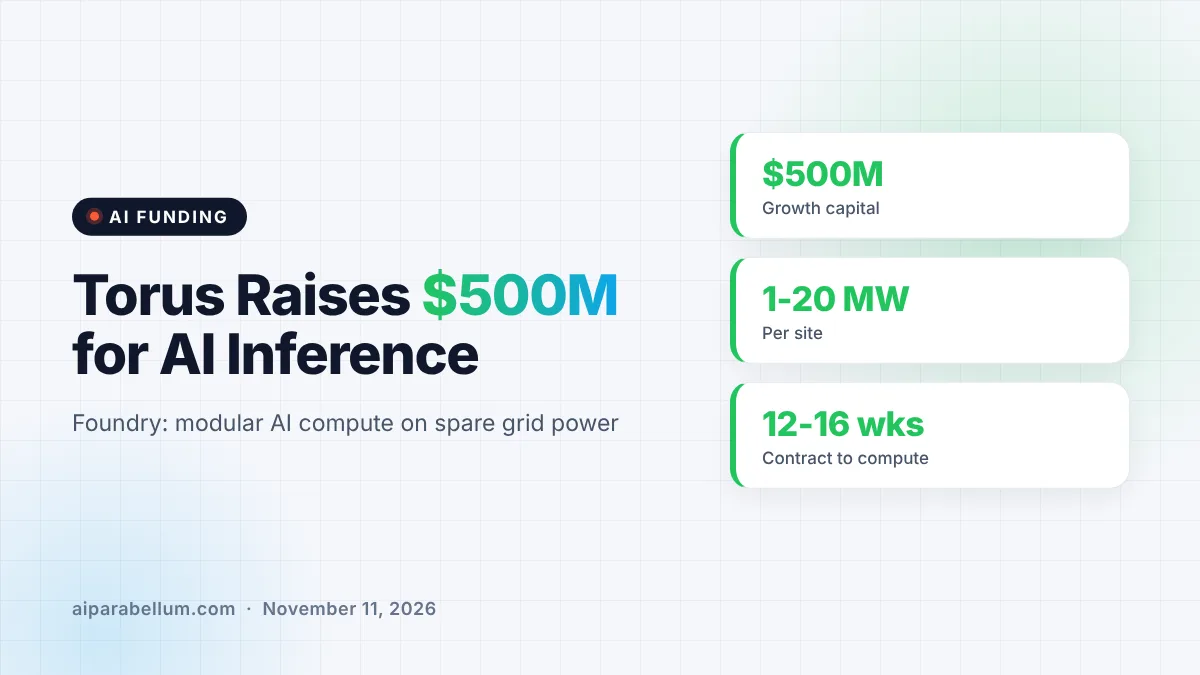
Utah-based Torus has launched Torus Foundry, a prefabricated system that packs power, cooling, networking and GPUs into modular units for running AI inference. The company also announced $500 million in growth capital led by Magnetar. Its pitch is simple: instead of waiting years for a giant new data center, put compute where spare grid power already exists.
What Torus Foundry Actually Is
Foundry is a factory-built unit that bundles everything an AI compute site needs. That includes power, energy storage, cooling, networking and the compute itself. Torus says a site can range from 1 to 20 megawatts and go from signed contract to running workloads in 12 to 16 weeks.
No new building is required. Torus says the smallest system is roughly the size of a small cargo van, which means it can sit at an existing commercial or industrial site.
Built to use power the grid already has
The core idea is that many sites have unused electrical capacity sitting between substations and the buildings they serve. Torus installs Foundry behind the meter, using spare headroom at individual transformers rather than asking utilities for new lines. The company argues this avoids the costly upgrades that can push up electricity rates for everyone else.
Every Foundry is paired with Torus Reserve, the company’s energy storage and management product. It combines flywheel and battery storage to cover demand peaks, shape power use and provide backup during grid outages.
The $500M Torus Funding Round
Magnetar led the round, with ICONIQ, Origin Ventures, Ridgeline Partners and Trinity Capital also taking part. Torus says the money will expand its Salt Lake City factory, called GigaOne, and speed up Foundry and Reserve deployments across the United States. In a statement, Magnetar’s Dave Snyderman said the answer to AI’s power problem is “making better use of what’s already available.”
| Detail | What Torus Says |
|---|---|
| Funding | $500 million in growth capital, led by Magnetar |
| Site size | 1 to 20 megawatts per site |
| Time to deploy | 12 to 16 weeks from contract to compute |
| GPU target | More than 47,000 GPUs in Foundry units by end of 2027 |
| Factory | 545,000 sq ft GigaOne plant in Salt Lake City |
| Workforce | Nearly 400 employees |
Why AI Inference Needs a Different Kind of Data Center
Training a model happens in big bursts at huge central campuses. Inference, the work of actually answering your prompts, runs all day and benefits from being closer to users. Citing McKinsey, Torus says data center demand for inference is projected to grow about 35% a year through 2030, compared with about 22% for training.
That shift is part of a wider trend toward inference scaling, where the cost and speed of running models matters as much as building them. We have seen investors pour money into this layer before, such as fal’s inference platform raising a much larger round.
Power is now the main bottleneck. Big AI labs are wrestling with the same issue, and OpenAI recently launched a grid protection program aimed at data center power cuts.
How Customers Can Buy Torus Foundry
Torus is launching Foundry with its first customers: Hydra Host and another, unnamed AI cloud provider. The company says Foundry already has thousands of GPUs deployed. It offers three ways to buy:
- Strategic: a powered shell with power and enclosure, but no GPUs.
- Partner: a turnkey bare-metal unit that includes power, enclosure and GPUs.
- Direct: dedicated, single-tenant inference capacity sold straight to enterprises.
Torus also says it handles the full stack, from fiber and cooling to networking and security, with ongoing maintenance included. Its cooling loop is waterless, and the company claims it uses 95% less water than evaporative coolers.
A fast-growing factory
Torus says GigaOne opened its first production line in early 2026 and has added a new line every 21 days this year. The Foundry line is designed to produce 500 megawatts of IT load, with plans to reach 1 gigawatt. These are company figures and have not been independently verified.
What This Means for You
You will not buy a Foundry unit yourself, but this kind of infrastructure shapes how fast and how cheaply your AI tools respond. Here is what to watch:
- More local capacity could mean lower latency for AI apps, since inference can run closer to where people use it.
- Businesses with data rules may get more options for private, single-tenant AI hardware instead of shared cloud.
- If behind-the-meter setups spread, they could ease some pressure on local grids that huge data centers create.
- The 47,000-GPU goal for 2027 is a target, so track whether real deployments keep pace.
If you follow the bigger picture of data center spending, Torus is a bet that smaller, scattered sites can complement the giant campuses. For more stories like this, browse our latest AI news.
Sources
Primary source: Torus press release. The same announcement was distributed via Business Wire and carried by Yahoo Finance.
Conclusion
Torus is betting that the fastest way to add AI inference capacity is to bring compute to power that already exists, rather than waiting years for new plants and transmission lines. With $500 million from Magnetar and other investors, plus early cloud customers, Torus Foundry now has the backing to test that idea at scale. The big questions are whether its 12 to 16 week deployment promise holds up and whether it can hit its 2027 GPU target. Either way, it shows how central power has become to the AI race.