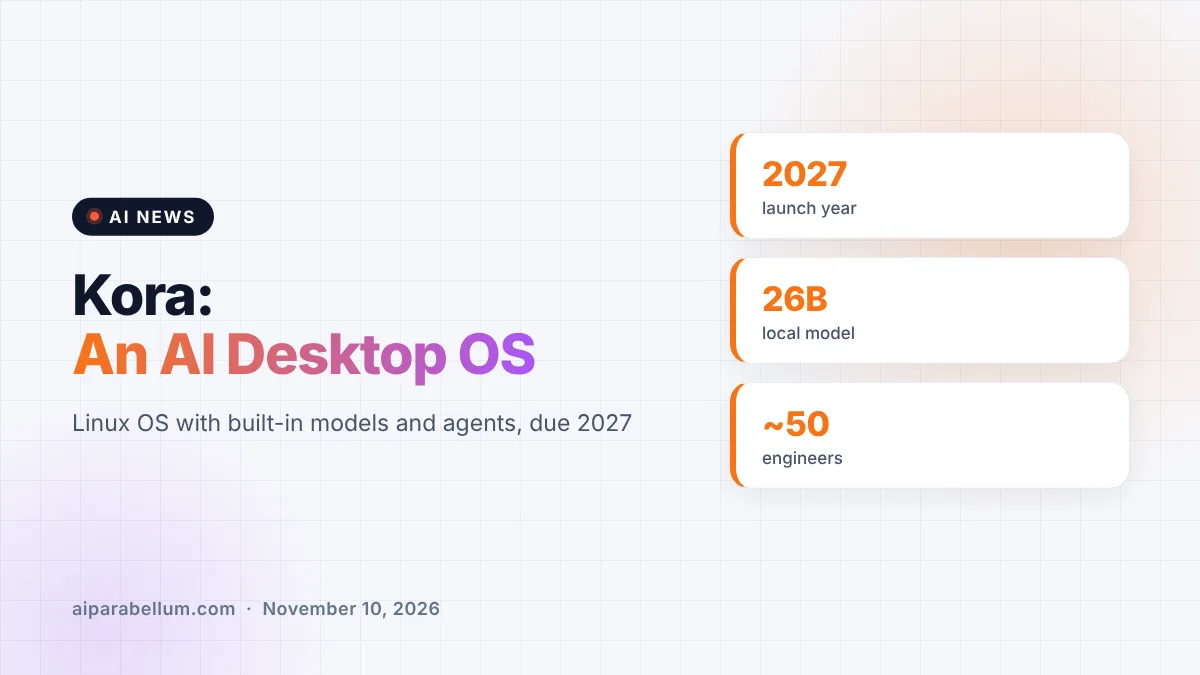
Kora Systems just unveiled Kora, a new AI desktop OS built on Linux that puts AI models and agents inside the operating system itself. The company is led by Kirt McMaster, who co-founded Cyanogen, the Android alternative from the last decade. Kora is set to arrive in 2027, with Qualcomm helping bring it to Snapdragon-powered PCs.
What Is Kora, the New AI Desktop OS?
Kora calls itself “The Operating System for Intelligence.” The idea is simple to explain but hard to build. On Windows and macOS, AI tools mostly live inside an app or a browser tab, so they can’t see much of your computer.
Kora flips that around. Models and agents sit at the system level, where they can work across apps, reach your files with permission, and remember context between tasks. The company says any model from any lab, local or cloud, will be able to plug in.
Cortex, workspaces and a smarter file system
The heart of the system is an inference engine called Cortex. It treats your CPU, GPU and NPU as one pool of computing power, and can even pull in other machines on your local network. Local models run by default, and bigger frontier models step in when a job needs more muscle.
Instead of the usual folders and app windows, Kora uses “neural workspaces” organized around the task you’re doing. Each workspace is a sandbox where you control what apps and agents can touch. A “neural file system” indexes files by meaning, so you can find a contract by describing a detail you remember rather than its file name.
Key Features of the Kora AI Desktop OS
| Feature | What it does |
|---|---|
| Cortex engine | Spreads AI work across CPU, GPU, NPU and networked machines |
| Neural workspaces | Task-based sandboxes with user-set permissions |
| Neural file system | Search files by what they contain, not just by name |
| Windows compatibility | Runs selected Windows x86-64 apps inside Linux |
| GameFrame | One-click play mode for PC games |
| Developer SDK | Gives outside apps access to memory, semantic search and email |
The Qualcomm and HUMAIN Partnerships
Kora says it has spent close to a year working with Qualcomm engineers on PCs that use the Snapdragon X2 Elite chip. According to their joint release, those machines can run a 26-billion-parameter language model fully on the device. Qualcomm is also pushing X2 Elite support into the main Linux kernel, which helps the wider Linux world too.
The first PCs to ship on this foundation won’t actually run Kora. They’ll run HUMAIN OS, an enterprise version Kora is building with Saudi AI company HUMAIN, due in 2027. Kora itself follows later in 2027, and the company says x86-64 PCs from Intel and AMD will be supported as well.
Who Is Behind Kora
The founding team has shipped operating systems before. McMaster co-founded Cyanogen and Boost Mobile, then started Playtron, which built a Linux gaming OS called GameOS. Kora grew out of Playtron, and GameOS lives on inside it as GameFrame.
Co-founder John Lagerling led Android business development at Google, and CTO Franck De Girolami built GameOS. The company says a team of about 50 engineers is building Kora, leaning heavily on AI coding tools such as OpenAI’s Codex and Anthropic’s Claude assistant. Investors include Samsung Next, Square Enix, Polychain, VanEck, Circle and Alumni Ventures, though the amount raised hasn’t been shared.
The business plan
McMaster isn’t chasing every Windows user. He’s targeting the tens of millions of heavy AI users who already pay for models and run agents all day. According to TechCrunch, Kora is expected to be free to use, with revenue coming from subscriptions that bundle AI models and agent services.
What This Means for You
Kora won’t land on your PC until 2027, but it’s an early look at how an AI desktop OS might feel. Here’s what to keep in mind:
- If you juggle several AI tools daily, a system-level approach could cut down on copying context between apps.
- Kora is aimed at powerful machines, so plan on serious hardware to run large local models.
- Kora’s core software, including Cortex, is proprietary even though it runs on open-source Linux.
- Windows app support covers only selected programs, so check your must-have software before switching.
Kora also joins a growing push toward agents that act on your computer, similar in spirit to local AI agents on Nvidia hardware. And with tools like Claude Code already common, AI-built operating systems are no longer a strange idea. Follow more stories on our AI news hub.
Sources
Primary source: Kora’s official press kit and announcement. Additional reporting from TechCrunch, SiliconANGLE and WIRED.
Conclusion
Kora is a bold bet that the next big operating system will be built around AI rather than apps and folders. The team has real OS experience, and the Qualcomm partnership gives it serious hardware backing. Still, beating Windows is a long shot, and nothing ships until 2027. If you’re a heavy AI user, Kora is one to watch.