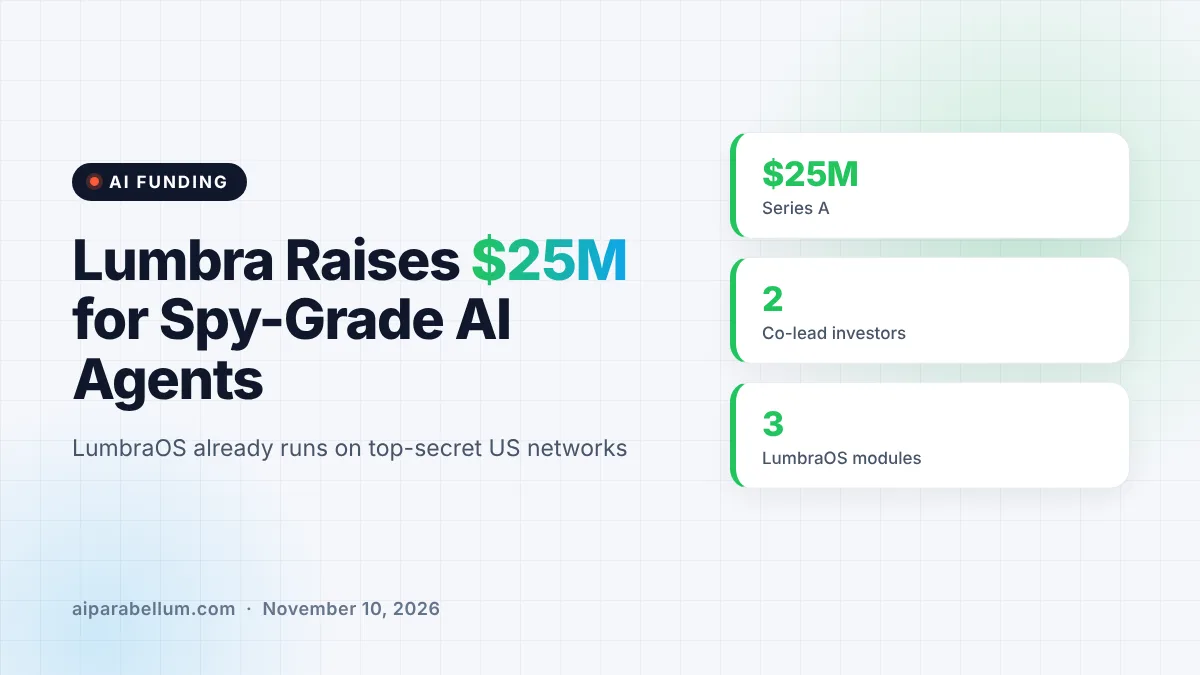
Lumbra, a Washington, DC startup that builds AI agents for spy agencies and the Pentagon, has raised a $25 million Series A. The round was co-led by Point72 Ventures and Ansa Capital, with seed backer Costanoa Ventures joining again. Lumbra AI agents already run on top-secret government networks, and the company now wants to bring the same tools to banks, hospitals and law firms.
What Lumbra Announced
The company announced the funding on Tuesday, November 10, 2026. It says the money will grow its engineering and product teams and speed up its sales push. A big part of that push is a move beyond defense into what Lumbra calls regulated commercial sectors.
Lumbra was founded last year by CEO Aaron Brown and CTO Michael Hiebert. Brown is a former CIA counterterrorism officer and Army Ranger, while Hiebert is a fellow Ranger and an MIT-trained computer scientist.
| Detail | What we know |
|---|---|
| Round | $25 million Series A |
| Lead investors | Point72 Ventures and Ansa Capital |
| Also investing | Costanoa Ventures (seed investor) |
| Headquarters | Washington, DC |
| Main product | LumbraOS, an operating system for AI agents |
| Next markets | Healthcare, finance and law |
How Lumbra AI Agents Work
Lumbra’s platform, LumbraOS, is a control layer that sits on top of AI models. The company calls it “model-neutral,” which means customers can pick from both proprietary and open-weight models depending on how hard a task is. The idea is that the system, not any single model, is what keeps the agents in check.
LumbraOS has three main parts:
- Nebula: the orchestrator that runs the agents, records their actions and traces every claim back to its source data.
- StarChart: a knowledge graph that links findings across datasets and stores them with sensitivity labels.
- Astrolabe: an evaluator that tests agents before deployment and keeps scoring them in production against the customer’s own benchmarks.
The common thread is traceability. A human analyst can check where each finding came from before it reaches a decision-maker, which matters a lot when the decision involves national security.
Why Traceability Matters
Most AI agents today handle simple chores like drafting emails or booking travel. Lumbra is aiming at a much harder job: sorting through huge amounts of sensitive intelligence and turning it into options for commanders. In that setting, an agent that makes up a fact is not just annoying, it can be dangerous.
Early Wins With the Pentagon and Spy Agencies
Lumbra says it signed its first contracts in the intelligence community. Reports say it landed a multimillion-dollar deal with an unnamed US intelligence agency about two months after launching its platform, and had agents running on a top-secret network within six months.
The Pentagon’s Chief Digital and Artificial Intelligence Office then picked Lumbra as one of two companies for its “Agent Network” project, alongside Palantir. That project is one of the Defense Department’s pace-setting efforts under its AI Acceleration Strategy, and it aims to shorten the time it takes to turn intelligence into decisions. This fits a wider trend of the military testing autonomous AI agents for real operations.
Lumbra’s Push Into Business Markets
The founders believe the same tools can help companies that handle sensitive data. Brown has said most firms in high-stakes fields use agents for single tasks at best, because they lack ways to make them controllable and auditable at scale. Lumbra is betting that strict governance and audit logs will change that.
That puts Lumbra in a crowded and fast-growing space. Investors have been pouring money into startups focused on AI agent security, and big platforms are adding their own tools for agent governance too. Lumbra’s pitch is that it has already proven its system in some of the most demanding environments there are.
Ansa Capital’s Marco DeMeireles said trust and verifiability are the biggest barriers to using agents in high-stakes settings. He added that Lumbra has shown it can bring these capabilities “into production” inside the US government.
What This Means for You
You probably won’t use LumbraOS directly. Still, this funding shows where the AI agent market is heading, and it may shape the tools your workplace adopts.
- Auditability is becoming a selling point. Expect more AI tools to show where every answer came from.
- Model choice is shifting to the platform. Companies increasingly want to swap models in and out without rebuilding their systems.
- Regulated industries are next. If you work in healthcare, finance or law, agent platforms with strict controls may reach your team soon.
- Human review still matters. Even Lumbra’s design keeps a person checking agent findings before they are acted on.
If your company is weighing agents for sensitive work, ask vendors how they log actions and test agents over time. Our earlier story on Microsoft’s agent security tools shows what big vendors offer, and you can follow more deals in our latest AI news.
Sources
Reporting from Tectonic Defense and SiliconANGLE.
Conclusion
Lumbra’s $25 million Series A backs a simple idea: AI agents can do serious work only if humans can check what they did and why. The startup has already won trust inside US intelligence agencies and the Pentagon, which gives it a strong story as it moves into business markets. The next test is whether hospitals, banks and law firms see the same value. Either way, traceable and testable agents look set to become the norm rather than the exception.